
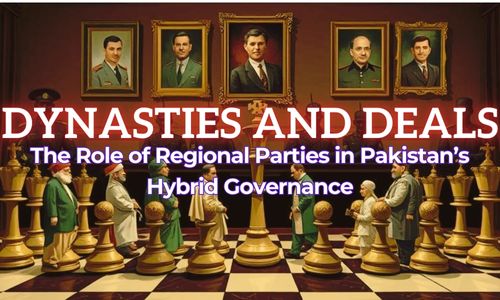
Dynasties and Deals – Role of Regional Parties in Dynastic Politics and Hybrid Rule
Pakistan’s political landscape is deeply intertwined with dynastic politics and hybrid governance structures, where military influence and civilian rule coexist. Regional parties—often perceived as challengers to central power—paradoxically play a central role in sustaining this hybrid model. They not only reinforce family-centered political dynasties but also adapt conveniently within the frameworks of controlled democracy and establishment-mediated arrangements.
Dynastic Politics: A Widespread Regional Phenomenon
Inherited Power Across Provinces
While dynastic politics is commonly associated with national parties like PPP and PML-N, regional parties are equally entrenched in family dominance:
-
ANP (Awami National Party): The Wali family has dominated the party across generations—from Abdul Wali Khan to Asfandyar Wali Khan to Aimal Wali Khan. Leadership decisions remain centralized within the family.
-
BNP-M (Balochistan National Party – Mengal): The Mengal family maintains exclusive control, with Sardar Akhtar Mengal as the central figure, continuing his father’s political legacy.
-
JUI-F (Jamiat Ulema-e-Islam – Fazl): A religious party that also perpetuates dynastic tradition, passing influence from Mufti Mahmood to his son Maulana Fazlur Rehman, and now grooming the next generation.
-
PkMAP (Pashtunkhwa Milli Awami Party): Led by Mahmood Khan Achakzai, this party has long been a family-driven political vehicle.
These dynasties monopolize party narratives, limit internal democracy, and protect their hold by elevating loyal family members rather than grassroots leaders.
Hybrid Rule: Regional Parties as Silent Pillars of the Establishment
Strategic Complicity with the Establishment
Regional parties frequently position themselves as anti-establishment in rhetoric, but their practical roles often align with state institutions, particularly the military establishment, which orchestrates power arrangements from behind the scenes.
-
BAP (Balochistan Awami Party) is widely perceived as a product of establishment engineering, created to manage the province’s political instability while ensuring loyalty in the Senate and National Assembly.
-
MQM (Muttahida Qaumi Movement) has oscillated between opposition and alignment, often striking deals with power brokers in return for influence over Karachi’s administration.
-
JUI-F has participated in multiple coalition governments and negotiations, ensuring political accommodation in both military-backed and civilian setups.
These parties often become bridge actors—serving as useful intermediaries to legitimize hybrid arrangements, especially in fragmented parliamentary houses.
Coalition Politics: Gateways to Power without Popular Mandates
In an era where no single party often secures a majority, regional parties become indispensable to government formation. Their negotiating power increases, and in return for their support, they demand:
-
Ministerial portfolios
-
Budget allocations for constituencies
-
Legal immunity or concessions
-
Support for their dynastic leadership
This transactional politics reinforces status quo governance, bypassing reform and enabling the continuation of hybrid democracy, where military oversight, judicial influence, and media management co-exist with civilian governments.
Suppressing Political Reforms and Grassroots Leadership
Barriers to Political Modernization
Regional parties—dominated by dynasties—are often the biggest obstacles to democratization within their ranks. They:
-
Suppress internal elections
-
Eliminate emerging youth leaders
-
Discourage dissent and debate
-
Avoid digital modernization and transparency
In doing so, they preserve archaic power structures that are compatible with hybrid rule, where loyalty, predictability, and control are more valued than reform, merit, or innovation.
Ethnic Politics: A Convenient Tool of Division
Instrumentalizing Identity
Regional parties frequently use ethnic, sectarian, or linguistic identity to consolidate votes while avoiding broader national responsibilities.
-
MQM uses the Muhajir card in urban Sindh.
-
ANP rallies around Pashtun nationalism.
-
BNP-M invokes Baloch grievances.
-
JUI-F and PkMAP mix tribal and religious identities for electoral gain.
This creates fragmented electoral mandates, making it easier for central actors—including the establishment—to manipulate alliances, maintain control, and delay democratic institutionalization.
Participation in Senate Politics: Control Without Accountability
With equal provincial representation in the Senate, regional parties exert legislative power disproportionate to their national vote base. Their senators often:
-
Secure committee chairmanships
-
Influence key constitutional amendments
-
Vote in bloc with establishment preferences
This leverage enhances their role in maintaining the status quo, often trading their votes for provincial concessions or political favors, without broader policy accountability.
The Media Nexus: Reinforcing Dynasties and Hybrid Control
Limited Media Scrutiny
Regional parties, especially those aligned with hybrid rule, receive limited critical scrutiny in national media. This is due to:
-
Backdoor alignments with establishment media controllers
-
State media support during coalitions
-
Ethnic sensitivity in critique
This media shielding allows them to maintain personal cults, family myths, and regional propaganda, insulating their leaders from national criticism.
Enablers of Controlled Democracy
Regional parties in Pakistan are not merely victims of hybrid rule—many are its active collaborators. By promoting dynastic politics, ethnic fragmentation, and establishment alliances, they form the scaffolding of a controlled democratic system. While they claim to represent the people, their actions often undermine institutional democracy, limit political innovation, and block reform.
Unless internal democracy is enforced and political accountability expanded, these parties will continue to preserve a hybrid system that favors stability over representation, personal power over public interest, and alliances over ideology.











LEAVE A COMMENT