
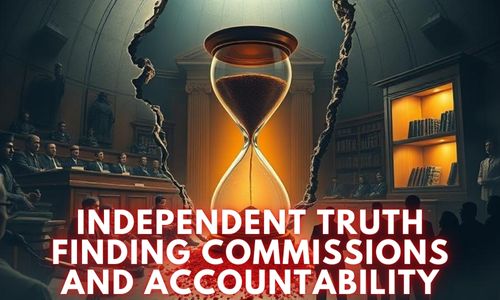
Independent Truth Finding Commissions and Accountability
ESSAY OUTLINE
1. Introduction
- Hook: In societies emerging from conflict, corruption, or repression, truth is often the first casualty.
- Background Information: Explain the concept of truth-finding (or truth and reconciliation) commissions and their role in transitional justice and accountability.
- Thesis Statement: Genuine accountability cannot be achieved without a truth-finding commission, as such bodies uncover hidden abuses, acknowledge victims’ experiences, and lay the groundwork for justice, reconciliation, and institutional reform.
2. The Purpose and Role of Truth-Finding Commissions
- A. Uncovering facts and historical record: Truth commissions investigate past abuses and establish an authoritative narrative.
- B. Recognizing victims and validating experiences: These commissions give voice to victims who are often ignored or silenced.
- C. Providing recommendations for justice and reform: Their findings often shape legal, institutional, and social reforms aimed at preventing recurrence.
3. The Link Between Truth and Accountability
- A. Accountability requires transparency: Without establishing facts, justice systems cannot identify perpetrators or assign responsibility.
- B. Truth-finding enables legal action: Evidence gathered by commissions supports prosecutions and reparations.
- C. Moral and societal healing: Truth-telling helps societies confront past wrongs and fosters a culture of responsibility.
4. Case Studies Demonstrating the Importance of Truth Commissions
- A. South Africa – Truth and Reconciliation Commission: Helped transition from apartheid by balancing justice with reconciliation.
- B. Argentina – National Commission on the Disappearance of Persons: Uncovered state terror during the Dirty War and led to trials.
- C. Rwanda – Gacaca Courts (community-based truth processes): Enabled mass participation in justice after the genocide.
5. Consequences of the Absence of Truth-Finding
- A. Perpetuation of impunity: Without facts, perpetrators escape justice and abuses may continue.
- B. Victims’ trauma and mistrust grow: Ignoring truth fosters resentment, fear, and a sense of injustice.
- C. Institutional decay: Lack of accountability erodes faith in law, governance, and democracy.
6. Challenges to Establishing Truth Commissions
- A. Political resistance and denial: Governments or elites may obstruct truth-seeking to protect themselves.
- B. Security concerns and witness protection: Truth-finding requires protecting those who testify or cooperate.
- C. Limited resources and mandates: Commissions need funding, independence, and time to be effective.
7. Pathways Forward
- A. Advocating for independent, well-resourced commissions: Civil society must demand credible truth mechanisms.
- B. Integrating truth commissions with judicial and institutional reforms: Truth must be linked to actionable outcomes.
- C. Ensuring public participation and transparency: A national commitment to truth enhances legitimacy and impact.
8. Conclusion
- Restate Thesis: Accountability cannot thrive in darkness; only truth-finding commissions can provide the light needed to uncover past abuses and ensure justice.
- Call to Action: Nations must embrace truth-finding as a necessary step toward justice, healing, and genuine accountability.
ESSAY
In societies emerging from conflict, corruption, or authoritarian rule, truth often becomes the first casualty. Facts are distorted, victims are silenced, and history is rewritten to serve the interests of those in power.
Truth-finding commissions—also known as truth and reconciliation commissions—play a crucial role in transitional justice. These bodies investigate past human rights violations and systemic abuses, often committed during times of war, dictatorship, or civil unrest. Unlike courts focused solely on legal guilt, truth commissions aim to uncover the full narrative of what happened, why it happened, and how it affected individuals and communities. They serve not only to document the past but also to provide a platform for victims to share their stories, to promote healing, and to recommend reforms that prevent future abuses.
Genuine accountability cannot be achieved without a truth-finding commission, because only such bodies can reveal the hidden dimensions of injustice, validate the experiences of victims, and build the foundation for justice, reconciliation, and meaningful institutional reform.
Truth-finding commissions actively investigate past abuses, gathering testimonies, documents, and other evidence. They work to establish a comprehensive and authoritative narrative about human rights violations, war crimes, or systemic corruption. By doing so, these commissions expose hidden truths that governments or perpetrators may have suppressed, ensuring that history accurately reflects what really happened.
Truth commissions prioritize giving voice to victims who have long been ignored, marginalized, or silenced. By listening to survivors’ accounts in formal hearings or confidential interviews, these bodies acknowledge the pain and suffering endured. This recognition restores dignity to victims, empowers them to tell their stories, and fosters societal empathy, which is crucial for healing and reconciliation.
After uncovering the truth, commissions compile detailed reports that include actionable recommendations. These recommendations often call for criminal prosecutions, reparations for victims, institutional reforms, and measures to prevent future abuses. Governments and international actors frequently use these findings as blueprints to reform legal systems, strengthen human rights protections, and rebuild trust between citizens and institutions.
Justice systems depend on transparency to function effectively. Without a clear and verified understanding of what occurred, courts and tribunals cannot accurately identify perpetrators or assign responsibility. Truth-finding commissions establish this transparency by revealing facts that may have been hidden or denied, making it possible for legal institutions to pursue justice.
The evidence that truth commissions collect—such as testimonies, documents, and forensic data—provides a vital foundation for legal proceedings. Prosecutors use this information to build cases against individuals responsible for crimes, ensuring they face appropriate consequences. Moreover, the truth uncovered supports reparations and restitution for victims, contributing to restorative justice.
Truth-telling plays a critical role in healing collective wounds. When societies openly confront past injustices, they promote a culture of responsibility and acknowledgment. This process fosters reconciliation by helping victims and perpetrators understand the impact of their actions, ultimately encouraging forgiveness, trust-building, and a commitment to preventing future abuses.
The South African Truth and Reconciliation Commission (TRC) played a pivotal role in the country’s transition from apartheid to democracy. By encouraging perpetrators to confess their crimes in exchange for amnesty, the TRC balanced the demands for justice with the need for national reconciliation. It uncovered widespread abuses, validated victims’ experiences, and fostered a sense of healing in a deeply divided society. The commission’s work laid the foundation for a new democratic order rooted in truth and mutual understanding.
Argentina’s National Commission on the Disappearance of Persons investigated the state-sponsored “Dirty War” during which thousands of people were forcibly disappeared. The commission gathered testimonies and evidence that exposed systematic human rights violations by the military regime. Its findings paved the way for criminal trials against high-ranking officials, breaking decades of impunity and providing long-awaited justice to victims and their families.
Following the 1994 genocide, Rwanda implemented Gacaca courts—grassroots community tribunals aimed at delivering justice on a massive scale. These courts combined truth-telling with local participation, enabling survivors and perpetrators to share their stories publicly. This innovative approach facilitated accountability, promoted reconciliation, and allowed Rwanda to address its painful past despite limited judicial resources.
When societies fail to establish the truth about past abuses, perpetrators often escape justice. Without clear facts, legal systems struggle to prosecute offenders, allowing them to act with impunity. This lack of accountability sends a dangerous message that violations can continue without consequences, undermining the rule of law and enabling cycles of abuse.
Ignoring the truth denies victims the recognition and validation they deserve. This neglect deepens their trauma and fosters resentment and fear within affected communities. When societies fail to acknowledge past wrongs, victims feel isolated and abandoned, which hampers healing and perpetuates divisions and social mistrust.
A failure to hold perpetrators accountable weakens public confidence in legal, political, and governance institutions. When justice systems appear ineffective or biased, citizens lose faith in democracy and the rule of law. This erosion of trust can destabilize societies and hinder efforts to build sustainable peace and good governance.
Governments or powerful elites often resist establishing truth commissions because they fear exposure of their own wrongdoing. They may deny abuses, obstruct investigations, or undermine the commission’s authority to protect their interests. This political resistance can delay or prevent the truth from emerging, weakening efforts to achieve accountability.
Truth-finding commissions rely on victims and witnesses to come forward and share their stories. However, these individuals often face threats, intimidation, or violence. Protecting their safety becomes a critical challenge. Without robust witness protection programs, many may remain silent out of fear, limiting the commission’s ability to uncover the full truth.
Effective truth commissions require sufficient funding, legal independence, and adequate time to conduct thorough investigations. Limited budgets and restrictive mandates can hinder their scope and impact. Without these essential resources, commissions struggle to collect evidence, hold public hearings, and produce comprehensive reports, undermining their ability to promote accountability.
Civil society organizations, activists, and the international community must actively push for the establishment of truth commissions that operate independently from political interference. They should advocate for adequate funding, skilled staff, and legal authority to conduct thorough investigations. Only well-resourced and impartial commissions can credibly uncover the truth and promote accountability.
To ensure lasting impact, truth commissions should work hand-in-hand with judicial processes and broader institutional reforms. Governments need to translate commission findings into concrete actions such as prosecuting perpetrators, reforming security forces, and strengthening legal frameworks. Linking truth-seeking to tangible justice outcomes reinforces the commission’s role in dismantling impunity.
Engaging the public in truth-seeking processes enhances legitimacy and fosters collective ownership of the outcomes. Commissions should hold open hearings, provide regular updates, and encourage community involvement to build trust. A transparent and inclusive approach mobilizes national commitment to truth and reconciliation, paving the way for meaningful accountability.
Accountability cannot thrive in darkness; truth-finding commissions provide the essential light that uncovers past abuses and paves the way for justice. Without these commissions, societies risk perpetuating cycles of impunity, mistrust, and division. Therefore, nations must actively embrace and support truth-finding as a vital step toward achieving justice, promoting healing, and ensuring genuine accountability for all.









LEAVE A COMMENT