
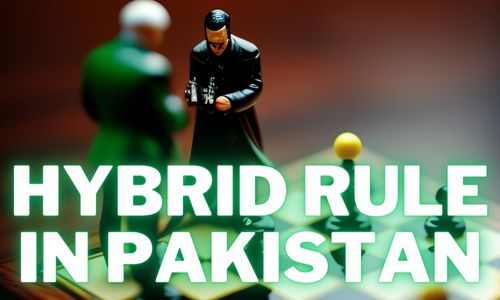
Hybrid Rule in Pakistan
Understanding Hybrid Rule in Pakistan
In the intricate landscape of Pakistani politics, hybrid rule has become an integral part of the nation’s political fabric. This article aims to shed light on the phenomenon of hybrid rule in Pakistan and the role played by dynastic political parties in further institutionalizing it.
Introduction
Hybrid rule in Pakistan is a complex and evolving concept, reflecting the unique blend of civilian and military power structures. To comprehend this intricate system, it is crucial to explore the dynamics that have shaped it over the years.
Historical Context
The roots of hybrid rule can be traced back to Pakistan’s independence in 1947. The country has experienced numerous military coups and periods of direct military rule, which have had a profound impact on its political landscape. Despite intermittent periods of civilian governance, the military has consistently wielded significant influence.
Characteristics of Hybrid Rule
- Civilian Government
While Pakistan has experienced periods of civilian rule, they have often been marred by allegations of corruption, inefficiency, deals and guarantees with local and world powers. Dynastic political parties have played a crucial role in maintaining a civilian façade while being influenced by the military.
- Military Influence
The military exerts control over key aspects of the government, including foreign policy, security, and strategic decision-making. The military establishment is a major player in shaping the country’s politics and direction.
- Dynastic Political Parties
Dynastic political parties are a cornerstone of the hybrid rule in Pakistan. These parties are often led by powerful political families with a history of political dominance. They tend to prioritize their family’s interests over the nation’s welfare, perpetuating the cycle of hybrid rule.
The Dynastic Political Parties
Pakistan People’s Party (PPP)
The Pakistan People’s Party, founded by Zulfikar Ali Bhutto, has been one of the prominent dynastic political parties in Pakistan. The Bhutto family has maintained a stronghold on the party, passing leadership from one generation to the next. This political dynasty has been instrumental in sustaining the hybrid rule.
Pakistan Muslim League-Nawaz (PML-N)
The Sharif family has been at the helm of the Pakistan Muslim League-Nawaz for decades. The party’s influence has extended beyond provincial boundaries, further solidifying the grip of dynastic politics in the country.
Jamiat Ulma e Islam (JUIF)
Jamiat Ulma e Islam (F) group is the defection of original Jamiat Ulma e Islam which was originally founded by Shabbir Ahmed Usmani, against the Jamiat Ulma e Hind who was then in favour of integrated subcontinent and favouring Congress Party of India. After the death of Sami ul Haque, who hold the JUI (S), Fazlur Rahman take over the party in which his father Molvi Mufti Mehmood was the member. After the death of Fazlur Rahman’s father, he emerged as the only leader of JUI and later his son also emerged as a senator of Pakistan Senate. While JUI directly or indirectly holds share in every federal or provincial government.
Jamiat Ulema-e-Islam (S)
JUI-S is another defection group from original JUI which was founded by Shabbir Ahmed Usmani, but JUI-S led by Maulana Sami ul Haque later in 1980 as Sami ul Haque was not oonly influential among Taliban leadership but considered as mentor of Afghan Taliban during Afghan Jihad against Russian Invasion of Afghanistan and War Against terrorism of US against Afghanistan. After the assassination of Sami ul Haque, JUI-S was succeeded by his son Hamid ul Haque Usmani. While the party holds shares in provincial and federal governments of Pakistan in past.
Awami National Party (ANP)
ANP carries the legacy of great Bacha Khan who was a great Pashtoon group leader famous in Pakistan and across border i.e Afghanistan. Abdul Wali Khan’s son, Asfandyar Wali Khan, succeeded him, forming ANP in 1986 based on the traditions of intense Pashtun nationalism. ANP was the most vocal voice for the rights of Pashtuns during the Russian Invasion of Afghanistan and later the US war against terrorism in Afghanistan.
Pakistan Muslim League (PMLQ)
Mian Muhammad Azhar founded it after Pervez Musharraf’s coup, but the Chaudharys of Gujrat, specifically the Pervez Elahi and Shujaat Hussain families, later captured it. PML(Q) enjoys the government on and off in both federal governments along with provincial governments.
Balochistan National Party (BNP) (Mengal)
BNP (Mengal) group is the disintegrated faction of ANP after the arrest of Attaullah Mengal who was the chief minister of Baloshistan in 1972 but dethroned by ZA Bhutto on the allegation of sperating Balochistan from Pakistan by Nawab Akbar Khan Bugti. BNP Mengal group led by Akhtar Mengal who is son of Attaullah Mengal. While the party holds the interests in Baloshistan.
Jamhoori Wattan Party (JWP)
JWP carries the legacy of Nawab Akbar Khan Bugti, the renowned Baloch tribal leader of the Bugti tribe. Pervez Musharraf-led military action later martyred him as he was allegedly leading a Baloch separatist group. Later which caused unrest among Bugti tribes which caused division JWP among his sons Brahamdagh and Shahzain later and now it is led by Shahzain Bugti as the successor of Akbar Bugti.
Tehreek-e-Labbaik Pakistan (TLP)
TLP emerged in 2015 under the command of Khadim Hussain Rizvi, who made TLP a major political pressure group who known for its protests against any changes to the blasphemy laws in Pakistan. After the death of Khadim Hussain Rizvi, his son Hafiz Saad Hussain Rizvi succeeded the party and now enjoys the legacy of his father.
Implications of Dynastic Politics
The concept of “hybrid rule” has further exacerbated the long-standing concern of dynastic politics in Pakistan. It delves into how the combination of military influence and civilian dynasties has created a toxic political environment, undermining democracy, perpetuating corruption, and hampering the nation’s progress.
Undermining Democracy
Hybrid rule, which combines military influence with civilian governments, has allowed dynastic politics to flourish in Pakistan. This arrangement often prioritizes power-sharing between the military establishment and political dynasties, while neglecting the core principles of democracy. Dynastic families continue to hold sway over key positions, perpetuating the rule of a select few and diminishing the voice of the electorate. Political elites sideline genuine representation and open competition, undermining the very essence of democracy.
Perpetuating Corruption
One of the most alarming consequences of dynastic politics under hybrid rule is the perpetuation of corruption. The marriage of military and civilian interests often results in policies and decisions driven by personal gains rather than the welfare of the nation. Dynastic leaders and their allies may receive preferential treatment, leading to a culture of nepotism and cronyism. This culture of corruption erodes the integrity of government institutions, squanders public resources, and leaves the general population at a disadvantage.
Hampering National Progress
Dynastic politics, under the umbrella of hybrid rule, also hampers the nation’s progress and development. Personal interests often influence key policy decisions and national priorities, emphasizing short-term gains rather than long-term national growth. This can result in a lack of vision and strategic planning, which is essential for sustainable progress. Citizens feel the repercussions of this approach, bearing the brunt of stagnation and missed opportunities for economic and social advancement.
Conclusion
In conclusion, operating under the framework of hybrid rule further exacerbates the horrors of dynastic politics in Pakistan. This combination of military and civilian influences can undermine democracy, perpetuate corruption, and hamper the nation’s progress. To overcome these challenges, Pakistan must prioritize principles of democracy, good governance, and the rule of law.
It is essential to reduce the military’s role in civilian affairs. This involves promoting transparency and accountability, as well as ensuring that political leadership is determined by merit rather than family connections. By taking these steps, Pakistan can strive for a more equitable and prosperous future, free from the adverse effects of dynastic politics under hybrid rule.










LEAVE A COMMENT