

Iranian Missile Program
Iran’s missile program remains one of the most consequential military capabilities in the Middle East. Public assessments describe Iran as holding the largest stockpile of ballistic missiles in the region, and Iranian officials continue to treat missile power as a central pillar of deterrence. Current reporting also notes that Tehran maintains a self-imposed range ceiling of 2,000 km, which it says is sufficient to defend the country and hold regional adversaries at risk.
When we examine the program closely, we see a force built around mobility, survivability, and layered reach. Iran fields short-range ballistic missiles, medium-range ballistic missiles, and land-attack cruise missiles, with several systems publicly linked to road-mobile launchers and underground storage facilities. Reuters reports at least five known underground “missile cities” spread across Iranian provinces, which helps explain why the program is treated as a serious strategic challenge by regional governments.
Why Iran Invests So Heavily in Missiles
Iran’s missile doctrine is built around deterrence, retaliation, and asymmetric warfare. Rather than depending on a large modern air force, Tehran has expanded missile forces that can be dispersed, concealed, and launched quickly. CSIS missile profiles show that many of Iran’s key systems are road-mobile, while Reuters notes that Western powers view the arsenal as both a conventional regional threat and a potential delivery mechanism for nuclear weapons if Tehran ever chose that path. Iran, for its part, denies any intent to build atomic bombs.
This approach gives Iran a layered strike architecture. Short-range missiles can be used for nearby military targets and battlefield pressure, while longer-range systems can reach deeper into the region. Cruise missiles add another dimension because they can fly lower and more slowly, which complicates interception and expands the set of possible targets. In practical terms, the missile program gives Iran strategic depth even when its conventional forces are under strain.
Iranian Missile Program History in One View
The program has evolved from early reverse-engineered systems into a broader domestic missile industrial base. CSIS profiles show that the Shahab family formed an important foundation, while later variants such as Ghadr and Emad improved range and guidance. Iran also moved into solid-fuel systems such as Fateh-110 and Fateh-313, which offer faster launch readiness and better survivability than older liquid-fueled designs. That shift matters because solid-fuel missiles are generally easier to keep ready and quicker to fire.
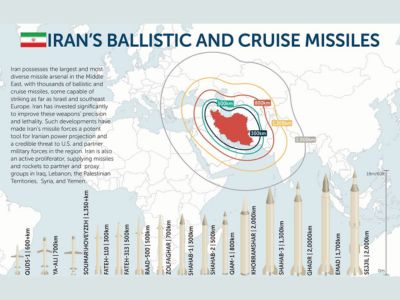
We also see Iran expanding into cruise missile capability. CSIS lists Soumar as an operationally presumed cruise missile family with a range of 2,000 to 3,000 km, while Hoveyzeh has been described by CSIS as a cruise missile with a reported range of 1,350 km. That combination of ballistic and cruise systems shows a program designed for variety, redundancy, and target set flexibility.
Overview of Iran’s Missile Classification
We categorize Iran’s missile systems into three primary groups:
- Short-Range Ballistic Missiles (SRBMs) – up to 1,000 km
- Medium-Range Ballistic Missiles (MRBMs) – 1,000 to 3,000 km
- Cruise Missiles and Advanced Systems – precision-guided and low-altitude capabilities
Each category demonstrates significant technological evolution, enabling Iran to target both regional adversaries and distant strategic locations.
Short-Range Ballistic Missiles (SRBMs)
Shahab-1
- Range: ~300 km
We recognize the Shahab-1 as one of Iran’s earliest ballistic missiles, derived from Scud-B technology. It serves as a foundation for Iran’s missile development, primarily used for battlefield-level targeting.
Shahab-2
- Range: ~500 km
An improved version of Shahab-1, the Shahab-2 offers greater range and payload efficiency, making it suitable for regional strike missions.
Fateh-110
- Range: ~300 km
We identify the Fateh-110 as a precision-guided missile, representing a major advancement in accuracy and maneuverability. It uses solid fuel, enabling faster deployment and reduced preparation time.
Zolfaghar
- Range: ~700 km
The Zolfaghar missile extends the Fateh family’s capabilities with enhanced range and improved targeting systems, allowing deep-strike precision attacks.
Medium-Range Ballistic Missiles (MRBMs)
Shahab-3
- Range: ~1,000–1,300 km
We consider the Shahab-3 a cornerstone of Iran’s missile arsenal, capable of reaching key regional targets. It is based on North Korean Nodong technology but significantly upgraded.
Ghadr-110
- Range: ~1,800–2,000 km
The Ghadr-110 represents a modernized version of Shahab-3, featuring improved accuracy, faster launch readiness, and extended range.
Emad
- Range: ~1,700 km
We note the Emad missile as Iran’s first precision-guided MRBM, equipped with maneuverable reentry vehicles (MaRV) for increased accuracy.
Sejjil
- Range: ~2,000–2,500 km
The Sejjil missile is a solid-fuel, two-stage ballistic missile, marking a major technological leap. Its solid fuel design allows rapid deployment and improved survivability.
Intermediate and Long-Range Developments
Khorramshahr
- Range: ~2,000 km
We highlight the Khorramshahr missile for its heavy payload capacity, capable of carrying multiple warheads. It represents a significant threat due to its destructive potential.
Khorramshahr-4 (Kheibar)
- Range: ~2,000 km
An advanced iteration, the Khorramshahr-4 features improved guidance systems, reduced launch preparation time, and enhanced survivability.
Iranian Cruise Missiles
Soumar
- Range: ~2,000–2,500 km
We identify the Soumar cruise missile as a long-range, low-altitude system designed for stealth and precision strikes. It is believed to be based on reverse-engineered foreign technology.
Hoveyzeh
- Range: ~1,350 km
The Hoveyzeh missile is a refined cruise missile with high accuracy and terrain-following capability, making it difficult to detect.
Ya Ali
- Range: ~700 km
We note the Ya Ali missile as a shorter-range cruise system, ideal for regional precision targeting.
Advanced Hypersonic and Emerging Systems
Fattah Hypersonic Missile
- Range: ~1,400 km (estimated)
We recognize the Fattah missile as a hypersonic system capable of maneuvering at extremely high speeds, designed to evade missile defense systems.
Fattah-2
- Range: Undisclosed (advanced capability)
An upgraded version, the Fattah-2 is believed to include glide vehicle technology, significantly enhancing penetration capabilities.
Missile Range Comparison Table
| Missile Name | Type | Range (km) |
|---|---|---|
| Shahab-1 | SRBM | 300 |
| Shahab-2 | SRBM | 500 |
| Fateh-110 | SRBM | 300 |
| Zolfaghar | SRBM | 700 |
| Shahab-3 | MRBM | 1,000–1,300 |
| Ghadr-110 | MRBM | 1,800–2,000 |
| Emad | MRBM | 1,700 |
| Sejjil | MRBM | 2,000–2,500 |
| Khorramshahr | MRBM | 2,000 |
| Soumar | Cruise | 2,000–2,500 |
| Hoveyzeh | Cruise | 1,350 |
| Ya Ali | Cruise | 700 |
| Fattah | Hypersonic | ~1,400 |
Technological Advancements in Iran’s Missile Program
We observe several critical advancements that define Iran’s missile capabilities:
1. Solid Fuel Technology
Solid-fuel missiles such as Sejjil and Fateh-110 provide:
- Faster launch readiness
- Improved mobility
- Reduced vulnerability to preemptive strikes
2. Precision Guidance Systems
Modern missiles like Emad and Zolfaghar feature:
- Advanced navigation systems
- Terminal guidance capabilities
- Increased strike accuracy
3. Maneuverable Reentry Vehicles (MaRV)
These allow missiles to:
- Change trajectory mid-flight
- Evade missile defense systems
- Enhance targeting precision
4. Hypersonic Technology
With the introduction of Fattah, Iran aims to:
- Achieve speeds exceeding Mach 5
- Bypass advanced defense shields
- Increase survivability of strike systems
Strategic Importance of Missile Ranges
We emphasize that missile range directly influences geopolitical reach and deterrence capability:
- Short-range missiles secure battlefield dominance
- Medium-range missiles enable regional deterrence
- Long-range and cruise missiles provide strategic depth and precision targeting
This layered capability ensures that Iran can respond flexibly across multiple conflict scenarios.
What These Range Figures Tell Us
The headline range numbers matter because they show how Iran thinks about geography and deterrence. Systems around 300 to 800 km cover nearby theaters and border regions. Missiles in the 1,300 to 1,700 km class can threaten much of the Levant and the Gulf. The 2,000 km tier is especially important because it places much of the Middle East within reach, including Israel, a point Reuters and CSIS both underscore in their current and archival coverage.
We should also read the ranges as part of a broader engineering story. Longer range usually comes with tradeoffs in payload, fuel efficiency, and guidance complexity. CSIS notes that Shahab-3 variants and Ghadr systems gained range through airframe and fuel-tank changes, while Sejjil’s solid-fuel design reflects another path toward quicker launch readiness and survivability. In other words, Iran’s missile program is not just about distance; it is about balancing distance, accuracy, and launch flexibility.
Operational Use and Recent Conflict
Iran has not kept these systems on the parade ground alone. Reuters reported that during the June 2025 war with Israel, Tehran fired ballistic missiles into Israel, causing deaths and damage, and that Israel likely destroyed around a third of Iran’s missile launchers during the conflict. Reuters also reported that Iran fired missiles at the U.S. Al Udeid base in Qatar in response to U.S. participation in the air war, after giving advance warning.
Earlier use also shows the program’s real-world role. Reuters and CSIS both connect Iranian missiles to strikes on U.S. forces in Iraq in 2020, and CSIS notes that the Fateh-313 may have been used in those attacks. This operational history matters because it demonstrates that the missile force is not theoretical. It is an active instrument of state policy and regional signaling.
Why the Iranian Missile Program Remains Important
The Iranian missile program continues to matter because it combines scale, survivability, and variety. Iran has a large stockpile, multiple missile classes, mobile launchers, underground storage, and a broad range of public estimates spanning short-range, medium-range, and cruise systems. Reuters also reports that Iranian officials still describe the 2,000 km ceiling as sufficient for national defense, while at the same time leaving the door open to further range increases if needed.
For analysts, the central question is not whether Iran has missiles, but how those missiles are being refined. The program has steadily added accuracy, mobility, and flexibility, and it now sits at the center of Iran’s deterrence posture. That is why the names Shahab, Fateh, Qiam, Sejjil, Khorramshahr, Soumar, Hoveyzeh, and Fattah continue to dominate discussion of Iranian military power.
Final Words
The 2026 Iran war has successfully degraded Iran’s missile program from its peak as a regional superpower. The massive, coordinated barrages of 1,000+ missiles seen in 2024 are likely no longer possible.
However, declaring the program “dead” is premature. Iran has shifted tactics to firing fewer missiles with higher accuracy and longer ranges. The revelation of 4,000 km+ range capability changes the strategic calculus for Europe, while the precision strike capability keeps critical infrastructure (oil fields, ports) in the Gulf at risk.
Iran’s missile program is best understood as a multi-layered deterrent force rather than a single weapons family. It includes short-range battlefield systems, medium-range regional strike missiles, and longer-range cruise missiles that widen Tehran’s options. Publicly available estimates show ranges from roughly 285 km all the way to 3,000 km, depending on the system and variant. That spread is exactly what makes the program strategically significant: it gives Iran reach, resilience, and the ability to threaten a wide set of targets without relying on a traditional airpower model.












LEAVE A COMMENT