
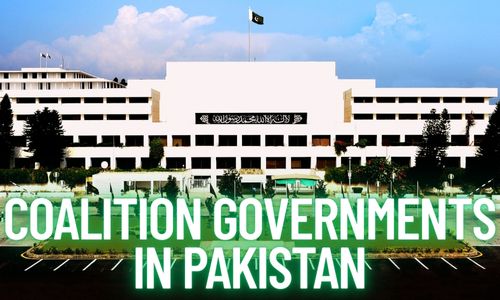
Coalition Governments In Pakistan
In Pakistan’s turbulent political landscape, coalition governments have become an increasingly common phenomenon. While they are often viewed as a necessary compromise in a fragmented political environment, the question remains: are coalition governments a catalyst for national progress or a recipe for legislative paralysis?
Understanding Coalition Governments
A coalition government is formed when no single political party achieves a majority in the legislature, compelling multiple parties to join hands to form a functioning government. In Pakistan’s parliamentary system, this has become the norm rather than the exception due to intense political rivalry and a fragmented vote bank.
Historical Context of Coalition Politics in Pakistan
Pakistan’s coalition experience can be traced back to the early years after independence, but became more prominent post-2008. Key examples include:
-
PPP-led Coalition (2008–2013)
Included ANP, MQM, and PML-Q at different times. The government passed major reforms like the 18th Amendment, devolving powers to the provinces. -
PML-N Coalition (2013–2018)
Though it had a near-majority, PML-N relied on smaller parties and independents, particularly in the Senate. -
PTI-led Coalition (2018–2022)
PTI partnered with GDA, MQM-P, and BAP. Fragile alliances led to internal instability, culminating in a no-confidence motion in 2022 which resulted in ouster of Imran Khan. -
PDM-led Coalition (2022–2023)
A diverse and ideologically split alliance of over a dozen parties took power, exposing both the strengths and weaknesses of broad-based coalitions.
Advantages of Coalition Governments
1. Inclusive Governance
Coalitions represent a broader spectrum of society, incorporating diverse regional and ethnic interests. This can lead to more balanced policy-making.
2. Checks and Balances
With no single party dominating, coalition partners can act as a check against autocracy, preventing unilateral decisions and promoting democratic norms.
3. Legitimacy and Stability (When Managed Well)
If parties agree on a common minimum program, coalitions can provide legitimacy, especially in diverse and divided societies.
Disadvantages of Coalition Governments
1. Policy Gridlock
Conflicting ideologies and political priorities often result in indecisiveness and slow legislation. Critical reforms may be stalled due to lack of consensus.
2. Fragile Alliances
Coalitions in Pakistan are often formed out of political convenience, not ideological alignment. This leads to frequent infighting, backdoor negotiations, and government collapses.
3. Compromised Governance
To keep allies happy, governments may allocate ministries and funds based on political necessity rather than merit, reducing administrative efficiency.
Coalition Dynamics: Regional vs National Level
Coalition politics is even more complex at the provincial level. For instance:
-
In Balochistan, coalition governments are a constant, reflecting tribal and political diversity but often hampering long-term development planning.
-
In Sindh, MQM-P has historically played a kingmaker role, influencing urban policy through strategic alliances.
Public Perception and Voter Fatigue
Frequent political maneuvering, breakups, and reshuffles have eroded public trust. Voters increasingly view coalitions as opportunistic alliances that prioritize power over performance. This has deepened cynicism and reduced political engagement.
The Way Forward: Reforming Coalition Politics
To transform coalition governments into engines of progress rather than gridlock, Pakistan must:
-
Institutionalize coalition agreements to ensure policy continuity.
-
Promote intra-party democracy to reduce personality-based politics.
-
Introduce electoral reforms, such as proportional representation, to reflect voter diversity more accurately and reduce post-election horse-trading.
-
Strengthen judicial and parliamentary oversight to hold coalition governments accountable.
Conclusion: Progress or Gridlock?
Coalition governments in Pakistan are a double-edged sword. They have the potential to unite the nation through shared governance, but when poorly managed, they plunge the country into chaos. Their success depends on political maturity, transparent agreements, and a commitment to national interest over party gain.
In essence, coalition governments are not inherently flawed — but their fate in Pakistan hinges on how wisely they are built and how honorably they are upheld.









LEAVE A COMMENT