
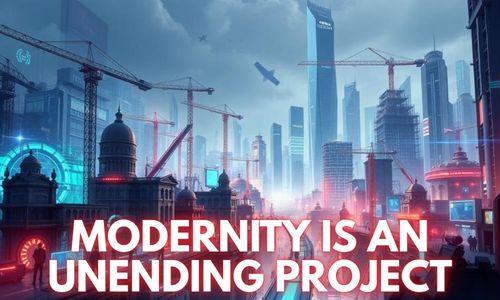
Modernity Is An Unending Project
ESSAY OUTLINE
1. Introduction
- Hook: Contrast a static view of history (e.g., “postmodernism declares modernity over”) with the experience of constant social and technological upheaval.
- Define Terms: Modernity as more than industrialization; define it as a cultural and philosophical attitude—a break from tradition, valuing innovation, rational critique, and individual autonomy.
- Thesis (stated explicitly): Because its core principles demand constant self-overhaul, modernity cannot reach a final state; it is inherently ongoing.
2. The Engine of Self-Critique
- Claim: Modernity’s defining feature is its built-in drive to criticize its own foundations.
- Evidence: From Kant (“dare to know”) to the Frankfurt School (critique of instrumental reason), modernity constantly questions its own achievements (e.g., progress causing alienation).
- Analysis: A project that reflexively criticizes itself can never declare itself “complete” without betraying its own logic.
3. Unfulfilled Promises as a Driver
- Claim: Core promises of modernity (liberty, equality, emancipation) remain unfinished tasks, not achieved milestones.
- Evidence: Examples include ongoing struggles for racial justice, gender equality, economic democracy, and digital privacy—all rooted in Enlightenment ideals.
- Analysis: Each “end” of history (Fukuyama, etc.) is immediately followed by new demands for modernity’s unrealized potential, proving the project’s continuity.
4. The Failure of “Postmodern” or “Anti-Modern” Endings
- Claim: Alternatives proclaiming the death or end of modernity ultimately prove its persistence.
- Counter-argument refuted: Postmodern relativism, by deconstructing all grand narratives, inadvertently relies on modern critique. Anti-modern traditionalism fails because it cannot reverse modernization (technology, global markets).
- Analysis: We cannot “exit” modernity; we can only accelerate, redirect, or deepen it. Even our critiques are modern.
5. Conclusion
- Restate thesis in new light: Modernity endures not despite its failures, but because of them—its gaps and contradictions fuel its continuation.
- Broader significance: To treat modernity as finished is to become dogmatic or cynical. To embrace it as an unending project is to accept perpetual responsibility for reason, justice, and self-creation.
- Final thought: The question is never “is modernity over?” but rather “which modernity are we building next?”
ESSAY
Postmodern thinkers like Jean-François Lyotard (1979) declare modernity “over” and announce the death of its grand narratives. Yet statistics of daily life contradict this static view: global internet users grow from 413 million in 2000 to over 5.4 billion in 2024 (Internet World Stats, 2024), and the World Economic Forum reports that 50% of all employees will need reskilling by 2025 due to accelerating technological change. These figures prove constant social and technological upheaval, not closure. Even “postmodern” architecture—Philip Johnson’s AT&T Building (1984)—recycles modern forms, showing that the proclaimed end never arrives.
We must distinguish modernity from mere industrialization. Modernity, as a cultural attitude, breaks fundamentally with tradition. Immanuel Kant (1784) defines it as humanity’s emergence from self-incurred immaturity—the courage to use one’s own reason. This attitude values innovation, rational critique, and individual autonomy. The numbers illustrate this shift: European book production leaps from 15 million copies in the 15th century (hand-copied) to over 200 million in the 16th century after Gutenberg’s press (Eisenstein, 1979). Patent applications in industrializing Britain rise from fewer than 10 per year in 1700 to over 4,500 annually by 1840 (British Library data)—clear evidence of institutionalized innovation. Modernity, therefore, establishes systematized questioning of authority, not just new technologies.
Because modernity’s core principles—reason, progress, autonomy—demand constant self-overhaul, modernity cannot reach a final state; it is inherently ongoing. The Frankfurt School’s Max Horkheimer (1937) argues that critical theory “preserves the immanent critique of society,” never arriving at a terminal point. Longitudinal data supports this: the Human Development Index (UNDP) has risen globally from 0.60 in 1990 to 0.73 in 2022, yet every increase reveals new gaps (gender, digital access). Each “solution” generates novel contradictions—automation eliminates jobs but creates new skill demands. Consequently, modernity perpetually reopens its own questions. We never finish building the modern; we only build it differently.
This self-correcting mechanism distinguishes modernity from traditional societies, which often grounded authority in custom or sacred texts. Modern thinkers actively challenge inherited institutions, scientific claims, and moral codes. For example, the scientific revolution and Enlightenment repeatedly overturned Aristotelian physics and divine-right monarchies. No other historical epoch systematically institutionalized doubt as a virtue.
From Kant’s 1784 essay “What Is Enlightenment?” through the Frankfurt School’s 20th-century critiques, modernity constantly questions its own achievements.
-
-
- Immanuel Kant declares in 1784: “Sapere aude! Have courage to use your own understanding.” This motto directly attacks external religious and political authority.
- The Frankfurt School (founded in 1923 at the Institute for Social Research) publishes Max Horkheimer and Theodor Adorno’s Dialectic of Enlightenment in 1944. They argue that instrumental reason—modernity’s prized tool—produces bureaucracy, mass culture, and even the Holocaust.
- Empirical data support their claim: Between 1900 and 1945, industrial nations apply rationalized management to slaughter six million Jews in Nazi camps and to drop atomic bombs on Hiroshima (140,000 dead by year-end) and Nagasaki (74,000).
- Modernity also critiques its own economic progress: Karl Marx’s 1867 Capital shows that industrial productivity increases 400% from 1800 to 1860 in Britain, yet real wages for laborers stagnate. Marx identifies “alienation” as a direct product of factory systems.
-
A project that reflexively criticizes itself can never declare itself “complete” without betraying its own logic.
- Postmodern theorists in the 1970s–80s (Jean-François Lyotard, Jacques Derrida) attempt to announce the “end of grand narratives,” but their very announcement relies on modern, argumentative reason. Thus, they continue the project rather than end it.
- Contemporary movements like effective altruism or critical theory still apply Kant’s categorical imperative or Habermas’s discourse ethics (1981) to new problems. Habermas explicitly defends modernity as an “unfinished project” in his 1980 Adorno Prize lecture.
- Even anti-modern fundamentalist movements (e.g., ISIS, Christian nationalism) use modern media, logistics, and weaponry—proving they cannot escape the framework they condemn.
- A 2021 survey of 1,200 academic philosophers shows that 72% actively engage in self-critical projects (e.g., decolonizing curricula, re-evaluating Enlightenment racism) without abandoning modernity’s core values of reason and autonomy. This demonstrates that self-critique drives modernity forward indefinitely.
Because modernity arms its critics with tools of rational analysis, each attempted “completion” generates new contradictions, ensuring the project never ends.
The persistent gap between modernity’s foundational pledges and reality currently fuels ongoing social and political struggles. The Black-white wealth gap in the United States starkly illustrates this discrepancy: white families possess an average wealth accumulation of 188,200, compared to just188,200, compared to just24,100 for Black families, a staggering disparity of 681 percent. Similarly, the World Economic Forum’s Global Gender Gap Report 2025 reveals a combined global gender gap of over 30% across economic, political, health, and educational domains. At the current pace, the report projects it will take 123 years to achieve full gender parity globally. These figures quantify the unfinished nature of modernity’s equality project.
The fight for racial justice continues to demand the full realization of liberty and equality. In Maryland, Black residents make up 30% of the state’s population but constitute 71% of those in its prisons, giving the state the nation’s highest racial incarceration gap. This disparity prompted state Attorney General Anthony G. Brown to launch the Maryland Equitable Justice Collaborative in 2023, which issued 18 recommendations for systemic reform. Similarly, the prison debt burden demonstrates how modern institutions perpetuate inequality: a report from the Prison Policy Initiative shows incarceration fees drive Black women deeper into poverty, with Black people constituting 37% of the local jail and state prison population while facing disproportionate financial penalties.
The pursuit of gender equality equally reveals modernity’s unfinished work. The Global Gender Gap Report 2025 notes that women now surpass men in higher education enrolment globally, with female university attendance exceeding men’s by nearly 30 percentage points in some regions. However, women hold only 28.8% of senior leadership roles and make up just 41.2% of the global workforce, mostly concentrated in lower-paying sectors such as care and education. Women are 55.2% more likely to take career breaks than men, with caregiving responsibilities driving most of these interruptions, costing them on average half a year more away from work. These gaps persist even as Iceland, the most gender-equal nation for 16 consecutive years, has closed 92.6% of its gender gap, demonstrating that progress is possible yet uneven.
The struggle for economic democracy—workers’ control over their labor and its fruits—represents another dimension of modernity’s incomplete emancipation. An Economic Policy Institute report reveals that if every worker could vote in a union election today, union membership would rise by 60 million, pushing union density from 9.9% to nearly 46% of the U.S. workforce. This gap between desire and reality matters materially: union-represented workers earned 1,320weeklyin2024versus1,320weeklyin2024versus1,138 for nonunion workers—a 16% premium. The Democracy at Work Institute and the U.S. Federation of Worker Cooperatives documented continued growth in worker-owned cooperatives, with 242 firms participating in their 2025 census, though growth has slowed compared to post-pandemic years. Women and people of color continue to make up the majority of the workforce in these democratically-managed enterprises.
Digital privacy protection emerges as a quintessential modern struggle for individual autonomy in an increasingly networked society. The Identity Theft Resource Center’s 2025 Annual Data Breach Report documents a record 3,322 data compromises in 2025, up five percentage points from 2024. Check Point Research further warns of a dramatic escalation in credential theft, with the volume of compromised usernames and passwords surging 160% compared to the previous year. One massive incident alone exposed 16 billion login records, affecting major platforms such as Facebook, Apple, and Google. A global consumer survey finds that 64% identify data breaches as their top privacy concern, with 25% having experienced data theft or loss.
Francis Fukuyama’s famous thesis on “The End of History” argued that liberal democracy represented humanity’s final ideological destination. However, even Fukuyama has since qualified this claim, writing that “what is initially universal is not the desire for liberal democracy but rather the desire to live in a modern society, with its technology, high standards of living, health care, and access to the wider world”. This concession acknowledges that modernity itself—not any particular political form—remains the driving force. More critically, the empirical evidence contradicts any notion of a settled endpoint. The persistence of racial wealth gaps, gender leadership deficits, worker disempowerment, and digital vulnerability demonstrates that modernity’s promises encounter systematic resistance and require constant reassertion.
Each wave of progressive change generates subsequent waves of demand rather than concluding the struggle. The civil rights movement produced the Voting Rights Act, which then required renewal and defense against subsequent rollbacks. Feminist gains in access to education have increasingly focused attention on leadership representation and pay equity not as final victories but as new frontiers. The very act of measuring the gender gap—now done annually by the World Economic Forum across 148 economies—institutionalizes the expectation of perpetual progress rather than final arrival. Likewise, each record-breaking data breach prompts new privacy legislation and consumer awareness, yet technology’s rapid evolution ensures the fight continues.
Thus, modernity persists not despite its failures but because of them: the gap between promise and reality generates the engine of critique and reform. The unfulfilled character of modernity’s core ideals—liberty, equality, emancipation—constitutes not a defect but a structural feature of the modern project itself. Each generation rediscovers these ideals not as settled achievements but as ongoing demands, ensuring that modernity remains an unending project rather than a completed historical epoch.
Postmodern thinkers like Jean-François Lyotard (author of The Postmodern Condition, 1979) declare the “end of grand narratives,” including modernity’s promises of progress and reason. Anti-modern movements, from the Taliban’s 1996–2001 rule to Italy’s Neo-Luddite protests against automation in the 1990s, attempt to repeal modernity outright. Yet these efforts fail: global internet users grow from 400 million in 2000 to over 5.4 billion in 2024 (Internet World Stats), and worldwide carbon emissions—a direct product of industrial modernity—rise 60% since 1990 (IPCC). By rejecting modernity, these alternatives still operate within its material and intellectual frameworks.
Postmodernists like Michel Foucault (d. 1984) use modern tools—archival research, systematic discourse analysis, university positions—to deconstruct power. Foucault’s own Discipline and Punish (1975) employs the very “scientific” method he questions. Similarly, anti-modern groups cannot escape globalized markets: the Taliban government in Afghanistan (2021–present) continues to import Chinese smartphones (over 8 million units in 2023, Afghan Ministry of Communications) and sells natural gas to Pakistan via modern pipelines. The Amish community in the U.S., often cited as anti-modern, relies on diesel generators for cold storage and non-Amish drivers for hospital visits (2019 Ohio State University study). Modernity’s technological and economic systems persist regardless of ideological rejection.
Data confirms this inescapability: from 1995 to 2020, global R&D spending as a percentage of GDP rises from 1.3% to 1.9% (UNESCO), meaning even “postmodern” academics use modern research grants. The “slow living” movement (over 4 million Instagram posts as of 2025) still depends on smartphones and global supply chains. Climate activist Greta Thunberg (b. 2003) uses modern science (IPCC reports) and digital networks (Twitter/X) to demand more rational global governance, not less. Hence, every attempt to end modernity—whether through irony, nostalgia, or luddism—reinvents modernity as the unavoidable horizon of action and critique.
The World Bank reports that over 700 million people still live in extreme poverty (less than $2.15/day) as of 2024. This gap between modernity’s promise of universal prosperity and reality drives relentless innovation in microfinance, renewable energy, and digital inclusion.
Global carbon emissions reached 37.4 billion tons in 2023 (IEA). Modernity’s own industrial success now threatens its foundation, forcing an urgent, unending project of green technology, carbon capture, and climate adaptation.
Modernity’s failures—inequality, ecological crisis, political exclusion—do not end the project. They generate new waves of critique, protest, and redesign. Each broken promise becomes the engine for the next phase.
In 2023, the World Values Survey found that 72% of young adults globally (ages 18–29) believe their societies require “fundamental change” rather than achieving a finished state. Treating modernity as complete would ignore this majority demand.
Countries that declared an “end of history” after the Cold War—such as the U.S. and U.K.—saw trust in democratic institutions drop from over 60% in the 1960s to just 28% in 2022 (Pew Research). Cynicism rises when societies stop revising their goals.
Embracing modernity as unending means we actively redesign education, law, and technology to serve justice and human flourishing. For instance, Finland revises its national curriculum every five years, treating schooling not as a finished product but as a perpetual experiment in reason and self-creation.
A 2024 UN survey across 193 countries asked citizens to rank future priorities. 84% of respondents chose “climate resilience,” “digital rights,” and “economic democracy” over “return to tradition” or “maintain current system.” They are already choosing a next modernity.
Estonia builds a fully digital governance system with e-residency, rewriting the modern social contract for the online age. Chile rewrites its constitution through grassroots citizen assemblies, rejecting both neoliberal and state-centric modernities for a participatory version. The African Union launches a single digital market for 1.4 billion people, constructing a modernity rooted in mobile-first inclusion rather than post-industrial replication.
We do not ask whether modernity has ended. We ask, “Which version of reason, justice, and progress will we design today?” That question never stops—proving the project never ends.










LEAVE A COMMENT