

Aafia Siddiqui
Aafia Siddiqui is a Pakistani neuroscientist who gained international attention due to her controversial case. Born on March 2, 1972, in Karachi, Pakistan, Siddiqui studied neuroscience at the Massachusetts Institute of Technology (MIT) and obtained a Ph.D. in 2001. In 2003, Siddiqui mysteriously disappeared with her three children, leading to intense speculation about her whereabouts. It later came to light that she had been detained by Pakistani intelligence agencies and allegedly handed over to the United States. In July 2008, Siddiqui was arrested by Afghan police in Ghazni and accused of carrying suspicious documents. During her arrest, she allegedly grabbed a U.S. soldier’s rifle and opened fire, but no one was injured. She was subsequently transferred to the custody of the United States.


Siddiqui’s trial took place in New York in 2010. The prosecution claimed that she intended to kill Americans, while Siddiqui maintained that she had been abducted and tortured during her disappearance. The trial was highly controversial, with Siddiqui’s supporters claiming she was innocent and a victim of injustice, while the U.S. government portrayed her as a dangerous terrorist. Ultimately, Aafia Siddiqui was convicted in February 2010 on charges of attempted murder and assault. She was sentenced to 86 years in prison by a U.S. federal court. Her case has been a source of controversy and has drawn attention from human rights organizations and activists who have raised concerns about her treatment and the fairness of her trial.
Imprisonment
Aafia Siddiqui was sentenced to prison for 86 years following her conviction on charges of attempted murder and assault. During her trial, the prosecution presented evidence that Siddiqui had grabbed a U.S. soldier’s rifle and fired it at a group of U.S. personnel who were present at the time of her arrest in Afghanistan in 2008. No one was injured in the incident. The jury found Siddiqui guilty of attempted murder, which is a serious offense that carries significant penalties under U.S. law. The specific circumstances of the case, including the alleged act of violence directed at U.S. personnel, likely contributed to the lengthy sentence imposed by the federal court.
It’s important to note that sentencing decisions are made by judges based on a variety of factors, including the nature of the offense, the defendant’s criminal history, and any relevant sentencing guidelines. The specific details of Siddiqui’s case and the factors that influenced her sentence would have been determined during her trial and subsequent sentencing hearing. It’s worth mentioning that Siddiqui’s case has been a subject of controversy, with some individuals and organizations expressing concerns about the fairness of her trial and the conditions of her detention. However, the information I provided regarding her sentence is based on the available facts and legal outcome of the case.
US Stance
The imprisonment of Aafia Siddiqui in the United States has been a subject of debate and controversy. From the perspective of the U.S. government, Siddiqui was convicted and sentenced for charges related to attempted murder and assault. The prosecution argued that she had grabbed a U.S. soldier’s rifle and opened fire on U.S. personnel during her arrest in Afghanistan in 2008. As a result, Siddiqui was found guilty and received a lengthy prison sentence.
The U.S. government’s stance in Siddiqui’s case was primarily focused on prosecuting her for the alleged crimes committed against U.S. personnel and maintaining the rule of law. From their perspective, the achievement of Siddiqui’s imprisonment would have been to hold her accountable for her actions and ensure justice for the individuals involved. It’s important to note that the specific intentions or motivations of the U.S. government in Siddiqui’s case can be a matter of interpretation, and different individuals may have different perspectives on the matter. The circumstances surrounding Siddiqui’s case have been a source of controversy, and some individuals and organizations have raised concerns about the fairness of her trial and the conditions of her detention.
Pakistan’s Efforts
Pakistan has made efforts to bring Aafia Siddiqui back to the country. Since her arrest and imprisonment in the United States, the Pakistani government has been engaged in diplomatic efforts and advocacy to secure her repatriation. The Pakistani government has raised concerns about Siddiqui’s well-being, the fairness of her trial, and her overall treatment while in custody. Pakistani officials, including government representatives and diplomats, have been in contact with their U.S. counterparts to discuss Siddiqui’s case and request her repatriation to Pakistan.
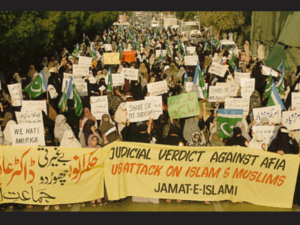
In addition to diplomatic channels, Pakistani civil society, human rights organizations, and various political and religious groups have also expressed their support for Siddiqui and have demanded her release. Protests and demonstrations have taken place in Pakistan, both to highlight Siddiqui’s case and to call for her repatriation. The Pakistani public’s sentiment regarding Siddiqui’s case has been mixed, with some perceiving her as a victim of injustice and supporting the government’s efforts to bring her back, while others hold differing opinions. However, it’s important to note that despite these efforts, securing Siddiqui’s repatriation to Pakistan has proven challenging. The U.S. legal system and the specific circumstances of her case have posed obstacles to her return.
Use of Aafia’s Imprisonment for Political Gains in Pakistani
The usage of Aafia Siddiqui’s case in Pakistani politics was a low point, that her case was exploited or manipulated for political purposes in a negative or unethical manner. The politicization of sensitive cases can often be a contentious issue, as it may overshadow the core issues at hand or lead to misinformation and polarization. Using high-profile cases or individuals for political gain can be seen as opportunistic or exploitative, especially if it involves misrepresentation, manipulation of public sentiment, or the diversion of attention from more pressing matters. Critics argue that such practices undermine the pursuit of justice and detract from substantive policy discussions.
It’s worth noting that the usage of cases for political purposes is not unique to Pakistan and can occur in various countries. As in the past PML (N), PML (Q). PPPP, PTI, TLP & JI and along with others too has used Aafia’s jail sentence as a political card as these parties vigorously used Aafia as a political tool to attract voters in their election campaigns but they all failed to make solid steps to pave path of freedom for Aafia. While there have been several hindrances in the release of Aafia Siddiqui from imprisonment. Some of the factors that have contributed to the challenges and complexities in her case include:
- Legal Process: Siddiqui was convicted and sentenced by a U.S. federal court, which followed a legal process involving trial, evidence presentation, and a verdict. The U.S. legal system operates independently, and the process of appealing or overturning a conviction can be complex and time-consuming.
- Diplomatic Relations: The case of Aafia Siddiqui has strained diplomatic relations between the United States and Pakistan. Political tensions, differing perspectives on her case, and broader geopolitical dynamics have made it difficult to reach a resolution that satisfies both countries.
- National Security Concerns: Siddiqui’s case has been intertwined with national security considerations. The U.S. government has argued that she was involved in activities that posed a threat to U.S. personnel, while the Pakistani government has sought to address concerns about her treatment and well-being.
- Public Perception and Controversy: Siddiqui’s case has been highly controversial, and public opinion on her culpability and treatment varies. Diverging views and the emotions surrounding her case have made it challenging to find a consensus or a resolution that satisfies all parties involved.
- Legal and Administrative Processes: Various legal and administrative processes, such as extradition requests, transfer agreements, and international conventions, can further complicate efforts to secure Siddiqui’s release and repatriation to Pakistan.
- Sentencing and Lengthy Prison Term: Siddiqui’s lengthy prison sentence of 86 years makes it difficult to pursue avenues for release or clemency. It requires significant legal efforts and the intervention of relevant authorities to review or modify her sentence.
- Addressing these hindrances requires navigating complex legal, diplomatic, and political landscapes. The resolution of Aafia Siddiqui’s case would involve concerted efforts and negotiations between the U.S. and Pakistani governments, as well as potentially addressing concerns related to national security, legal considerations, and public sentiment.
Overall Dilemma
Since Aafia Siddiqui’s imprisonment, several developments have occurred globally. here are some notable changes and events that have taken place:
- 20-year American-Afghan War ended
- Osama bin Laden eliminated
- Mullah Omar eliminated
- Musharraf eliminated
- US Iraq War ended
- Saddam Hussein eliminated
- Muammar Gaddafi eliminated
- Husni Mubrek eliminated
- Muhammed Morsi of Egypt died during imprisonment
- Guantanamo Bay prison ended
- All detainees in Guantanamo Bay prison released
- Aafia Siddiqui’s mother passed away
- Aafia Siddiqui’s eldest daughter became a doctor
- Since Aafia Siddiqui’s arrest, her youngest son reached adolescence
Despite Aafia is not involved in any of the global conflicts but still Aafia Siddiqui is an unfortunate woman who is falsely accused and still remains in Supermax prison because the Superpowers and its allies consider her a threat to global peace. During her imprisonment:
- Tunisia fell into chaos
- Syria experienced a civil war
- Libya fell into chaos
- Lebanon experienced internal strife
- Egypt fell into chaos
- Yemen faced a civil war
- Russia-Ukraine conflict began
- Peace between Iran and Saudi Arabia
- Peace between Saudi Arabia and Turkey
- Peace between Turkey and the UAE
- Peace between Iran and Turkey
- Peace between the UAE and Iran
- Ceasefire against rebels in Yemen
- US in decline
- China rising as a global power
- Few Arab states accepted Israel
- Trade & Diplomatic relations formed between Arab States and Israel.
But despite all this, global peace is still threatened by a mere woman Aafia Siddiqui!!!
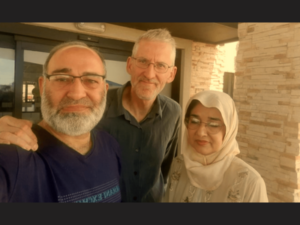
Recently the JI senator Mushtaq Ahmed Khan along with Aafia Siddiqui’s sister meet Aafia in US jai after 20 years of her illegal abduction and after the meeting they told the media about the awful condition of Aafia in US imprisonment where she is denied of basic facilities including medical facilities due to which she is suffering with different diseases along with loss and damage to physical parts i.e broken teeth. Despite all theses from the bottom of my heart, I pray that Allah resolves Aafia Siddiqui’s difficulties and grants her freedom to live the rest of her life with her family. Amen.












LEAVE A COMMENT