
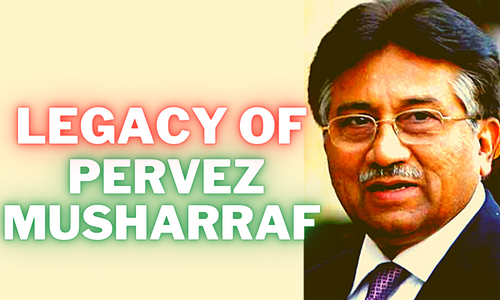
Legacy of Pervez Musharraf
Today the ex president, dictator and ex army chief of Pakistan has been passed away in Dubai after a prolonged illness. His regime is considered controversial as he introduced some of the socio-economic reforms in the society of Pakistan but throw Pakistan in a war against terror by allying as a state with US-NATO forces during the invasion of Afghanistan to capture Osama Bin Laden who is alleged responsible for the 9/11 attacks of terrorism over USA.
He served as the President of Pakistan from 1999 to 2008 and as the Chief of Army Staff from 1998 to 2007. He came to power in 1999 after leading a military coup that overthrew the elected government of Nawaz Sharif.
During his rule, Musharraf played a key role in the US-led coalition’s war on terror and introduced several reforms aimed at modernizing Pakistan, including economic and educational reforms. He faced criticism from opposition politicians and human rights organizations for violating civil liberties and human rights, and for suppressing political opposition and media freedom.
After leaving the presidency in 2008, Musharraf faced legal challenges and lived in self-imposed exile for several years. He returned to Pakistan in 2013 to participate in the general elections, but his political career was cut short as he faced several court cases and was placed under house arrest.
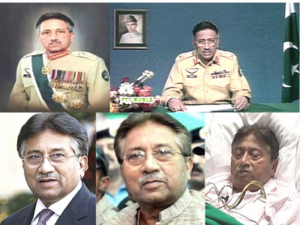
During his rule, he left a legacy marked by both achievements and criticism.
Achievements:
- He launched the National Crime Crisis Management Cell to combat terrorism and extremism.
- He implemented socio-economic reforms that led to an increase in qualified professionals along with increase in foreign investment which boosted Pakistan’s economy.
- He also introduced educational reforms aimed at modernizing the education system in Pakistan.
- He is credited to provide freedom to media and for making press and electronic media policy by allowing private channels to run transmissions over news, entertainment, sports and religion
- He ensured people empowerment through devolution at grass roots level.
- He stressed upon women empowerment at all tiers of government / legislature.
- Legislation against honour killings. Women Protection Bill.
- Empowerment of minorities through joint electorate as well as reserved seats.
- To prevail political sense and to empower youth he reduced voter age from 21 to 18 years.
- He brings reforms in economy, health, education, law, energy sector, agricultural, industrial, sports, telecommunication and other social reforms
- He started and successfully completed many mega projects of Pakistan including functionality of modern Gawadar seaport along with developing many water reservoirs in country in the replacement of Kala Bag Dam.
- He specifically worked for the betterment and empowerment of women, development of basic infrastructure, increasing literacy rate, sustaining alleviating poverty, creating employment opportunities and introducing light and moderation through Islamic teachings and by promoting sufiism.
- He encouraged qualified professionals of their fields by providing allowances, aids and special awards to encourage more people
- Due to his measures the per capita income got increased along with direct foreign investment also boost.
- During his rule Pakistan successfully completed the IMF program with the hope of never considering it in future which makes great impact on economy as provided sustainability and growth by gradual decrease in debts.
Criticism:
- Musharraf’s opposition criticized his policies for being authoritarian and undemocratic practices which is rightly so due to Martial Law.
- Musharraf played a key role in the war on terror, aligning Pakistan with the US-led coalition. Due to which he is criticized for his one sided policies in favour of USA.
- He is responsible for giving NRO to the opposition including PML(N) and PPP leaders which make huge adverse impact on economic growth of Pakistan later.
- He faced criticism for handing over military basis to USA for carrying out logistic operations in Afghanistan.
- He was heavily criticized for being pro India in reference of making relations through trade, culture and cricket diplomacy.
- In his era unfortunately the practicing muslims were labelled as extremists due to his light and moderation policy as he idealizes Mustafa Kamal Ataturk who prohibited Islamic culture in Turkiye including Azan after abolishing the Ottoman empire.
- He faced criticism from Americans for not doing enough to curb terrorism in the region and for the human rights violations committed by the Pakistani military.
- He was also criticized for his handling of the conflict in Kashmir and for his alliance with the US in the war on terror.
- He faced criticism for not carrying out aerial strikes against US operated drone attacks within Pakistani territories which killed many innocent Pakistanis in Tribal areas (FATA) of Pakistan then.
- He was criticized for killing of Bugti and Baloch nationalists for providing aid to Baloch separatists.
- He launched military operations in Baluchistan and FATA which initiated insurgency in the areas and eventually give birth to suicidal attacks across Pakistan afterwards 2004.
- He was heavily criticized for launching operation against pupil of Lal Masjid in Islamabad which is considered worst state backed military action so far in the history of Pakistan
- He make a judicial reference against Iftikhar Chaudhary which initiated the lawyers’ movement against him as the movement created more hatred towards him and his policies.
- He sold Pakistani nationals including Aafia Siddiqui to USA for the sake of US Dollars, who were later kept in military prison of Guantanamo Bay in Cuba.
- He banned the funding of Islamic Madrassas and make legislations to force them to operate under the central body.
- Due to his Kashmir policy the stance of Pakistan as a state over the valley of Kashmir got badly affected.
- He normalized singing, private parties and mix gatherings within the society.
- He backed the co-education system in the society which make negative effects over students.
- Due to his light and moderation policy, vulgarity and obscenity prevailed and modesty becomes the symbol of backwardness which shook the social norms and practices.
In conclusion, Pervez Musharraf was a significant figure in Pakistan’s modern political history, known both for his role in the war on terror and for his efforts to modernize the country, but also criticized for his authoritarian style of governance and human rights violations. He also wrote a book named “In the Line of Fire” which was translated in Urdu as “Sab se Pehlay Pakistan or Pakistan above all” in which he discussed many aspects during his rule but the book was written while holding office and many events are not covered in it.








LEAVE A COMMENT