
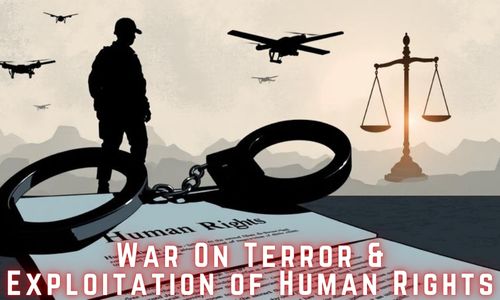
War on Terror And Exploitation of Human Rights
ESSAY OUTLINE
1. Introduction
- Hook: Highlight how global counterterrorism efforts intensified after 9/11.
- Context: Explain how states expanded security measures under the banner of national protection.
- Thesis Statement: Despite its aim to combat terrorism, the war on terror has resulted in widespread human rights violations, including unlawful detentions, torture, surveillance, and discrimination.
2. Expansion of State Power and Erosion of Civil Liberties
- Point: Governments strengthened security institutions, often at the cost of fundamental freedoms.
- Evidence: Anti-terror laws allowing warrantless arrests, prolonged detentions, and restricted freedom of movement.
- Explanation: Concentrated state power reduces accountability and increases the risk of abuse.
3. Unlawful Detentions and Torture
- Point: Counterterrorism operations have normalized extrajudicial practices.
- Evidence: Guantánamo Bay, CIA black sites, secret detention centers, and reports of torture.
- Explanation: These practices violate international human rights norms and undermine legal protections.
4. Mass Surveillance and Privacy Violations
- Point: Intelligence agencies expanded surveillance under the pretext of preventing terrorism.
- Evidence: Digital monitoring, phone tapping, and data collection laws in the US, UK, and other countries.
- Explanation: Broad surveillance infringes on privacy and creates a climate of fear among civilians.
5. Racial and Religious Profiling
- Point: War on terror policies disproportionately target certain ethnic and religious groups.
- Evidence: Increased scrutiny of Muslims, immigration restrictions, and discriminatory airport security checks.
- Explanation: Such profiling violates equality and fosters social marginalization.
6. Civilian Casualties in War Zones
- Point: Military operations justified under anti-terrorism have harmed large civilian populations.
- Evidence: Drone strikes, bombings, and counterinsurgency operations in Afghanistan, Iraq, Syria, and Pakistan.
- Explanation: Civilian suffering deepens grievances and raises ethical and legal concerns.
7. Weak International Accountability
- Point: Global institutions have struggled to restrain states from overreaching.
- Evidence: Lack of punishment for countries involved in torture, illegal invasions, and human rights breaches.
- Explanation: Weak enforcement emboldens nations to continue violations.
8. Conclusion
- Restate Thesis: The war on terror, despite its stated goals, has fueled systematic human rights abuses around the world.
- Summarize Key Points: Expanded state authority, unlawful detentions, mass surveillance, and discrimination have become normalized.
- Final Thought: To truly ensure global security, nations must uphold human rights principles rather than undermine them in the name of counterterrorism.
ESSAY
Global counterterrorism efforts intensified rapidly after the 9/11 attacks, as governments across the world launched large-scale military campaigns and introduced aggressive security policies. Nations justified sweeping measures in the name of national security, creating an environment where extraordinary actions became acceptable under the fear of terrorism.
In the aftermath, states expanded their security apparatus by passing stringent anti-terror laws, increasing surveillance, and empowering law-enforcement agencies with broader discretionary authority. These expanded powers allowed governments to arrest suspects without warrants, hold individuals for extended periods, and monitor private communications—all under the banner of protecting citizens from potential threats.
Despite its declared intention to eliminate terrorism, the war on terror has directly contributed to widespread human rights abuses. Governments have engaged in unlawful detentions, used torture during interrogations, implemented intrusive surveillance systems, and promoted discriminatory practices against specific ethnic and religious groups. These consequences reveal how counterterrorism strategies have undermined fundamental human rights at both national and international levels.
Governments across the world expanded their security institutions in the name of fighting terrorism, and this expansion directly compromised fundamental civil liberties. They introduced stricter monitoring systems, empowered intelligence agencies, and broadened police authority. As a result, ordinary citizens experienced a noticeable reduction in their freedom of expression, movement, and privacy. By prioritising national security above individual rights, states actively reshaped the balance of power in their own favour and weakened long-standing democratic protections.
In many countries, new anti-terror laws enabled security forces to arrest individuals without warrants, hold suspects for prolonged periods without trial, and restrict their movement under vague or unproven allegations. Authorities repeatedly used these laws to detain people on mere suspicion rather than concrete evidence. Such practices demonstrate how the war on terror empowered states to bypass established legal procedures that once protected citizens from arbitrary actions. These examples show a clear shift from rule-of-law principles to unchecked executive authority.
When governments accumulate excessive power under the pretext of counterterrorism, accountability naturally declines and the potential for abuse rapidly grows. By centralising authority in security agencies and reducing judicial oversight, states create an environment where violations can occur without challenge. This concentration of power allows officials to act without transparency and weakens mechanisms that traditionally safeguard human rights. As a result, civil liberties erode, and the likelihood of human rights abuses increases significantly.
Counterterrorism operations increasingly normalize extrajudicial practices as states prioritize security over legality. In the name of preventing terrorism, governments bypass due process, detain suspects without warrants, and ignore judicial oversight. These actions create a parallel system where security agencies operate with unchecked authority, making extrajudicial measures appear acceptable and even necessary.
Guantánamo Bay stands as a major example, where the U.S. has held detainees for years without trial or charges. Similarly, the CIA operated secret “black sites” across Europe, the Middle East, and Asia, where intelligence officers conducted interrogations involving torture and coercive techniques. Other countries also created secret detention centers, using forced disappearances and unlawful confinement. Numerous human rights reports document beatings, waterboarding, sleep deprivation, and psychological abuse under the banner of counterterrorism.
These practices directly violate international human rights laws, including the UN Convention Against Torture and the International Covenant on Civil and Political Rights. By detaining individuals without legal representation or transparent trials, states undermine the right to a fair hearing and protection from inhumane treatment. Such actions weaken public trust, erode the rule of law, and set dangerous precedents that allow governments to silence dissent under the guise of national security.
Intelligence agencies expanded surveillance powers under the pretext of preventing terrorism, broadening the scope of monitoring from targeted suspects to whole populations. Governments passed emergency measures and amended legal authorities that allowed security services to intercept communications, compel data retention, and access private records with fewer procedural safeguards. Agencies argued that these powers improved detection and prevention, which in practice led to routine, large-scale collection programs.
Authorities implemented widespread digital monitoring that captured emails, social-media activity, and internet metadata, while law enforcement and intelligence units used phone-tapping and location tracking more frequently. Legislatures in several countries updated data-collection and surveillance laws to permit bulk data access and mandatory retention by telecoms and platforms, and intelligence partnerships enabled cross-border sharing of intercepted material. These measures moved surveillance from occasional, court-approved interceptions to systematic harvesting of personal information.
Such broad surveillance erodes individuals’ reasonable expectation of privacy and chills free expression, because people change their online and offline behaviour when they believe they are watched. The reduction of procedural checks—like judicial oversight or strict probable-cause requirements—weakens accountability and increases the risk of misuse, profiling, and errors. Ultimately, pervasive monitoring creates a climate of fear and self-censorship that undermines democratic participation and civil liberties.
War on terror policies have frequently singled out particular ethnic and religious groups for intensified scrutiny and control. Governments and security agencies have implemented profiling practices—whether in law enforcement, border control, or counterterrorism operations—that focus on characteristics such as religion, nationality, ethnicity, or community background rather than on individual behaviour or credible intelligence. As a result, whole communities often face routine checks, stops, and monitoring simply because they belong to a perceived “at-risk” group, which widens distrust between those communities and state institutions.
Security measures introduced after major terrorist incidents often translated into concrete policies that disproportionately affected Muslims and some migrant or minority populations. Authorities increased identity checks at airports and border crossings, introduced watchlists and no-fly lists that disproportionately included people from certain backgrounds, and tightened immigration rules targeting nationals of specific countries. Law enforcement agencies also carried out raids and surveillance programs concentrated in neighbourhoods with large minority populations. These practices produced statistical and anecdotal patterns showing heavier enforcement and more frequent stops for members of targeted groups.
Such profiling undermines fundamental principles of equality and non-discrimination because it treats individuals as suspect based on group identity rather than personal conduct. When authorities routinely single out entire communities, they stigmatize ordinary citizens, damage social cohesion, and drive some individuals toward isolation or resentment. Over time, this marginalization erodes trust in public institutions, discourages cooperation with police and security services, and weakens the very counterterrorism aims those policies were supposed to advance. In short, profiling sacrifices both civil rights and long-term security by alienating the communities whose support is often essential to preventing radicalisation and detecting genuine threats.
Nations, primarily the United States and its coalition partners, have initiated extensive military campaigns under the justification of dismantling terrorist networks and preventing future attacks. These operations, often launched in densely populated regions, have consistently inflicted severe harm on non-combatant populations. The framing of these conflicts as a “global war on terror” has frequently led to battlefield rules and legal interpretations that prioritize operational expediency over stringent civilian protection, resulting in widespread destruction of essential infrastructure, including hospitals, schools, and markets, which form the backbone of civilian survival. This strategic approach has transformed entire cities and regions into perilous war zones, directly exposing millions of innocent men, women, and children to violence, displacement, and death, thereby creating a human cost that vastly exceeds the initial casus belli.
Unmanned aerial vehicles, or drones, operated by intelligence and military agencies, have conducted thousands of strikes in countries like Afghanistan, Pakistan, Somalia, and Yemen. These remote-controlled attacks, while touted for their precision, have repeatedly misidentified civilians as combatants or have caused significant “collateral damage” through secondary explosions and faulty intelligence, killing families in their homes and travelers on roadways. Simultaneously, conventional aerial bombings by coalition and partner forces in urban centers like Raqqa, Syria, and Mosul, Iraq, have flattened entire city blocks, often relying on explosive ordnance with a wide blast radius in densely populated neighborhoods. Furthermore, ground-based counterinsurgency operations, which aimed to clear and hold territory, have frequently involved night raids, artillery barrages, and checkpoint shootings that have mistakenly targeted civilians, while also empowering local militias with questionable human rights records, leading to extrajudicial killings and sectarian violence.
The pervasive loss of innocent life actively fuels the very cycles of violence it seeks to contain. When a drone strike obliterates a wedding convoy or when an airstrike collapses a residential building on a family, the surviving relatives and community members often channel their anguish into profound grievance and rage. This bitterness provides militant groups with a powerful recruitment tool, allowing them to frame their struggle as a defensive jihad against foreign aggressors who show disregard for local lives. Ethically, these actions provoke a fundamental crisis, as they force a confrontation between the stated goal of protecting civilians from terrorism and the harsh reality of causing their deaths. Legally, the high rate of civilian casualties challenges compliance with international humanitarian law, particularly the core principles of distinction (between combatants and civilians) and proportionality (ensuring that the military advantage outweighs the incidental civilian harm), raising accusations of war crimes and creating a lasting legacy of animosity and distrust.
Global institutions like the United Nations and the International Criminal Court consistently fail to curb the aggressive actions of powerful nations. Veto-wielding members of the UN Security Council routinely block decisive resolutions against their own allies or strategic interests, paralyzing the primary body responsible for maintaining international peace. Simultaneously, major powers often ignore rulings from international courts or withdraw their recognition of the court’s jurisdiction when a case targets them, demonstrating a clear disregard for the very legal frameworks they helped establish. This structural impotence allows states to systematically expand their influence and pursue geopolitical goals through military and economic coercion, effectively placing national interest above international law and order.
Recent history provides stark evidence of this accountability deficit, as powerful nations commit grave violations without facing meaningful consequences. Following the 2003 invasion of Iraq, which the UN Secretary-General himself later declared illegal, the invading coalition suffered no sanctions or legal penalties from the Security Council. Furthermore, despite the 2014 US Senate report meticulously detailing the CIA’s use of torture, no international body prosecuted American officials, revealing a system that holds weaker states to a different standard. More recently, despite the International Court of Justice ordering provisional measures, the ongoing conflict in Gaza continues, highlighting the inability of global governance to enforce its own directives and protect civilian lives against determined state actors.
This consistent failure to enforce rules actively encourages further violations by creating a culture of impunity. When states observe that even the most serious breaches—such as wars of aggression and torture—go unpunished, they rationally calculate that the benefits of their actions outweigh the negligible risks. This dynamic erodes the deterrent power of international law, transforming it from a binding constraint into a set of optional guidelines that powerful nations can follow or ignore at their convenience. Consequently, nations not only repeat their own transgressions but also feel empowered to escalate their behavior, as competitors and rivals, seeing the lack of consequences, may launch their own illegal invasions or human rights abuses, fearing no retribution from a fractured and ineffective international community.
The stated objectives of the global war on terror have consistently masked its corrosive impact on fundamental freedoms. Despite promises of security and stability, this prolonged conflict has, in practice, fueled systematic human rights abuses across the globe, creating a dangerous precedent where exceptional measures have become permanent fixtures of state power.
Governments worldwide have leveraged the climate of fear to expand their state authority, aggressively passing sweeping legislation that erodes judicial oversight, criminalizes dissent under the guise of combating extremism, and grants security agencies unprecedented, and often unchecked, powers to act with impunity.
This expansion of power has directly enabled the normalization of unlawful detentions and mass surveillance. Security forces indefinitely hold suspects without charge or fair trial in facilities like Guantánamo Bay and Bagram, while intelligence agencies collectively mine the private data of millions, transforming entire populations into subjects of suspicion rather than citizens with rights to privacy.
Furthermore, these policies have institutionalized widespread discrimination and targeted violence. State authorities and societal factions disproportionately profile, harass, and persecute individuals based on their religion, ethnicity, or national origin, fostering a culture of Islamophobia and xenophobia that fractures social cohesion and breeds further resentment.
Ultimately, this trajectory proves self-defeating. To build a durable and legitimate global security framework, nations must decisively reverse this course. We must anchor our counterterrorism strategies firmly in the bedrock of human rights principles, demonstrating through action that justice, accountability, and the unwavering protection of human dignity offer the only sustainable path to a truly secure world.










LEAVE A COMMENT