
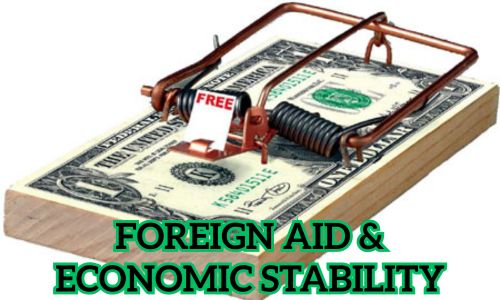
Foreign Aid and Economic Stability
ESSAY OUTLINE
1. Introduction
- Hook: Begin with a striking fact or paradox—for instance, that sub-Saharan Africa has received over $1 trillion in aid over decades yet remains home to many of the world’s poorest economies, while South Korea, once a major aid recipient, now stands as a donor nation.
- Define Key Terms:
- Foreign Aid: Official development assistance (ODA), including grants, concessional loans, technical assistance, and humanitarian aid provided by governments, multilateral institutions (IMF, World Bank), and private organizations.
- Economic Stability: A condition characterized by steady GDP growth, low inflation, manageable public debt, stable exchange rates, consistent employment levels, and resilience to external shocks.
- Contextualize the Debate: Present the long-standing ideological divide—modernization theorists argue aid provides crucial capital for development, while dependency theorists contend aid perpetuates underdevelopment through structural inequality and donor conditionality.
- Thesis Statement: Foreign aid does not guarantee economic stability and, in many cases, actively undermines it when disbursed without institutional safeguards, strategic alignment, or recipient ownership; however, aid can contribute meaningfully to stability when structured as targeted, time-bound, and conditionally linked to governance reforms and domestic resource mobilization.
2. The Case for Foreign Aid as a Stabilizing Force
- A. Filling Resource Gaps and Financing Development
- Aid supplements domestic savings and tax revenues in low-income countries facing capital shortages.
- Provides critical funding for infrastructure (roads, energy grids, telecommunications) that forms the backbone of economic activity.
- Example: The Marshall Plan (1948–1952) provided $13.3 billion to Western Europe, financing reconstruction and laying the foundation for decades of economic stability and integration.
- B. Stabilizing Balance of Payments and Currency
- Balance of payments support helps countries avoid currency crises during periods of fiscal stress or commodity price collapses.
- IMF programs, while controversial, have provided liquidity to prevent sovereign defaults in countries like Pakistan (2019, 2023) and Ghana (2015), offering breathing room for fiscal adjustment.
- Example: During the 1997 Asian Financial Crisis, IMF and World Bank assistance helped South Korea, Thailand, and Indonesia stabilize reserves and restructure debt, preventing deeper collapses.
- C. Supporting Social Sectors and Human Capital
- Aid funds health, education, and social safety nets that protect vulnerable populations during economic downturns.
- Investments in human capital enhance long-term productivity and labor market stability.
- Example: Global Fund and PEPFAR programs have transformed HIV/AIDS outcomes in sub-Saharan Africa, preserving workforce productivity and reducing the economic burden of disease.
- D. Catalyzing Policy Reforms and Institutional Strengthening
- Donors often attach conditionality that pushes recipient governments toward fiscal discipline, anti-corruption measures, and regulatory improvements.
- Technical assistance builds administrative capacity in finance ministries, central banks, and revenue authorities.
- Example: Rwanda’s post-genocide reconstruction benefited from coordinated donor support that strengthened governance institutions, contributing to two decades of sustained growth and relative stability.
3. The Case Against Foreign Aid as a Source of Instability
- A. The Resource Curse and Dutch Disease
- Large and unpredictable aid inflows cause real exchange rate appreciation, rendering export sectors uncompetitive.
- Creates “aid dependency” where governments prioritize donor relations over domestic accountability and tax collection.
- Evidence: Studies show that aid-dependent countries exhibit weaker revenue mobilization; for every $1 of aid, tax revenues often fall by $0.30 to $0.50.
- Example: Tanzania in the 1990s saw its manufacturing sector contract as aid-fueled currency appreciation undermined export competitiveness.
- B. Fiscal Profligacy and Moral Hazard
- Governments treat aid as free money, expanding recurrent expenditures without sustainable revenue sources.
- Creates moral hazard: governments take on risky policies knowing donors will provide bailouts.
- Example: In several West African nations, aid financed unsustainable civil service wage bills that later required painful IMF adjustment programs.
- C. Political Instability and Governance Distortions
- Aid flows empower incumbent governments, reducing their incentive to negotiate or build broad coalitions.
- In weak institutional environments, aid fuels patronage, corruption, and elite capture.
- Research: A meta-analysis by经济学家 finds that aid correlates with increased political violence in countries with weak institutions, as aid becomes a prize contested by armed groups.
- Example: In Afghanistan (2001–2021), over $100 billion in aid failed to produce a stable economy or state, with much of the funding fueling corruption, rent-seeking, and insurgent financing.
- D. Fragmentation and Donor Proliferation
- Multiple donors with competing priorities impose high transaction costs on recipient governments.
- Short-term project cycles (1–3 years) undermine long-term planning and institutional continuity.
- Example: In the early 2000s, Zambia faced over 300 separate donor missions annually, diverting senior civil servants from core governance functions to donor coordination.
- E. Volatility and Uncertainty
- Aid flows are highly volatile, fluctuating with donor budget cycles, geopolitical shifts, and changing development fashions.
- Volatile aid undermines fiscal planning and introduces exogenous shocks to national budgets.
- Data: OECD figures show that country-level aid volatility often exceeds revenue volatility, making aid a destabilizing rather than stabilizing fiscal input.
4. The Conditional Success: When and How Aid Contributes to Stability
- A. Institutional Quality Matters
- Aid works best in countries with strong institutions, rule of law, and accountable governance.
- Weak institutions absorb aid inefficiently or corruptly, rendering even well-intentioned assistance counterproductive.
- Evidence: The World Bank’s Assessing Aid report (1998) concluded that aid boosts growth only in countries with sound policies and institutions; elsewhere, its impact is negligible or negative.
- B. Strategic Alignment and Country Ownership
- Aid contributes to stability when it aligns with nationally defined priorities rather than donor agendas.
- The Paris Declaration on Aid Effectiveness (2005) emphasized ownership, alignment, harmonization, and mutual accountability.
- Example: Botswana’s successful development stemmed from strong governance and aid that reinforced—rather than supplanted—domestic institutions.
- C. Gradual Exit and Transition Planning
- Aid supports stability when structured with clear time horizons and transition strategies.
- Successful aid programs gradually shift from direct financing to technical support, and ultimately to domestic resource mobilization.
- Example: South Korea transitioned from heavy aid reliance in the 1950s and 1960s to self-sufficiency by the 1980s through a combination of strategic aid utilization and export-oriented industrialization.
- D. Targeted vs. Programmatic Aid
- Targeted aid for specific purposes (vaccination campaigns, infrastructure projects) often yields better outcomes than broad budgetary support in weak institutional environments.
- Project aid allows for more direct accountability and measurable results, though it carries coordination costs.
- Example: The eradication of smallpox (completed 1980) represents a case of targeted, time-bound aid that achieved a definitive outcome and then ceased.
- E. Complementarity with Domestic Revenue
- Aid contributes most effectively when it complements, rather than substitutes for, domestic revenue mobilization.
- Programs that strengthen tax administration and broaden tax bases create sustainable fiscal foundations.
- Example: Rwanda’s aid strategy explicitly linked donor support to progress on domestic revenue collection, which grew from 9% of GDP in 2000 to over 15% by 2020.
5. Alternative Perspectives and Evolving Aid Architecture
- A. The Rise of Emerging Donors and South-South Cooperation
- China, India, and Gulf states provide aid with different modalities—often no conditionality, infrastructure-focused, and tied to commercial interests.
- This challenges the traditional Western aid model and introduces new dynamics for recipient stability.
- Debate: Does Chinese infrastructure lending (e.g., Belt and Road Initiative) promote stability through asset creation, or does it risk debt distress and strategic dependency?
- B. The Shift to Climate Finance and Global Public Goods
- Contemporary aid increasingly targets climate adaptation, pandemic preparedness, and other global public goods.
- This shifts the calculus: such aid may stabilize global systems even if its impact on individual recipient economies is complex.
- Example: Climate finance for vulnerable nations (small island states, Bangladesh) may directly contribute to stability by mitigating existential threats.
- C. Aid vs. Trade and Private Capital Flows
- Many economists argue that trade liberalization, foreign direct investment, and remittances matter more for economic stability than aid.
- For middle-income countries, remittances now dwarf aid flows; for low-income countries, aid remains significant but declining relative to private capital.
- Data: Global remittances exceeded $800 billion in 2023, while ODA stood at approximately $220 billion.
6. Conclusion
- Restate Thesis (in new words): Foreign aid possesses no intrinsic power to secure or destabilize an economy; its effects depend entirely on the institutional context into which it flows, the strategic discipline with which donors disburse it, and the degree to which recipients integrate it into coherent national development strategies. We cannot judge aid as inherently good or bad—rather, we must evaluate it as a tool whose utility varies with the skill of its use.
- Summarize Key Points:
- Aid can stabilize by filling capital gaps, supporting social sectors, and catalyzing reforms—as demonstrated by the Marshall Plan and successful institutional strengthening cases.
- However, aid frequently destabilizes by creating dependency, distorting governance, fueling resource curse dynamics, and introducing fiscal volatility—evidenced by Afghanistan, parts of sub-Saharan Africa, and empirical meta-analyses.
- Success depends on institutional quality, country ownership, strategic targeting, and complementarity with domestic revenue mobilization.
- Concluding Thought: The future of aid must move beyond the ideological binary of “aid works” or “aid fails.” We must instead design aid as a transitional mechanism—one that strengthens domestic institutions, builds tax capacity, and creates conditions for its own obsolescence. For Pakistan and similarly situated nations, this means demanding aid that respects national priorities, imposes disciplined conditionality, and prioritizes building the fiscal and governance capacity that ultimately renders foreign assistance unnecessary. Only by treating aid as a means to its own end—self-reliance—can the international community ensure that today’s assistance contributes to tomorrow’s genuine economic stability.
ESSAY
A stark paradox defines the landscape of international development. Sub-Saharan Africa has received over one trillion dollars in foreign aid over the past six decades, yet the region still accounts for a disproportionate share of the world’s poorest economies, with fragile growth and persistent poverty. Contrast this trajectory with that of South Korea. In the 1950s, South Korea ranked among the world’s poorest nations, surviving on American aid. Today, it stands as a formidable donor nation, a member of the OECD Development Assistance Committee, and a global economic powerhouse. This divergence in outcomes forces a critical question: does foreign aid serve as a catalyst for prosperity or a subtle impediment to it?
This analysis rests on two core concepts. First, foreign aid refers specifically to Official Development Assistance (ODA)—the grants, concessional loans, technical assistance, and humanitarian aid that flow from high-income governments, multilateral institutions like the International Monetary Fund (IMF) and World Bank, and private philanthropic organizations. These resources aim to promote economic development and welfare. Second, economic stability constitutes more than just growth statistics. A stable economy exhibits steady GDP expansion, low and predictable inflation, manageable public debt that does not crowd out private investment, stable exchange rates that facilitate trade, consistent employment levels that provide household security, and sufficient resilience to withstand external shocks such as commodity price collapses or global financial crises.
A long-standing ideological divide shapes how we interpret aid’s impact. Modernization theorists argue that developing countries lack the capital necessary to break the cycle of poverty; they view foreign aid as a vital injection of resources that builds infrastructure, educates workers, and jumpstarts industrialization. In their view, aid bridges the gap between a nation’s present needs and its future takeoff. Dependency theorists, in contrast, offer a trenchant critique. They contend that aid perpetuates underdevelopment by creating structural inequality, enriching local elites who act as intermediaries for donor interests, and imposing policy conditionality that forces recipient nations to open markets or privatize industries in ways that serve foreign capital rather than local needs. For them, aid becomes a tool of neo-colonial control, not liberation.
Foreign aid does not guarantee economic stability; in fact, it actively undermines stability when disbursed without institutional safeguards, strategic alignment, or genuine recipient ownership. In such cases, unpredictable aid flows can fuel inflation, inflate exchange rates, encourage corruption, and create debilitating debt cycles. However, aid can contribute meaningfully to stability when actors structure it as targeted, time-bound interventions explicitly linked to governance reforms and domestic resource mobilization. When donors tie aid to strengthening tax systems, rooting out corruption, and building independent judiciaries—and when recipients lead the strategy—aid transitions from a potential liability to a powerful tool for building the self-sustaining economic foundations that underpin long-term stability.
Foreign aid directly fills critical resource gaps in low-income countries where domestic savings and tax revenues fall far short of investment needs. It provides the essential capital for large-scale infrastructure projects—such as roads, energy grids, and telecommunications networks—that form the backbone of economic activity and private sector growth. The Marshall Plan (1948–1952) exemplifies this principle: the United States channeled $13.3 billion to Western Europe, financing the physical reconstruction of war-torn economies. This infusion of resources did not merely rebuild factories and bridges; it laid the foundation for decades of economic stability, integration, and eventual prosperity across the continent.
When countries face fiscal stress or sudden collapses in commodity prices, aid provides crucial balance of payments support that helps stabilize national currencies and avert financial crises. International Monetary Fund (IMF) programs, despite their controversies, offer liquidity that prevents sovereign defaults, giving governments the necessary breathing room to implement fiscal adjustments without plunging their economies into chaos. For instance, IMF assistance packages for Pakistan in 2019 and 2023, and for Ghana in 2015, provided these nations with the foreign exchange reserves needed to stabilize their currencies and maintain essential imports. Similarly, during the 1997 Asian Financial Crisis, coordinated assistance from the IMF and the World Bank helped South Korea, Thailand, and Indonesia stabilize their depleted reserves, restructure unsustainable debt, and prevent a deeper regional economic collapse.
Aid strengthens social stability by funding health, education, and social safety nets that protect vulnerable populations, particularly during economic downturns. By investing in human capital—improving the health and skills of the workforce—aid enhances long-term productivity and ensures a more resilient labor market. Global health initiatives like the Global Fund and PEPFAR (the President’s Emergency Plan for AIDS Relief) demonstrate this impact clearly: these programs transformed HIV/AIDS outcomes in sub-Saharan Africa by providing antiretroviral treatment to millions. This intervention preserved workforce productivity, reduced the overwhelming economic burden of disease on families and health systems, and stabilized communities that had been devastated by the epidemic.
Donors leverage aid by attaching policy conditionality that encourages recipient governments to adopt fiscal discipline, implement anti-corruption measures, and pursue regulatory improvements. Beyond financial leverage, technical assistance builds the administrative capacity of core state institutions—such as finance ministries, central banks, and revenue authorities—enabling them to manage public resources more effectively and independently. Rwanda’s post-genocide reconstruction offers a compelling example: coordinated donor support did not just fund projects but actively strengthened governance institutions, from local administration to national financial oversight. This institution-building contributed directly to two decades of sustained economic growth and relative political stability, demonstrating how well-designed aid can catalyze lasting structural change.
Large and unpredictable aid inflows trigger Dutch Disease by driving real exchange rate appreciation. This appreciation directly renders a nation’s export sectors, such as agriculture and manufacturing, uncompetitive on global markets. Simultaneously, aid creates deep-seated “aid dependency,” prompting governments to prioritize donor relations over cultivating domestic accountability and robust tax collection. Studies demonstrate this dynamic clearly: for every $1 of aid received, tax revenues fall by $0.30 to $0.50, as states forego the politically difficult work of taxing their own citizens. Tanzania in the 1990s exemplifies this phenomenon, where a surge in aid-fueled currency appreciation led to a pronounced contraction of its manufacturing sector, effectively dismantling its nascent industrial base.
Governments frequently treat aid as free money, leading to fiscal profligacy where they expand recurrent expenditures—such as public sector wages and subsidies—without establishing sustainable domestic revenue sources to support them. This environment fosters moral hazard, as governments adopt risky economic policies or delay necessary reforms, secure in the knowledge that donors will provide bailouts to prevent state collapse. In several West African nations, for instance, aid directly financed unsustainable civil service wage bills. When these budgets inevitably proved untenable, these same governments required painful International Monetary Fund (IMF) adjustment programs that imposed austerity measures on the very populations the aid was meant to serve.
Aid flows empower incumbent governments by providing them with a steady stream of resources that reduces their incentive to negotiate with opposition groups or build broad-based political coalitions. In environments with weak institutional safeguards, this influx fuels patronage networks, systemic corruption, and elite capture, where a small ruling class diverts resources for personal gain. A meta-analysis by Economist finds that aid correlates with increased political violence in weak institutional settings, as the influx of external resources transforms the state itself into a prize contested by armed groups. Afghanistan from 2001 to 2021 provides a stark example: over $100 billion in aid failed to build a stable economy or state, instead fueling endemic corruption, rent-seeking behavior, and even indirectly financing insurgent networks that undermined the government.
A fragmented landscape of multiple donors, each pursuing competing priorities and imposing distinct reporting requirements, imposes high transaction costs that overwhelm recipient governments. Short-term project cycles, typically lasting only one to three years, actively undermine long-term planning, institutional continuity, and the development of a stable civil service. In the early 2000s, Zambia faced over 300 separate donor missions annually. This proliferation diverted senior civil servants from core governance functions like policy formulation and service delivery, forcing them to spend countless hours instead managing donor relations, completing disparate reports, and attending coordination meetings that yielded little sustainable progress.
Aid flows are highly volatile, fluctuating unpredictably with donor budget cycles, shifts in geopolitical priorities, and changing development fashions in donor capitals. This volatility undermines fiscal planning, introducing exogenous shocks that destabilize national budgets beyond the control of recipient governments. OECD data confirms that country-level aid volatility frequently exceeds revenue volatility, meaning that aid often serves as a destabilizing fiscal input rather than a reliable, stabilizing one. Instead of smoothing economic fluctuations, unpredictable aid forces governments to make sudden, disruptive cuts to capital investments or essential services when flows decrease, and to engage in wasteful spending when flows unexpectedly surge.
Strong institutions form the bedrock for effective aid. Countries with robust rule of law, accountable governance, and transparent public financial management systems absorb assistance productively, channeling resources toward their intended developmental goals. In such environments, governments possess the capacity to coordinate complex programs, enforce contracts, and maintain the political stability necessary for long-term planning. Conversely, weak institutions absorb aid inefficiently or corruptly. When governance structures fracture along ethnic or factional lines, or when officials lack accountability, even well-intentioned assistance can become counterproductive. It can fuel rent-seeking, entrench unaccountable elites, and inadvertently exacerbate the very conflicts it aims to resolve. The World Bank’s seminal Assessing Aid report (1998) conclusively demonstrated this conditional reality: aid boosts economic growth only in countries with sound policies and institutions; elsewhere, its impact proves negligible or negative, confirming that institutional quality is not merely a backdrop but the primary determinant of aid effectiveness.
Aid contributes to long-term stability when it aligns with nationally defined priorities rather than imposing external donor agendas. We actively promote this principle through genuine country ownership, where partner governments lead the development process, set their own strategies, and coordinate donor activities. The Paris Declaration on Aid Effectiveness (2005) codified this approach, emphasizing ownership, alignment, harmonization, and mutual accountability as essential pillars. When donors bypass national systems or pursue fragmented, short-term projects that reflect their own foreign policy interests, they undermine state sovereignty and create parallel structures that weaken domestic institutions. Botswana’s successful development trajectory exemplifies the power of this approach. The government leveraged aid to reinforce—rather than supplant—its own accountable institutions and sound governance frameworks, ensuring that external resources supported a cohesive, nationally owned vision rather than a disjointed collection of donor priorities.
Aid supports stability most effectively when we structure it with clear time horizons and deliberate transition strategies. Rather than creating indefinite dependency, successful aid programs gradually shift from direct financing for core services to technical assistance and capacity-building, culminating in a focus on domestic resource mobilization. This planned exit incentivizes governments to assume fiscal responsibility and build sustainable systems. South Korea’s transformation from a major aid recipient in the 1950s and 1960s to an OECD donor by the 1990s illustrates this principle. Seoul strategically utilized foreign assistance to invest in education, infrastructure, and export-oriented industrialization while simultaneously maintaining a clear national vision for self-sufficiency. A gradual, predictable withdrawal of aid allowed South Korean institutions to mature and fill the financing gap, turning a recipient nation into a development partner.
In weak institutional environments, targeted aid for specific, time-bound purposes often yields better outcomes than broad budgetary support. Project aid, focused on discrete objectives such as vaccination campaigns or infrastructure construction, allows us to establish direct accountability, monitor measurable results, and minimize the risk of resource diversion through weak public financial systems. While this approach carries higher coordination costs and can fragment national planning, it provides a safer mechanism for delivering assistance where governance capacity is limited. The global eradication of smallpox, completed in 1980, stands as a definitive example of targeted aid. A focused coalition of donors and national governments pursued a single, technically feasible goal with a clear endpoint. The campaign achieved a permanent global public good and then ceased, demonstrating how narrowly defined, time-bound interventions can deliver transformative results without creating long-term dependency.
Aid contributes most effectively when it complements, rather than substitutes for, domestic revenue mobilization. We strengthen this complementarity by designing programs that build a country’s own fiscal capacity, reinforcing the social contract between the state and its citizens. When aid substitutes for domestic taxation, it can weaken government accountability to its populace. Conversely, programs that strengthen tax administration, broaden tax bases, and professionalize revenue authorities create sustainable fiscal foundations that outlast donor engagement. Rwanda’s aid strategy explicitly linked donor support to progress on domestic revenue collection. The government, with coordinated donor backing, invested in modernizing its revenue authority and expanding the tax net. This approach produced tangible results: domestic revenue grew from just 9% of GDP in 2000 to over 15% by 2020, allowing Rwanda to finance its own priorities, reduce aid dependency, and solidify the state’s legitimacy through effective service delivery funded by its own citizens.
Emerging donors like China, India, and Gulf states fundamentally reshape the aid landscape by offering a starkly different model of development cooperation. They provide financing with modalities that diverge sharply from traditional Western approaches: they attach no political conditionality regarding governance or human rights reforms, focus heavily on large-scale infrastructure projects like ports and highways rather than social sectors, and often tie their assistance directly to their own commercial interests, such as requiring the use of Chinese state-owned construction firms. This approach challenges the Western-led aid architecture by offering recipient nations a genuine alternative—one that prioritizes sovereignty and rapid physical transformation over policy prescriptions. This dynamic introduces new complexities for recipient stability. On one hand, Chinese infrastructure lending, exemplified by the Belt and Road Initiative, promotes stability by creating critical assets, spurring economic activity, and enhancing a government’s ability to deliver visible services. On the other hand, it risks destabilizing nations through unsustainable debt distress, creating opaque repayment obligations that can lead to strategic dependency and, in extreme cases, force recipients to cede control over strategic assets or foreign policy.
Contemporary aid is undergoing a fundamental shift in purpose, moving beyond a narrow focus on poverty reduction in individual countries to target global public goods like climate adaptation, pandemic preparedness, and biodiversity conservation. This transition fundamentally alters the calculus of aid’s effectiveness; donors now invest in these areas because stabilizing global systems—such as preventing the next pandemic or mitigating climate tipping points—serves collective international security, even when the direct impact on a single recipient’s economy remains complex or difficult to measure. For example, climate finance for vulnerable nations, such as small island states facing sea-level rise or Bangladesh confronting increased cyclone intensity, directly contributes to political and social stability. By funding seawalls, resilient infrastructure, and early-warning systems, donors help mitigate existential threats that could otherwise displace populations, trigger resource conflicts, and overwhelm state capacity. In this context, aid acts not merely as development assistance but as a strategic investment in preventing cross-border crises.
Many economists argue that focusing solely on official development assistance (ODA) overlooks the far more potent drivers of economic stability: trade liberalization, foreign direct investment (FDI), and remittances. These private and commercial flows often dwarf aid and exert a more direct influence on a country’s fiscal health, employment rates, and resilience to shocks. For middle-income countries, remittances now serve as the dominant stabilizing force; they provide a reliable, counter-cyclical source of household income that continues to flow even during domestic recessions, directly reducing poverty and smoothing consumption. For low-income countries, while aid remains a significant share of government budgets, its relative importance is declining as private capital increasingly seeks out new markets. Global data underscores this shift: in 2023, remittances to low- and middle-income countries exceeded $800 billion, a massive sum compared to the approximately $220 billion total ODA. This reality forces a reconceptualization of the aid architecture—moving from seeing aid as the primary lever for stability to viewing it as a catalytic tool that can de-risk private investment, enhance the development impact of remittances, and help countries integrate more effectively into the global trading system.
We restate our core argument: foreign aid possesses no intrinsic power to either secure or destabilize an economy. We cannot judge aid as inherently good or evil. Instead, its effects depend entirely on three factors: the institutional context into which it flows, the strategic discipline with which donors disburse it, and the degree to which recipients integrate it into coherent national development strategies. We must evaluate aid not as a moral statement but as a tool—a tool whose utility varies directly with the skill of its use.
Aid can stabilize an economy when wielded with precision. It fills critical capital gaps, allowing nations to invest in infrastructure and productivity without resorting to destabilizing debt. It supports social sectors, creating a healthier, more educated workforce that forms the bedrock of long-term growth. In its most effective form, aid catalyzes reforms; the Marshall Plan exemplifies this, providing not just funds but a framework for European integration and industrial renewal. Similarly, successful institutional strengthening programs show how targeted assistance can build the very entities—independent judiciaries, transparent treasuries—that eventually manage resources without external help.
However, aid frequently destabilizes when it flows without regard for local realities. It creates dependency, as routine infusions of cash allow governments to postpone the difficult work of building a robust tax base. It distorts governance, as leaders become more accountable to foreign donors than to their own citizens, weakening the social contract. In resource-rich yet fragile states, aid can fuel the resource curse, exacerbating corruption and conflict over windfall revenues. Empirical meta-analyses confirm this volatility, pointing to cases like Afghanistan, where a flood of aid created a parallel economy susceptible to capture, and parts of sub-Saharan Africa, where aid’s unpredictability hampered, rather than helped, fiscal planning. In these contexts, aid does not stabilize; it introduces a new form of economic shock.
The difference between these outcomes lies in a few critical determinants. Success requires institutional quality—strong, pre-existing systems capable of absorbing and managing funds effectively. It demands country ownership, where recipient nations, not donors, set the strategic agenda. Donors must practice strategic targeting, concentrating resources on specific, measurable objectives like vaccine delivery or agricultural yield rather than dispersing funds across vague sectors. Finally, aid must complement, not replace, domestic revenue mobilization. When aid supports a country’s own efforts to collect taxes, it builds the fiscal capacity that will ultimately sustain the state.
The future of aid, therefore, demands we move decisively beyond the ideological binary of “aid works” or “aid fails.” We must redesign aid as a transitional mechanism—one that actively strengthens domestic institutions, builds tax capacity, and deliberately creates the conditions for its own obsolescence. For Pakistan and similarly situated nations, this means demanding a new paradigm. It calls for aid that respects national priorities, shifting the balance of power from donor capitals to local ministries. It requires disciplined conditionality that focuses on institutional milestones—such as expanding the tax net or digitizing land records—rather than on ideological prescriptions. Most crucially, it means prioritizing the building of fiscal and governance capacity, rendering foreign assistance unnecessary. Only by treating aid as a means to its own end—the ultimate goal of self-reliance—can the international community ensure that today’s assistance contributes to tomorrow’s genuine economic stability.











LEAVE A COMMENT