
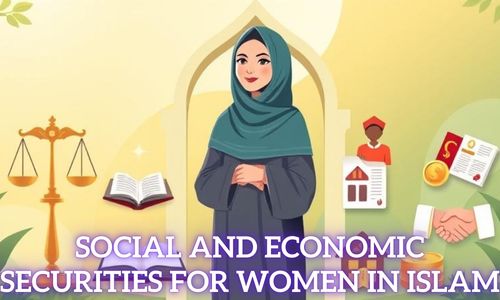
Social and Economic Securities for Women in Islam
ESSAY OUTLINE
1. Introduction
- Opening statement: Women’s rights have been debated globally, but Islam laid down clear principles of social and economic security over 1400 years ago.
- Context: Pre-Islamic Arabia deprived women of dignity, inheritance, and status; Islam revolutionized their position.
- Thesis statement: Islam provides women with profound social and economic securities through laws, moral values, and rights that safeguard dignity, financial independence, and societal respect.
2. Social Securities for Women in Islam
- Right to Dignity and Respect
- Qur’an: Women created as equal partners in humanity.
- Protection from exploitation and abuse.
- Right to Education
- Obligation of knowledge applies to both men and women.
- Women scholars in Islamic history (e.g., Aisha bint Abu Bakr).
- Marriage as a Social Security
- Marriage as a contract, not bondage.
- Consent of the woman is obligatory.
- Right to mahr (dowry as a gift, not price).
- Protection in Family Life
- Role of men as maintainers and protectors (Qur’an 4:34).
- Motherhood honored with highest social status.
3. Economic Securities for Women in Islam
- Right to Inheritance
- Guaranteed share in inheritance (Qur’an 4:7).
- Revolutionary compared to pre-Islamic customs.
- Right to Property and Wealth
- Women can own, buy, and sell property independently.
- No obligation to spend on household expenses.
- Financial Independence
- Right to mahr as her exclusive wealth.
- Earnings from work or business belong solely to her.
- Right to Work and Business
- Permitted within ethical and moral boundaries.
- Historical examples: Khadijah (RA) as a successful businesswoman.
4. Comparative Perspective
- Pre-Islamic Arabia: Women treated as property; no inheritance, no consent in marriage.
- Modern Context: Some Muslim societies deprive women due to cultural practices, not Islamic teachings.
- Contrast: Islam guaranteed rights centuries before Western legal reforms.
5. Challenges in Implementation
- Misinterpretation of religious texts.
- Cultural traditions overshadowing Islamic rights.
- Lack of awareness among women about their rights.
- Socio-economic barriers in conservative societies.
6. Conclusion
- Restate thesis: Islam ensures comprehensive social and economic securities for women that protect their dignity, independence, and role in society.
- Call to action: Need to revive true Islamic principles, educate communities, and implement these rights in practice.
- Final thought: A society cannot prosper unless it safeguards the rights and securities of women as enshrined in Islam.
ESSAY
The debate about women’s rights and their place in society is a global conversation. While many modern societies have only recently begun to codify these rights, Islam provided a clear set of principles for women’s social and economic security. Islam’s teachings on this matter are foundational, addressing rights related to marriage, inheritance, education, and financial independence. The religion’s principles establish a comprehensive system to protect women’s dignity and well-being.
Before the arrival of Islam, the society of pre-Islamic Arabia was harsh for women. People often denied them basic dignity; they were treated as property rather than human beings. Families often saw daughters as a burden, and some even practiced female infanticide. Women had no rights to inheritance and could not own property. Their status was low, and they were entirely dependent on men. Islam directly challenged this social structure by abolishing these practices and introducing a new legal and moral code that elevated women’s position in society.
Islam provides women with profound social and economic securities through a series of laws, moral values, and rights. These protections safeguard their dignity, financial independence, and societal respect. The laws on marriage and divorce ensure their safety and well-being, while laws on inheritance and property ownership guarantee their economic autonomy. Islam also promotes moral values that command respect for women, ensuring their place as essential and honored members of society. This comprehensive approach ensures a holistic protection of women’s rights within the Islamic framework.
The Quran establishes that women are created as equal partners in humanity with men. It explicitly states that both men and women come from a single soul, deserving equal respect and honor. This principle provides a strong foundation for their dignity, protecting them from exploitation and abuse. Islam’s teachings prohibit any form of physical, emotional, or verbal harm against women, creating a moral and legal framework that commands their respect.
Islam makes the pursuit of knowledge an obligation for both men and women. Prophet Muhammad (peace be upon him) said, “Seeking knowledge is an obligation upon every Muslim man and woman.” This powerful statement ensures that women have an unalienable right to education. Throughout history, women became prominent scholars, poets, and jurists. For example, Aisha bint Abu Bakr, the Prophet’s wife, was a renowned scholar who taught many companions and later generations. This historical tradition shows how Islam encouraged women’s intellectual growth.
Islam views marriage as a contract, not as a form of bondage. This contract elevates a woman’s status and provides her with legal rights. Her consent is obligatory, meaning she cannot be forced into a marriage against her will. This fundamental right ensures her autonomy. Furthermore, the husband must provide a mahr (dowry), which is a financial gift for the bride alone. This mahr is her personal property and serves as a form of economic security, distinguishing the Islamic marriage from systems where a woman is considered property.
Within the family, Islam assigns men the role of maintainers and protectors. The Quran states, “Men are the maintainers and protectors of women, because Allah has made one of them to excel the other, and because they spend (on women) from their means” (Quran 4:34). This verse places the financial responsibility and protection of women on men, freeing women from the burden of providing for the household. Islam also gives motherhood the highest social status. The Prophet said, “Paradise lies under the feet of mothers,” a profound statement that honors mothers and commands the utmost respect for them within the family and society.
The Quran grants women a guaranteed share in inheritance from their parents and spouses (Quran 4:7). This provision was revolutionary compared to the pre-Islamic customs of Arabia, which completely deprived women of any inheritance rights. While a son’s share is typically double a daughter’s share, this reflects the male’s financial responsibility for the household. Islam ensures that women receive a share that is rightfully theirs, providing a form of long-term economic security.
Islam grants women full control over their own property and earnings. A woman has the right to own, buy, and sell property independently, without a man’s permission. She is also not obligated to spend any of her own wealth on household expenses. This makes her financially independent from her husband or family.
Islam provides women with true financial independence. The mahr, or dowry, is her exclusive wealth. She can use this money as she pleases, and no one has a claim to it. Furthermore, any earnings from work or business belong solely to her. This right ensures that a woman’s financial status is protected and she has full control over her assets, regardless of her marital status.
Islam permits women to work and engage in business as long as they do so within ethical and moral boundaries. Islamic history provides compelling examples of women who were active in the marketplace. For instance, Khadijah bint Khuwaylid, the first wife of Prophet Muhammad (peace be upon him), was a highly successful and respected businesswoman who managed her own caravans and trade before her marriage. Her example demonstrates that Islam has always supported women’s right to pursue financial ventures and careers.
Before Islam, the culture of pre-Islamic Arabia was deeply discriminatory toward women. People treated women as property, not as individuals with rights. Families saw the birth of a daughter as a source of shame and a financial burden. Women had no right to inheritance and were entirely at the mercy of their male relatives. Men could marry women without their consent, and women had no right to divorce. The arrival of Islam completely abolished these customs and provided women with legal and social protections.
While Islam’s teachings are clear on women’s rights, some modern Muslim societies often fail to uphold these principles due to cultural practices, not because of Islamic law. These societies may adopt customs that deny women their right to inheritance, education, or free will in marriage. These practices often stem from tribal traditions or patriarchal norms that conflict with the Quran and the teachings of the Prophet Muhammad (peace be upon him). For instance, in some places, women are still denied their rightful share of inheritance, even though Islamic law explicitly grants it to them.
It’s important to recognize that Islam guaranteed rights for women centuries before Western legal reforms. While European societies in the Middle Ages and early modern period often denied women property rights and financial independence, Islam had already established these protections. For example, the right of a married woman to own her own property and income was a core Islamic principle since the 7th century, while many Western nations only gave women similar rights in the 19th and 20th centuries. This historical context highlights the truly revolutionary nature of Islam’s framework for women’s social and economic security.
People often misinterpret religious texts to justify patriarchal traditions and suppress women’s rights. They may take certain verses or hadiths out of context, or they may apply a narrow, rigid interpretation that favors men. These misinterpretations lead to practices that are not supported by the core principles of Islam, such as denying women education or the right to work. This can create a false religious justification for practices that are, in fact, culturally driven.
In many societies, deeply ingrained cultural traditions overshadow Islamic rights. These traditions often predate Islam and promote patriarchal norms. For example, some communities continue to practice customs that deny women their right to inheritance or force them into marriage against their will, even though Islam explicitly prohibits these actions. These cultural norms are powerful, and they can make it difficult for women to assert the rights that Islam gives them.
Many women, particularly in conservative societies, simply lack awareness about their own rights. They may not have access to a proper religious education and instead learn about their rights through cultural or familial traditions that are often distorted. This lack of knowledge makes them vulnerable to exploitation and prevents them from challenging unjust practices. Empowering women through education is a crucial step to help them claim the rights that Islam has already granted them.
Women in some conservative societies face significant socio-economic barriers that limit their freedom and autonomy. These barriers include a lack of access to education, limited job opportunities, and little or no control over their finances. Even if a woman knows her rights, she may be unable to exercise them due to financial dependency on a male relative or societal pressure. These systemic issues must be addressed to ensure that women can fully enjoy the social and economic securities that Islam provides.
Islam provides a comprehensive system of social and economic securities for women that safeguard their dignity, independence, and vital role in society. The religion grants women specific rights to inheritance, property ownership, and financial independence, which were revolutionary at their time. Socially, Islam protects women by guaranteeing their right to an education, giving them autonomy in marriage, and commanding respect for their role as mothers and partners. These principles form a holistic and just system.
We need to actively revive true Islamic principles by distinguishing them from cultural practices that unjustly restrict women. This requires a strong effort to educate communities, especially women themselves, about the rights Islam gives them. By promoting this knowledge, people can challenge cultural traditions that conflict with Islamic law. The ultimate goal is to implement these rights in practice, ensuring that women can fully exercise their rights to education, work, and financial autonomy, as enshrined in the Quran and the Sunnah of the Prophet.
A society cannot prosper unless it safeguards the rights and securities of women as Islam has ordained. A society that restricts women’s potential in education and the economy holds itself back. When women are empowered, they contribute to the prosperity of their families and their nation. Upholding the rights of women is not just a matter of justice; it’s a foundation for a healthy, balanced, and thriving society.












LEAVE A COMMENT