
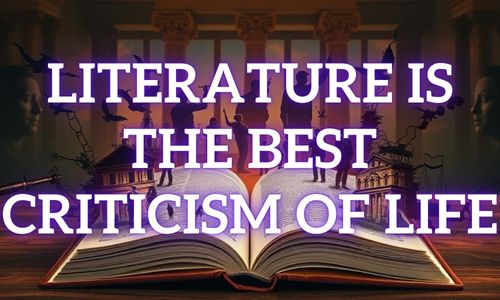
Literature is the Best Criticism of Life
ESSAY OUTLINE
1: Introduction
- Opening statement: Literature reflects the human experience in all its complexity.
- Thesis statement: Literature serves as the best criticism of life by offering deep insight into human nature, challenging societal norms, and portraying the emotional, moral, and philosophical struggles of existence.
2: Understanding the Quote
- Origin of the quote: Matthew Arnold, a 19th-century poet and critic.
- Interpretation: Literature does not merely entertain—it evaluates, questions, and reflects upon life and its values.
- Meaning of “criticism of life”: A thoughtful examination and interpretation of human experience.
3: Literature as a Mirror to Human Nature
- Character portrayal: Complex, relatable characters that mirror real emotions and conflicts.
- Examples:
- Hamlet by Shakespeare – inner conflict and existential questions.
- Anna Karenina by Tolstoy – personal vs. societal expectations.
4: Literature as a Social Critique
- Challenging norms and injustices: Writers often highlight social inequalities and hypocrisies.
- Examples:
- 1984 by George Orwell – critique of totalitarianism.
- The God of Small Things by Arundhati Roy – caste, gender, and class commentary.
5: Literature and Moral Philosophy
- Exploring ethical dilemmas: Literature examines good vs. evil, right vs. wrong.
- Examples:
- To Kill a Mockingbird by Harper Lee – racial injustice and moral courage.
- Crime and Punishment by Dostoevsky – guilt, redemption, and moral consequence.
6: Literature as a Personal and Emotional Criticism
- Empathy and emotional resonance: Literature helps readers understand their own lives and those of others.
- Examples:
- Poetry of Sylvia Plath – mental health and identity.
- The Diary of Anne Frank – resilience and hope amid tragedy.
7: Comparison with Other Forms of Criticism
- Philosophy, history, journalism: All examine life, but literature uniquely combines facts with feeling, imagination, and artistic expression.
- Unique power of storytelling: More immersive and impactful.
8: Conclusion
- Restate thesis: Through its exploration of human nature, society, and values, literature remains the most profound and enduring form of life’s criticism.
- Final thought: As long as humans seek to understand life, literature will continue to offer its richest, most nuanced reflections.
ESSAY
Writers across time have used literature to express the joys, sorrows, hopes, and fears that define the human journey. Through stories, poems, and plays, authors capture the nuances of everyday life and the extraordinary moments that shape individuals and societies. Literature does not shy away from portraying the raw truth—it actively engages with the full spectrum of emotions and situations that humans encounter.
Authors craft narratives that peel back the layers of human behavior, revealing what motivates people and how they interact with the world around them. They expose injustice, question tradition, and give voice to those often unheard. Through characters and plots, they actively explore life’s ethical dilemmas, spiritual conflicts, and personal battles. By doing so, literature not only entertains but also thoughtfully critiques the world we live in, making it the most profound and lasting form of life’s criticism.
Matthew Arnold, a prominent literary figure in the 19th century, coined the phrase “literature is the best criticism of life.” He emphasized the moral and reflective role of literature in his essays and poetry. He believed that great literature doesn’t just entertain—it teaches and elevates. Through his works, Arnold actively championed the idea that literature must engage with life’s deepest truths.
Writers use literature as a mirror to examine the world. They raise questions about morality, justice, love, power, and human suffering. Rather than offering easy answers, literature provokes thought. It challenges readers to see beyond surface appearances and encourages them to think critically about society and themselves. Authors deliberately craft stories that make readers evaluate the values they hold.
When authors write, they don’t just recount events—they interpret them. They highlight flaws in societal systems, reveal internal conflicts within individuals, and offer new perspectives on common struggles. By doing so, they critique the world—not with harsh judgment, but with insight and empathy. Literature actively questions what it means to live a good life, to love, to lose, and to seek truth.
Writers create characters who think, feel, and struggle like real people. They intentionally design these characters to reflect the emotional depth and psychological complexity of human beings. Through these portrayals, literature captures the contradictions, fears, and desires that define human nature. Authors allow readers to connect with characters by making them flawed, uncertain, and emotionally rich, just like people in real life.
Shakespeare crafts Hamlet as a deeply introspective character who grapples with the moral weight of revenge, justice, and the meaning of life. Hamlet famously asks, “To be or not to be,” a question that reflects the universal human struggle with purpose and existence. Shakespeare uses Hamlet’s soliloquies to explore guilt, indecision, and philosophical doubt, showing how human beings wrestle with their own conscience and mortality.
Tolstoy brings Anna Karenina to life as a passionate woman trapped in a rigid society. He shows how Anna’s desire for personal happiness clashes with the expectations and judgment of Russian aristocracy. Tolstoy uses Anna’s emotional turmoil and eventual downfall to critique the double standards in society, especially regarding gender and morality. He allows readers to witness the psychological cost of defying societal norms.
Authors use literature to challenge the status quo and expose societal flaws. They give voice to the marginalized, question authority, and reveal injustices that people might otherwise ignore. By creating narratives that confront power structures and cultural taboos, writers push readers to reflect on their own beliefs and values. They compel society to confront uncomfortable truths and reconsider what is accepted as “normal.”
Orwell constructs a dystopian world where a totalitarian regime controls every aspect of life. He exposes how propaganda, surveillance, and fear can silence dissent and strip individuals of their freedom. Orwell uses the character of Winston Smith to show how oppressive governments manipulate truth and crush resistance. He forces readers to question authority and the cost of blind obedience.
Arundhati Roy paints a vivid picture of life in India through the lens of caste, gender, and class oppression. She challenges deeply entrenched social hierarchies by portraying how they destroy lives and relationships. Roy gives her characters voices that resist silence and invisibility. She confronts the cruelty of cultural norms that restrict love, justice, and identity.
Writers actively explore ethical complexities through storytelling. They create situations where characters must confront moral choices and deal with the consequences of their actions. By doing so, authors challenge readers to reflect on their own sense of justice, compassion, and personal responsibility. Literature doesn’t preach—it poses questions, sparks debate, and reveals the moral tensions that shape human lives.
Harper Lee presents a powerful narrative that tackles racism and moral integrity in the American South. She uses the character of Atticus Finch to exemplify moral courage as he defends a Black man wrongly accused of a crime. Through Scout’s innocent yet observant eyes, Lee exposes the deep-rooted prejudices of society. She encourages readers to stand up for justice, even when the odds are against them.
Dostoevsky delves deep into the psychological and ethical torment of his protagonist, Raskolnikov, who commits a murder believing he can justify it for a greater good. The author forces Raskolnikov—and the reader—to grapple with guilt, suffering, and the path to redemption. He doesn’t offer easy answers but insists on confronting the full weight of moral choices.
Writers use literature to evoke deep emotions and build connections between readers and characters. They give voice to inner struggles, joys, fears, and dreams, allowing readers to recognize aspects of themselves in the text. By sharing intimate thoughts and experiences, authors help readers develop empathy for others and gain insight into the emotional complexities of life. Literature speaks to the heart as much as the mind, making personal pain, love, loss, and growth universally accessible.
Sylvia Plath explores the raw dimensions of psychological pain and personal identity in her poetry. She vividly expresses emotions of alienation, depression, and the search for meaning through rich, confessional verse. Her poems such as “Lady Lazarus” and “Daddy” allow readers to witness her inner battles and reflect on their own vulnerabilities. Through her work, Plath confronts taboos around mental health and opens up deeply personal experiences to public understanding.
Anne Frank captures the emotional world of a young girl hiding from Nazi persecution during World War II. She writes with honesty, clarity, and remarkable maturity, documenting not just the horrors around her but also her inner world—her fears, dreams, frustrations, and hopes. Through her words, readers feel the emotional weight of injustice and find inspiration in her resilience. Anne’s diary allows readers to connect personally with the broader tragedy of war and oppression through the lens of a single, poignant life.
Philosophers analyze life through logic and reason. Historians document events and interpret patterns from the past. Journalists report on current affairs and highlight pressing social and political issues. While these disciplines examine human life, they often rely on facts, arguments, and objectivity. In contrast, literary writers craft stories that weave together reality and imagination. They use metaphor, symbolism, and emotional depth to explore human experience in a more nuanced and personal way. Writers breathe life into abstract ideas, allowing readers to feel the truth rather than simply understand it intellectually.
Authors use storytelling to draw readers into the worlds they create. They build characters, settings, and plots that captivate the imagination and evoke empathy. By immersing readers in lived experiences—real or fictional—writers provoke reflection and emotional engagement that few other forms of criticism can achieve. While a news article may inform and a philosophical essay may argue, a novel or poem can transport, transform, and touch the soul. Literature turns criticism into a lived journey, making its impact longer lasting and more profound.
Literary works examine the human condition in ways that no other form of expression can replicate. Writers give voice to the unspoken emotions, moral dilemmas, and social conflicts that define our lives. They explore identity, suffering, love, injustice, and hope—not with detached analysis, but with intimate depth and artistic honesty. By presenting complex characters, rich narratives, and symbolic language, authors allow readers to confront reality from multiple perspectives. Through this process, literature critiques life not only by highlighting its flaws, but also by celebrating its beauty and resilience.
Readers will always turn to literature when they want to understand themselves and others more deeply. As long as people face existential questions, grapple with morality, or long for connection, authors will write stories and poems that mirror those experiences. Literature will continue to evolve, but it will never lose its place as the most vibrant, emotional, and thought-provoking lens through which we can examine the meaning of life.










LEAVE A COMMENT