
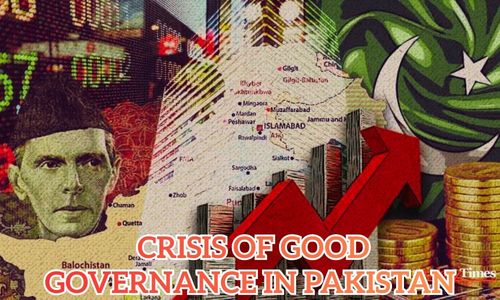
Crisis of good governance in Pakistan
ESSAY OUTLINE
1. Introduction
- Hook: Begin with a stark reality: despite possessing significant geopolitical importance, a youthful population, and abundant natural resources, Pakistan consistently underperforms on global indices for human development, economic stability, and corruption perception, pointing to a fundamental failure of governance.
- Definition of Good Governance: Briefly define the concept using established principles such as accountability, transparency, rule of law, responsiveness, and consensus-orientation (e.g., as outlined by the UN or World Bank).
- Thesis Statement: Pakistan’s persistent crisis of good governance stems not from a lack of policies or plans, but from a deep-seated structural decay of its core institutions, which remain politicized, over-centralized, and unaccountable; therefore, sustainable recovery demands a paradigm shift from personality-driven politics to systematic, merit-based institution building that guarantees the rule of law and devolves power.
2. The Manifestations of the Governance Crisis
- A. Economic Instability and Mismanagement:
- Recurring balance of payments crises and reliance on IMF bailouts.
- Poor tax-to-GDP ratio (one of the lowest in the world) due to a narrow, regressive tax base that exempts elite sectors.
- Unsustainable circular debt in the energy sector, crippling industry and everyday life.
- B. Erosion of the Rule of Law and Judicial Inefficiency:
- Massive backlog of cases in the judiciary, leading to delayed justice and a culture of impunity.
- Selective application of law, where influence and political affiliation determine legal outcomes.
- Lack of police reforms, leaving the police force politicized, under-resourced, and often viewed as an instrument of oppression rather than protection.
- C. Political Instability and Institutional Overreach:
- A history of extra-constitutional interventions (martial laws, judicial confrontations) that have stunted democratic maturation.
- The concentration of power in the federal executive, with frequent conflicts between the state’s pillars (executive, judiciary, legislature).
- Weak political parties with internal undemocratic structures, prioritizing family dynasties over public service.
- D. Deterioration of Public Service Delivery:
- Failure of the education sector (high out-of-school children, poor quality) and healthcare system (underfunded, inaccessible).
- Rapid urban decay, with unplanned urbanization and a lack of basic civic amenities like clean water and sanitation in major cities.
3. The Root Causes: Analyzing the Failure of Governance
- A. The Politicization of Bureaucracy and Institutions:
- Argue that the once-esteemed civil service has been systematically politicized through frequent transfers, postings based on loyalty, and the creation of parallel administrative structures (e.g., “Task Forces” led by political appointees).
- Discuss how key institutions (like the Federal Board of Revenue) have been weakened by political interference in appointments and policy.
- B. Over-Centralization and Denial of Local Governance:
- Explain how the absence of a genuine local government system undermines good governance.
- Despite constitutional provisions (Article 140-A), provinces have repeatedly failed to devolve power to the local level, concentrating administrative and fiscal authority in provincial capitals far removed from citizens’ needs.
- C. The Nexus of Power, Elites, and Corruption:
- Analyze how a symbiotic relationship between political elites, wealthy industrialists, and a complicit bureaucracy creates a system of rent-seeking.
- Show how this nexus undermines accountability and ensures that public resources serve private interests rather than public good.
- D. Inconsistent Policy Formulation and Implementation:
- Highlight the lack of continuity in policies, where every new government scraps the previous one’s initiatives (e.g., in energy, economy, and foreign policy) for political revenge rather than national interest.
- Contrast the frequent launch of ambitious, headline-grabbing projects with the consistent failure to complete them or ensure their sustainability.
4. The Need for Reforms and Institution Building
- A. Judicial and Police Reforms as the Foundation of Rule of Law:
- Police: Propose the urgent implementation of the Police Order 2002 (or a similar model) to insulate the police from political pressure, establish independent complaint authorities, and professionalize the force.
- Judiciary: Advocate for increasing the number of judges, establishing separate commercial and family courts to reduce the backlog, and ensuring a transparent, merit-based process for judicial appointments.
- B. Civil Service Reforms:
- Call for the establishment of a truly autonomous Civil Service Commission to oversee recruitment, training, and, most critically, postings and transfers.
- Recommend creating specialization tracks within the civil service (e.g., for finance, education, infrastructure) to build expertise and end the current system of generalists being shuffled across unrelated domains.
- C. Devolution and Strengthening Local Government:
- Argue for the immediate and irreversible implementation of the 18th Amendment’s spirit by holding provincial governments accountable for devolving full political and financial autonomy to district governments (zila councils, etc.).
- Stress that local governments must have control over their finances and local police to be truly responsive to citizens.
- D. Economic Governance and Fiscal Reforms:
- Focus on the need for an autonomous and empowered Federal Board of Revenue (FBR) to broaden the tax base and implement progressive taxation without political interference.
- Propose structural reforms in state-owned enterprises (SOEs) to end their dependence on the national exchequer.
- E. Strengthening Accountability Mechanisms:
- Discuss the need for a stable, non-partisan accountability framework that avoids the pattern of past cycles of “accountability” being used as political vengeance.
- Propose strengthening institutions like the Auditor General of Pakistan and provincial ombudsmen to provide continuous, non-political oversight.
5. Challenges to Implementation
- A. Political Will: Acknowledge that the very elites who benefit from the current dysfunctional system are the ones tasked with reforming it.
- B. Elite Capture: Discuss how any reform agenda will face fierce resistance from entrenched interests who thrive on the status quo of rent-seeking and discretionary power.
- C. Societal Capacity: Address the need to shift societal norms from patron-client relationships (where citizens seek favors from “powerful” individuals) to demanding rights from state institutions.
- D. Federal-Provincial Tensions: Note that reforms, particularly in devolution and fiscal management, require a rare and sustained consensus between the center and the provinces.
6. Conclusion
- Restate Thesis (in new words): Reinforce that the path to resolving Pakistan’s governance crisis does not lie in waiting for a “righteous” leader but in the painstaking, unglamorous work of building resilient, independent institutions that can outlast any single government.
- Summarize Key Points: Briefly recapitulate that the governance crisis manifests as economic instability and poor service delivery, rooted in the politicization of the bureaucracy and over-centralization. The solution, therefore, lies in a comprehensive reform agenda focusing on the rule of law, civil service autonomy, and true devolution.
- Concluding Thought: Conclude with a forward-looking statement that the choice for Pakistan is stark: continue on the current path of institutional decay, which will inevitably lead to further economic stagnation and social fragmentation, or embrace a difficult but necessary era of institutional reform that finally shifts the locus of power from the whims of individuals to the durable framework of the state, making good governance a reality for all its citizens.
ESSAY
Pakistan’s stark reality mocks its immense potential. The nation holds significant geopolitical importance, straddling critical trade and energy routes. It possesses a youthful population, with over 60% of its people under the age of thirty, representing a potential demographic dividend. Its land brims with abundant natural resources, from fertile agricultural plains to vast coal and mineral reserves. Yet, despite these profound advantages, Pakistan consistently underperforms on global indices. It ranks near the bottom on the Human Development Index, struggles with chronic economic instability that forces it into repeated International Monetary Fund programs, and sits persistently among the world’s most corrupt nations as measured by Transparency International. This persistent gap between immense potential and dismal outcomes points not to a failure of resources, but to a fundamental failure of governance.
Good governance provides the operational framework that transforms a nation’s potential into tangible progress for its citizens. It rests on established, interconnected principles that ensure the state functions for the public good. Accountability holds decision-makers answerable to the people for their actions and stewardship of resources. Transparency demands that government processes, decisions, and expenditures remain open to public scrutiny. The rule of law establishes a just legal framework, enforced impartially, particularly regarding human rights and due process. Responsiveness requires institutions to serve all stakeholders within a reasonable timeframe. Finally, consensus-orientation ensures that governance mechanisms mediate the differing interests of society to reach a broad consensus on what serves the common good and how to achieve it. These principles, as articulated by institutions like the United Nations and the World Bank, do not merely describe an ideal; they constitute the essential architecture for any stable, prosperous, and just society.
Pakistan’s persistent crisis of good governance stems not from a lack of policies or plans, but from a deep-seated structural decay of its core institutions. For decades, successive governments have produced a proliferation of well-intentioned national policies, vision documents, and development frameworks. These efforts fail, however, because they confront a state structure where key institutions—from the judiciary and civil services to the police and public enterprises—remain deeply politicized, serving the interests of individuals or factions rather than the nation. An over-centralized system concentrates power in the federal capital, strangling local initiative and responsiveness. Crucially, an absence of genuine accountability allows this decay to fester, with no meaningful consequences for institutional failure. Therefore, sustainable recovery demands a paradigm shift. Pakistan must move decisively away from personality-driven politics, where loyalty to a leader trumps institutional integrity. It must commit to systematic, merit-based institution building that guarantees the absolute primacy of the rule of law and devolves political, administrative, and fiscal power to the local level. Only by rebuilding its institutions on these foundational principles can Pakistan finally bridge the gap between its immense promise and the lived reality of its people.
Recurring balance of payments crises plague Pakistan’s economy, forcing the government to repeatedly seek IMF bailouts that impose harsh conditionalities without addressing structural roots. A notoriously poor tax-to-GDP ratio, one of the lowest globally, stems directly from a narrow and regressive tax base that deliberately exempts elite sectors like agriculture, real estate, and retail. This system places the heaviest burden on the salaried and manufacturing classes while allowing major industries to contribute minimally. Simultaneously, unsustainable circular debt cripples the energy sector; the government fails to recover costs from defaulting state-owned enterprises and powerful consumers, which forces power producers to operate at a loss. This creates frequent blackouts and exorbitant electricity tariffs that strangle industrial productivity and burden everyday citizens.
A massive backlog of over two million cases clogs the judiciary, delaying justice for decades and fostering a pervasive culture of impunity where the powerful exploit procedural delays to evade accountability. The selective application of law undermines public trust; courts and law enforcement frequently prioritize political affiliation and personal influence over merit, ensuring that opposition figures face harsh penalties while government allies receive favorable treatment. Police reforms remain absent, leaving the force highly politicized, under-resourced, and ill-trained. Instead of protecting citizens, the police often function as an instrument of oppression for local power brokers, engaging in extrajudicial actions, torture, and bribery with little fear of consequence.
A history of extra-constitutional interventions, including repeated martial laws and direct judicial confrontations, has stunted democratic maturation in Pakistan by interrupting political continuity and weakening civilian institutions. Power concentrates heavily in the federal executive, leading to frequent conflicts between the state’s pillars—the executive, judiciary, and legislature—as each institution encroaches on the others’ mandates rather than maintaining constitutional balance. Political parties themselves exacerbate instability; they operate with weak, undemocratic internal structures where family dynasties prioritize preserving personal fiefdoms over public service. This lack of internal accountability prevents the emergence of genuine leadership and leaves governance subject to the whims of a few powerful families.
The education sector suffers catastrophic failure, with over 20 million children out of school and a curriculum that emphasizes rote memorization over critical thinking, perpetuating cycles of poverty and extremism. Pakistan’s healthcare system remains critically underfunded; public hospitals lack essential medicines, basic equipment, and trained staff, making quality care inaccessible to the vast majority who cannot afford private alternatives. Rapid urban decay compounds these failures as unplanned urbanization engulfs major cities like Karachi and Lahore. Municipal governments fail to provide basic civic amenities—clean water, functioning sewerage systems, and waste management—leading to environmental degradation, the spread of waterborne diseases, and a collapsing quality of life for urban residents.
Pakistan’s once-esteemed civil service, the steel frame of the state, now operates as an extension of the political class rather than as a neutral, professional institution. Successive governments actively dismantle the civil service’s independence by wielding transfers and postings as weapons of loyalty, punishing capable officers who assert their professional judgment and rewarding pliant ones who prioritize political convenience over administrative procedure. This systematic politicization extends to creating parallel administrative structures, such as “Task Forces” or “Citizens’ Committees,” led by political appointees with no administrative experience; these bodies bypass the regular bureaucracy, issue contradictory directives, and ultimately erode the formal chain of command. Nowhere does this interference inflict more damage than in key institutions like the Federal Board of Revenue (FBR). Political governments consistently appoint compliant officials to the FBR’s top slots, prioritizing short-term revenue targets over long-term tax reform. They interfere in policy to protect powerful elite constituencies from taxation, directly undermining the FBR’s ability to broaden the tax base and establish a fair, transparent fiscal system.
Pakistan’s persistent failure to establish a genuine local government system lies at the heart of its governance crisis, creating a yawning gap between the state and the citizen. By denying power to the grassroots level, the state forces citizens to navigate a labyrinthine bureaucracy in distant provincial capitals for basic services like waste management, water supply, and primary education—services local governments could deliver more efficiently and accountably. Although the Constitution explicitly mandates devolution under Article 140-A, provincial governments repeatedly nullify this obligation, viewing local bodies as potential rivals for power rather than as essential tiers of governance. Provincial governments concentrate administrative and fiscal authority in the provincial capital, withholding both functional assignments and the necessary finances from local governments, thereby ensuring these bodies remain perpetually weak, underfunded, and incapable of responding to citizens’ immediate needs.
A deeply entrenched nexus of political elites, wealthy industrialists, and a complicit bureaucracy forms the central obstacle to accountable governance, creating a closed system designed for systematic rent-seeking. Political elites secure power and funding by offering regulatory favors and legal protection to a small clique of industrialists, who in turn finance their election campaigns. The bureaucracy, having lost its professional independence, becomes a willing participant in this system; its members either extract their share of rents by facilitating corrupt deals or remain silent for fear of retaliatory transfers. This symbiotic relationship actively undermines accountability, as no institution—whether the judiciary, anti-corruption bodies, or law enforcement—can effectively challenge the collective power of this triad. Consequently, the nexus ensures that public resources, from state land to lucrative contracts, consistently serve private interests, enriching a narrow elite while the public good remains an afterthought in policy and resource allocation.
A destructive cycle of policy inconsistency, driven by political vengeance rather than national interest, cripples Pakistan’s long-term development and erodes investor confidence. Each incoming government approaches governance not as a continuum but as a clean slate, summarily scrapping the previous administration’s initiatives in critical sectors like energy, economy, and foreign policy. Rather than evaluating these initiatives on their merits, governments nullify them to claim political victory over their predecessors, prioritizing partisan rivalry over stability and progress. This short-termism manifests starkly in the frequent launch of ambitious, headline-grabbing megaprojects that offer immediate political dividends but lack feasibility studies, proper planning, or sustainable funding. Governments inaugurate these projects with great fanfare but consistently fail to complete them, leaving behind a landscape of white-elephant infrastructure, ballooning circular debt, and a public deeply cynical about the state’s capacity to deliver on its promises.
Police: We propose the urgent implementation of the Police Order 2002, or a similarly robust model, to fundamentally restructure the police. This framework insulates the police from political pressure by establishing a clear chain of command and separating investigation from law enforcement. We establish independent public complaint authorities at the district and provincial levels, empowering them to investigate misconduct and hold officers accountable. This approach professionalizes the force by mandating modern training programs, merit-based promotions, and secure tenures for officers, allowing them to enforce the law without fear or favor.
Judiciary: We advocate for a significant increase in the number of judges to address the crushing backlog of cases that denies citizens timely justice. We establish separate commercial and family courts staffed by specialized judges to expedite disputes in these critical areas, thereby easing the burden on high courts. We ensure a transparent, merit-based process for judicial appointments by constituting commissions that include legal experts and parliamentarians in a consultative, non-political role, selecting judges based solely on their competence, integrity, and experience.
We call for the establishment of a truly autonomous Civil Service Commission that operates independently of the executive branch. This commission oversees all stages of a civil servant’s career, from recruitment through competitive examinations to training. Most critically, the commission controls postings and transfers, ending the practice of political interference that uses rotations as rewards or punishments. We recommend creating specialization tracks within the civil service, allowing officers to develop deep expertise in fields like finance, education, infrastructure, and public health. This approach ends the current system of generalists shuffling across unrelated domains, building a cadre of expert administrators capable of crafting and implementing informed policy.
We argue for the immediate and irreversible implementation of the 18th Amendment’s spirit by holding provincial governments strictly accountable for devolving full political and financial autonomy to district governments. We mandate that provinces transfer not only administrative functions but also the corresponding fiscal resources to zila councils, tehsil municipalities, and union councils. We stress that local governments must control their own finances, empowering them to levy, collect, and utilize local taxes and fees without seeking provincial approval. Furthermore, we insist on placing local police under the administrative control of elected local governments, making law enforcement truly responsive to citizens’ priorities and ensuring accountability at the grassroots level.
We focus on creating an autonomous and empowered Federal Board of Revenue (FBR) by transforming it into a statutory body with independent leadership, secure tenure for its officers, and direct administrative control over its resources. This autonomy allows the FBR to implement a broad-based, progressive taxation system without political interference, ending the practice of discretionary exemptions and effectively bringing the agricultural, retail, and real estate sectors into the tax net. We propose structural reforms in state-owned enterprises (SOEs) by placing them under a centralized asset management unit, professionalizing their boards, and subjecting them to strict commercial discipline. This approach ends their chronic dependence on the national exchequer by either turning them into profitable entities or pursuing privatization where feasible.
We discuss the need for a stable, non-partisan accountability framework that avoids the destructive pattern of past cycles where “accountability” served as political vengeance. We propose establishing a permanent, constitutionally anchored accountability commission with appointments made through a cross-party parliamentary process, ensuring its leadership enjoys broad consensus and fixed, non-extendable tenures. We strengthen existing institutions like the Auditor General of Pakistan by granting it full investigative autonomy and a constitutional mandate to audit all public expenditures, including those of provinces, without prior approval from the executive. We empower provincial ombudsmen (Mohtasibs) to provide continuous, non-political oversight, giving them the authority to investigate complaints of maladministration against government agencies and issue binding orders for redressal.
Entrenched elites, who directly benefit from the current dysfunctional system of discretionary power and opaque resource allocation, must paradoxically lead the charge for its reform. These actors, having mastered the existing rules to accumulate influence and wealth, face a fundamental conflict of interest where genuine reform would diminish their own advantages. We cannot expect them to voluntarily dismantle a structure that ensures their political survival and economic dominance without facing immense internal contradictions. Consequently, the absence of sincere political will manifests as cosmetic changes, token legislation, or the deliberate underfunding of reformist institutions, effectively sabotaging transformation from its inception.
A powerful nexus of political dynasties, corporate monopolists, and bureaucratic factions will fiercely resist any reform agenda that threatens their hold on rent-seeking and discretionary authority. These entrenched interests actively deploy their resources to co-opt or neutralize reform initiatives, often by placing loyalists in key oversight positions or by shaping new regulations to preserve their privileges. They exploit institutional vacuums to redirect reform efforts toward their own benefit, ensuring that even well-intended policies deliver patronage rather than public good. This capture transforms the reform process itself into a new battleground where the ultimate outcome serves the narrow interests of the few rather than the functional efficiency of the many.
We must shift deeply ingrained societal norms away from patron-client relationships, where citizens seek favors from powerful individuals, toward a culture where people actively demand rights from state institutions. For generations, a system of personalized dependency has conditioned citizens to view access to a strongman or bureaucrat as the primary pathway to justice, employment, or services, rather than viewing these as entitlements guaranteed by law. This transformation requires a sustained investment in civic education and the demonstrable success of institutional mechanisms that deliver impartial justice and services without requiring intermediary patrons. Until citizens perceive the state as a reliable source of rights rather than a collection of exploitable gatekeepers, they will continue to undermine systemic reform by feeding the very vertical networks of power that reformers seek to dismantle.
Successful reforms, especially those concerning fiscal management and political devolution, demand a rare and sustained consensus between the central government and the provinces, a condition often absent in highly polarized federations. Provinces, protective of their autonomy, frequently view central reform initiatives as encroachments on their constitutional domain, while the center perceives provincial resistance as an impediment to national cohesion and efficiency. Achieving breakthroughs in areas like the National Finance Commission awards or the devolution of key ministries requires navigating complex ethno-political sensitivities and negotiating a zero-sum mindset where one tier’s gain appears as another’s loss. Without a formal mechanism for continuous intergovernmental coordination that transcends partisan politics, any reform effort risks stalling in jurisdictional disputes or becoming a tool for political retribution between competing levels of government.
Pakistan’s journey toward stable governance does not require the arrival of a singular, “righteous” leader to deliver it from its troubles. Instead, the nation’s salvation lies in the demanding, unglamorous, and sustained endeavor of constructing resilient, independent institutions. We must shift our national focus from idolizing individuals to fortifying the bureaucratic, judicial, and local governance structures that form the state’s backbone. This approach alone ensures continuity, accountability, and functionality that outlast any single government, breaking the destructive cycle of personality-driven politics.
As this analysis has demonstrated, Pakistan’s governance crisis manifests clearly through persistent economic instability and the chronic failure to deliver basic public services—from education to sanitation. These symptoms stem directly from the deep-seated politicization of the bureaucracy, where officials serve partisan interests rather than public mandates, and from an entrenched over-centralization that paralyzes decision-making at the local level. Consequently, the path forward demands a comprehensive reform agenda that operates on three interconnected fronts: first, we must rigorously enforce the rule of law to create a predictable environment for both citizens and investors; second, we must guarantee civil service autonomy through merit-based hiring, security of tenure, and protection from political reprisal; and third, we must execute true devolution, constitutionally empowering local governments with both the authority and the fiscal resources to address their communities’ unique needs.
Pakistan therefore faces a stark and unavoidable choice. We can continue on our current trajectory of institutional decay—a path that will inevitably accelerate economic stagnation, deepen social fragmentation, and erode public trust in the very idea of the state. Or, we can embrace a difficult but necessary era of institutional reform. This alternative path does not promise quick victories, but it offers the only durable solution: shifting the locus of power decisively from the whims of transient individuals to the enduring framework of the state. By committing to this reform, we can finally transform good governance from a fleeting ideal into a tangible reality for all Pakistani citizens.












LEAVE A COMMENT