
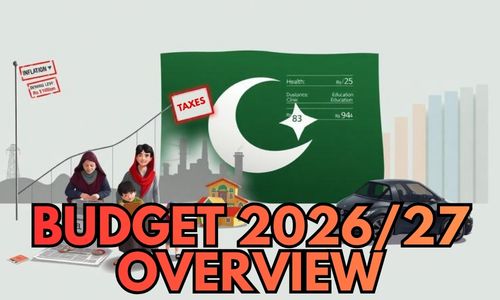
Budget 2026/27 Overview
However, beneath the macro-financial jargon lies a complex reality. The government announces limited tax relief for the salaried class and exporters, but it simultaneously increases reliance on regressive taxation such as the Petroleum Levy, cuts subsidies sharply, and raises defense spending to a staggering Rs 3 trillion. This analysis dissects the new taxes, identifies the sectors that still receive subsidies, and critically evaluates how these policies are likely to worsen inflation and deepen economic challenges for ordinary Pakistanis.
New Taxes & Revenue Measures: Where the Money is Coming From
To achieve an ambitious FBR tax collection target of Rs 15.264 trillion (a 17% increase over last year), the government has introduced a mix of direct tax reforms and indirect levy hikes.
-
Petroleum Development Levy (PDL): The government has set a collection target of Rs 1.727 trillion for the PDL, which is a per-litre tax on petrol and diesel. This implies an effective levy of approximately Rs 84-87 per liter, effectively raising fuel prices by Rs 6-9 per liter compared to current levels.
-
Luxury & EV Taxation: A tiered Federal Excise Duty (FED) has been slapped on imported CBU (Completely Built Unit) Electric Vehicles. EVs priced between Rs 20-30 million face a 30% FED, while those above Rs 30 million face a 40% FED. Similarly, petrol/diesel vehicles with engines above 3,000cc face an 81% FED, while an “Environmental Levy” will hit vehicles above 2,000cc.
-
Digital & Professional Services: A 15% tax is being imposed on professional services (including doctors, lawyers, and consultants). Meanwhile, the FED on e-liquid for vaping has been raised to Rs 16,500 per kilogram.
Which Sectors Still Receive Subsidies?
In a bid to tighten fiscal consolidation under the IMF program, the government has drastically reduced blanket subsidies from Rs 1.036 trillion to just Rs 830 billion (a 19% reduction). However, some targeted subsidies remain:
-
Power Sector: The subsidy remains at Rs 830 billion despite cuts, but this is lower than last year. Additionally, Rs 252 billion has been allocated to control circular debt.
-
Export Financing: Exporters have received a massive boost. The government allocated Rs 71 billion in subsidies to allow exporters to access financing at a concessionary rate of 4.5%.
-
Agriculture & Fertilizer: The government has allocated Rs 5.8 billion to support the production and supply of urea fertilizer and Rs 19 billion to help PASSCO cover the wheat price differential.
-
Electric Vehicles (EVs): The concessional tax regime for mass-market EVs remains intact (1% sales tax for EVs and 8.5% for hybrids up to 1800cc), supported by an Rs 8 billion EV subsidy allocation.
Financial Advisor’s Analysis: The Triple Threat of Inflation, Stagnation & Neglect
As a financial advisor, I dissect the budget not by what it promises on paper, but by how it changes the weekly grocery list and monthly utility bills of the average household. Here is the harsh reality:
1️⃣ The Salary vs. Inflation Gap (The “Real Income” Erosion)
The government has announced a 7% increase in salaries and pensions for federal employees and a 10% increase in the minimum wage to roughly Rs 40,700. However, the government’s own inflation assumption for the year is 8.2% . This means that despite the raise, a government employee’s real purchasing power will decline by over 1% next year. This 7% raise is grossly inadequate compared to the 50% pay hike demanded by unions.
2️⃣ The “Petroleum Levy” Tax Hike
This budget hides a major pressure point. By increasing the Petroleum Levy to Rs 84–87 per liter, the government will push petrol prices above Rs 320 per liter. As fuel costs rise, transport expenses increase, and these higher costs flow into the prices of almost everything—from bread (through wheat transportation) to vegetables (through freight charges).
Effectively, a fuel price hike adds a surcharge to every item a household buys. Although the budget’s revenue calculations rely on this increased levy, the speech does not clearly explain its full impact on everyday kitchen expenses.
3️⃣ Reduced Electricity Subsidies = Higher Bills
Cutting the power subsidy by 19%—from Rs 1.036 trillion to Rs 830 billion—will directly increase electricity tariffs for the middle class. With average tariffs already around Rs 33 per unit, economists warn that tariff rationalization could drive prices higher and raise monthly bills. Although the government has allocated Rs 838 billion for BISP cash transfers, this support may not fully offset the burden on working poor households.
4️⃣ Elite-Centric Tax Relief vs. No Relief for the Poor
A stark “Robin Hood in Reverse” policy is emerging. The government has reduced income tax rates by 20–32% for the salaried class earning between Rs 2.2 million and Rs 7 million annually, while it has provided no tax relief to low-income salaried workers. It has also reduced or abolished the super tax on high-income earners of up to Rs 500 million. Meanwhile, the government continues to impose an 18% GST on nearly all purchases, placing a heavier burden on ordinary citizens.
5️⃣ Social Sector Neglect: Health, Education & Welfare
The Defence vs. Development Dilemma
The Federal Budget prioritizes Defence and Security significantly. Allocations for the Army, Air Force, and Navy have crossed Rs 3 trillion, up nearly 18% from the revised estimates of the previous year. Additionally, Rs 822 billion is set aside for military pensions alone.
In contrast, the government caps the total Public Sector Development Programme (PSDP) at just Rs 1 trillion. While national security remains paramount, macroeconomic realities show that defence spending alone cannot sustain economic growth. When the government reduces development spending on infrastructure, industry, and technology, job opportunities decline and the tax base stagnates. Alongside this, the government allocates Rs 8.054 trillion for debt servicing, which leaves no fiscal space for productivity-enhancing investments.
Will This Budget Help the Economy at Large?
The Government’s Optimism
The Harsh Ground Reality
Independent analysts and opposition parties (PTI and PPP) have rejected the budget, calling it “elite-centric” and “anti-people.” The National Assembly’s Standing Committee on Finance has also expressed reservations, stating that the IMF-driven primary surplus target of 2% of GDP is being met by compressing development expenditure instead of broadening the tax base.
The Verdict: While macro data appears stable on paper, the budget is likely to trigger cost-push inflation through increases in fuel and power prices and to keep real wages stagnant, which will worsen economic conditions for the middle and lower classes in the short term. Without significantly increasing investment in health, education, and infrastructure, the government risks making the 4% growth target fragile.









LEAVE A COMMENT