
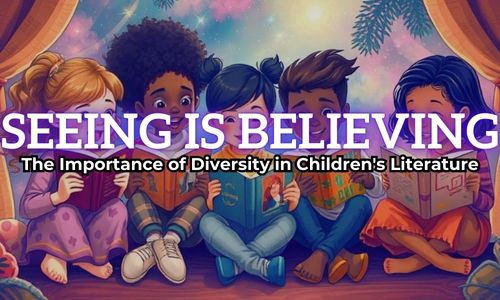
Seeing is Believing – The Importance of Diversity in Children’s Literature
In a world that is increasingly interconnected and diverse, the stories we tell our children matter more than ever. Children’s books are not just a source of entertainment; they are powerful tools that shape how young minds perceive the world, understand themselves, and relate to others. Representation in children’s literature is not just a trend—it’s a necessity. Here’s why diversity in children’s books is so important and why representation truly matters.
Mirrors and Windows: Seeing Themselves and Others
Children’s books serve as both mirrors and windows. For children from marginalized or underrepresented communities, books that reflect their experiences, cultures, and identities act as mirrors. They allow children to see themselves in stories, validating their existence and fostering a sense of belonging. When a child reads about a character who looks like them, speaks like them, or shares their experiences, it sends a powerful message: You matter. Your story matters.
On the other hand, books also serve as windows, offering children a glimpse into lives and experiences different from their own. For children from majority or privileged backgrounds, diverse books provide an opportunity to develop empathy, understanding, and respect for others. They learn that the world is made up of many voices, cultures, and perspectives, and that diversity is something to be celebrated, not feared.
Breaking Stereotypes and Challenging Bias
Children are not born with prejudices; they learn them. Books play a significant role in shaping how children perceive different groups of people. When children’s books lack diversity or rely on stereotypes, they reinforce harmful biases. For example, if a child only sees certain genders, races, or abilities portrayed in limited or negative ways, they may internalize these ideas and carry them into adulthood.
Diverse books challenge these stereotypes by presenting nuanced, authentic portrayals of people from all walks of life. They show that there is no single way to be Black, Asian, disabled, LGBTQ+, or any other identity. By exposing children to a wide range of characters and stories, we help them develop a more accurate and inclusive understanding of the world.
Building Self-Esteem and Confidence
Representation in children’s books has a direct impact on a child’s self-esteem and confidence. When children see characters who look like them achieving great things, overcoming challenges, or simply living their lives, it sends a message that they, too, can do the same. This is especially important for children from marginalized groups, who may rarely see themselves represented in mainstream media.
For example, a study by the Cooperative Children’s Book Center found that only a small percentage of children’s books feature characters of color, despite the growing diversity of the U.S. population. When children don’t see themselves in books, it can lead to feelings of invisibility or inadequacy. On the other hand, diverse books empower children by showing them that their stories are worth telling and that they have a place in the world.
Preparing Children for a Diverse World
The world is becoming increasingly diverse, and children need to be prepared to navigate it with empathy and understanding. Diverse books help children develop the skills they need to thrive in a multicultural society. They teach children how to appreciate differences, communicate across cultures, and stand up against injustice.
By reading stories about characters from different backgrounds, children learn that diversity is a strength, not a weakness. They learn to value different perspectives and to approach the world with curiosity and openness. These are essential skills for building a more inclusive and equitable society.
Encouraging a Love of Reading
When children see themselves reflected in books, they are more likely to develop a love of reading. Reading becomes a personal and meaningful experience, rather than a chore. Diverse books can also introduce children to new genres, styles, and voices, expanding their literary horizons and fostering a lifelong love of learning.
The Role of Authors and Publishers
While the importance of diversity in children’s books is clear, there is still much work to be done. Authors, illustrators, and publishers have a responsibility to create and promote books that reflect the diversity of our world. This includes not only increasing the number of diverse books but also ensuring that these stories are authentic, respectful, and free from stereotypes.
It’s also important to support diverse creators. By amplifying the voices of authors and illustrators from underrepresented communities, we can ensure that a wide range of perspectives are represented in children’s literature.
What Parents and Educators Can Do
Parents and educators play a crucial role in promoting diversity in children’s books. Here are a few ways to get started:
- Seek Out Diverse Books: Make a conscious effort to include books by and about people from different backgrounds in your child’s reading list. Look for books that feature characters of different races, ethnicities, genders, abilities, and family structures.
- Discuss the Stories: Use diverse books as a starting point for conversations about identity, culture, and social justice. Ask your child how they relate to the characters and what they learned from the story.
- Support Diverse Authors: Purchase books written by authors from underrepresented communities and recommend them to others. This helps ensure that diverse voices continue to be heard.
- Advocate for Change: Encourage schools, libraries, and publishers to prioritize diversity in children’s literature. The more demand there is for diverse books, the more likely it is that they will become the norm.
Diversity in children’s books is not just about checking boxes or being politically correct—it’s about creating a world where every child feels seen, valued, and empowered. Representation matters because it shapes how children see themselves and others, and it lays the foundation for a more inclusive and compassionate society.
By embracing diversity in children’s literature, we can give all children the opportunity to dream big, to see the beauty in difference, and to understand that their stories—and the stories of others—are worth telling. Let’s commit to filling bookshelves with stories that reflect the rich tapestry of our world, one page at a time.












LEAVE A COMMENT