

Red Heifer Sacrifice
The Red Heifer Sacrifice holds a profound significance in Jewish theology, deeply interwoven with the fabric of religious beliefs and historical narratives. Delving into the depths of Jewish mysticism and eschatology, we unravel the enigmatic layers surrounding this ancient ritual, exploring its symbolic resonance and its connection to the eschatological prophecies concerning the end of times.
Origins and Ritualistic Practice
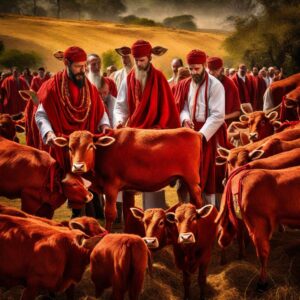
Dating back to the biblical era, the Red Heifer Sacrifice finds its roots in the book of Numbers within the Torah. According to Jewish tradition, practitioners perform the ritual by sacrificing a flawless red heifer, which they then burn to ashes. Subsequently, they mix these ashes with water to create the purifying agent known as “mei niddah” or the waters of purification.
Within Jewish law, the meticulous observance of this ritual outlines intricate details, emphasizing the necessity for utmost purity in both the heifer and the individuals involved in the sacrificial process. The selection criteria for the red heifer are stringent; it must be completely unblemished and devoid of any yoke.

Symbolism and Spiritual Purification
Central to the significance of the Red Heifer Sacrifice is its symbolic representation of purity and spiritual cleansing. The crimson hue of the heifer’s coat symbolizes sin and impurity, while its sacrifice serves as a means of atonement and restoration of spiritual sanctity.
In Jewish tradition, believers attribute the purification process facilitated by the ashes of the red heifer to cleansing individuals from the defilement of contact with the dead, thereby enabling them to partake in sacred rituals and communal worship. This purification ritual holds particular importance in the context of the Temple service, where ritual purity is paramount.
Eschatological Implications
Jewish messianic expectations and apocalyptic theology deeply root the eschatological significance of the Red Heifer Sacrifice. Certain interpretations within Jewish mysticism believe that the preparation of the red heifer’s ashes is a prerequisite for rebuilding the Third Temple in Jerusalem.

In eschatological discourse, scholars intricately link the construction of the Third Temple with the arrival of the Messiah and the ushering in of the Messianic Age. The Red Heifer Sacrifice, therefore, holds a pivotal role in the eschatological timeline, symbolizing the purification and restoration necessary for the realization of ultimate redemption.
Contemporary Perspectives and Interpretations
Though contemporary Judaism no longer observes the ritualistic practice of the Red Heifer Sacrifice due to the absence of the Temple, its theological significance continues to resonate within Jewish thought and religious discourse. Various interpretations and speculations surrounding its eschatological implications persist, fueling theological debate and speculation.
Contemporary Jewish scholars and theologians continue to explore the deeper spiritual dimensions of the Red Heifer Sacrifice, drawing parallels between its symbolism and the ongoing quest for spiritual purification and redemption in a modern context. The enduring significance of this ancient ritual serves as a testament to the enduring vitality of Jewish mythology and theological inquiry.
Conclusion
In conclusion, the Red Heifer Sacrifice holds a central place in Jewish mythology, embodying profound theological symbolism and eschatological significance. Rooted in biblical tradition and ritualistic practice, its symbolic resonance extends far beyond the confines of historical narrative, permeating contemporary theological discourse and spiritual reflection.
As we navigate the intricate tapestry of Jewish mysticism and eschatology, the Red Heifer Sacrifice serves as a potent symbol of spiritual purification and the eternal quest for redemption. Its enduring significance underscores the rich cultural heritage and theological complexity of the Jewish tradition, inviting us to delve deeper into the mysteries of faith and prophecy.











Comment (1)
Good as always..! ✨