
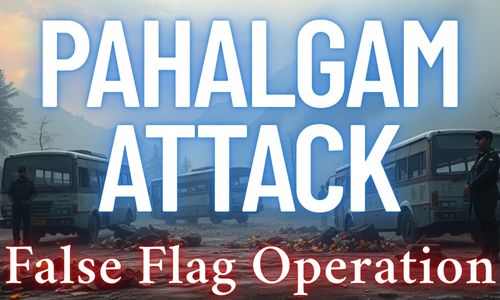
Pahalgam Attack – A False Flag Operation
Details of the Attack
On April 22, 2025, a devastating terrorist attack occurred in Baisaran Valley near Pahalgam, Anantnag district, Jammu and Kashmir, resulting in the deaths of 26 individuals and injuries to over 20 others. This incident is the deadliest targeting civilians in India since the 2008 Mumbai attacks.
The assailants, reportedly five in number, were heavily armed and dressed in traditional attire. They segregated men from women and children before executing the men at close range. Victims were targeted based on their inability to recite Islamic verses. The attackers used AK-47s and M4 carbines, firing approximately 60 rounds across various locations in the valley, including food stalls and forested areas. Among the deceased were 25 Indian nationals and one Nepali tourist; at least 17 others sustained injuries.
Aftermath and Response
In response to the attack, India took several measures:
- Downgraded diplomatic relations with Pakistan, including the expulsion of Pakistani defense advisors and reduction of embassy staff.
- Suspended the Indus Waters Treaty, a longstanding water-sharing agreement between the two nations.
- Closed the main land border crossing at Attari and canceled SAARC visas.
- Launched a large-scale manhunt involving the army, paramilitary forces, and local police to apprehend the perpetrators.
India accused Pakistan of supporting cross-border terrorism, a claim Pakistan denies, asserting that it provides only moral and diplomatic support to the Kashmiri cause.
Pahalgam Attack – A False Flag Operation Or A Terrorist Attack
Credible international and Indian sources widely report the Pahalgam attack on April 22, 2025, as a alleged terrorist attack, not a false flag operation but we will have a look into this deeply.
Evidences pointing to a terrorist attack:
a. Claim of Responsibility: The attack was allegedly claimed by The Resistance Front (TRF), a group allegedly believed to be an offshoot of the Pakistan-based Lashkar-e-Taiba (LeT). The group justified the killings on ideological grounds, citing opposition to demographic changes in Kashmir.
b. Pattern and Modus Operandi: The method — targeting civilians, segregating by religion, using military-grade weapons — matches past terror attacks in the region attributed to Islamist groups like LeT or Jaish-e-Mohammed.
c. Victim Testimonies: Survivors have described the attackers’ speech, behavior, and methods, consistent with terrorist activity rather than state-led staging.
d. Forensics and Intelligence: Preliminary forensic analysis reportedly found use of weapons like AK-47s and M4 carbines, and intercepted communications are believed to link the attackers to known militant networks.
Why Some May Suspect a False Flag
Some political commentators and social media voices, often from Pakistan or critical circles, considered it as a false flag — where a state carries out or allows an attack to justify political or military action — due to:
a. The attack happened close to the general elections, which could allegedly boost nationalist sentiment and consolidate votes for the ruling party by rallying the country around security and anti-terror measures.
b. India’s immediate, severe diplomatic backlash against Pakistan — downgrading ties, suspending the Indus Waters Treaty — seemed “pre-prepared,” as if the attack was used as a trigger for pre-decided moves.
c. Historical mistrust in the region, where both India and Pakistan have been accused of manipulation.
d. Use of U.S.-style M4 carbines raised eyebrows. Some skeptics argue that such weapons aren’t common among Kashmiri militants and could suggest a staged arsenal.
e. No neutral international bodies have confirmed the attackers’ identities or affiliations, fueling skepticism in some circles.
f. Indian-Occupied Kashmir remains a heavily militarized strategic region, hosting approximately 0.7 million armed personnel, including paramilitary forces. This intense security presence raises serious questions about the region’s intelligence capabilities, as alleged militants continue to carry out attacks despite the existence of checkposts across every area.
India has failed to present credible evidence linking Pakistan to the attack, while available information strongly points to it being a false flag operation.
Pakistan’s Reaction
Following the Pahalgam attack on April 22, 2025, which resulted in the deaths of 26 tourists, Pakistan has issued strong denials of involvement and taken significant retaliatory actions in response to India’s accusations and measures.
- Denial of Involvement: Pakistan has categorically denied any role in the attack, rejecting India’s allegations of cross-border terrorism. The Pakistani government condemned the violence and criticized India for leveraging the incident politically without conducting a credible investigation.
- Condemnation of India’s Actions: Pakistan has accused India of exploiting the tragedy to further its regional agenda, particularly in the context of the longstanding Kashmir dispute.
Retaliatory Measures by Pakistan
In response to India’s actions, Pakistan has undertaken several measures:
Suspension of Bilateral Agreements: Pakistan announced the suspension of the 1972 Simla Agreement and all other bilateral treaties with India, including the 1960 Indus Waters Treaty. The Pakistani government warned that any attempt by India to divert river waters would be considered an act of war.
Diplomatic and Economic Actions: Pakistan expelled Indian diplomats, closed its airspace to Indian aircraft, suspended bilateral trade, and canceled visas for Indian citizens.
National Security Measures: Prime Minister Shehbaz Sharif convened a meeting of the National Security Committee to address the escalating tensions and to formulate Pakistan’s response strategy.
Closure of Air: Pakistan closed the air usage for India for all kind of their flights which will cost too much to Indian commercial airlines
High Alert: Pakistan high alerted their forces for any misadventure by India and all the armed forces will back each other incase of act of war with the help of nation.
Regional and International Implications
The rapid deterioration in India-Pakistan relations has raised concerns about potential escalation between the two nuclear-armed neighbors. The suspension of the Indus Waters Treaty, in particular, threatens to exacerbate tensions, given its critical importance to Pakistan’s agriculture and water security. International observers have called for restraint and dialogue to prevent further escalation.
In summary, Pakistan has strongly denied any involvement in the Pahalgam attack and has taken significant diplomatic and economic measures in response to India’s actions. The situation remains tense, with both countries engaging in retaliatory actions that risk further destabilizing the region.
Further Escalations
Despite it was a false flag operation by India through the help of their allies, India is actively considering further escalations in response to the Pahalgam attack, which resulted in the deaths of 26 tourists. The Indian government has already taken significant diplomatic and strategic measures, and discussions about potential military actions are ongoing.
Potential Consequences of Further Escalation
- Risk of Military Conflict
Any military action by India could provoke a strong response from Pakistan, potentially leading to a cycle of retaliation. Given both countries possess nuclear weapons, the risk of a larger conflict cannot be ignored.
- Water Security Concerns
The suspension of the Indus Waters Treaty has significant implications for Pakistan, which relies heavily on the Indus River for agriculture and drinking water. Pakistan has warned that any attempt by India to divert river waters would be considered an act of war.
- Economic and Diplomatic Fallout
Escalation could lead to further economic sanctions, disruption of trade, and strained diplomatic relations not only between India and Pakistan but also with other countries concerned about regional stability.
Way Forward for Pakistan and India
For Pakistan:
- Engage in Track-II Diplomacy
- Action: Back-channel diplomacy with Indian civil society, former diplomats, and global mediators.
- Why: Keeps dialogue alive when official talks break down.
- Reframe the Kashmir Issue Internationally
- Action: Focus on human rights, not just geopolitics, to gather global sympathy and advocacy from UN bodies or neutral countries.
- Why: Framing it around civilian suffering often finds more traction internationally than territorial disputes.
- Avoid Escalatory Language
- Action: Maintain a strong yet calm public stance — no war rhetoric.
- Why: Helps avoid provocation, especially with international scrutiny increasing.
For India:
- Ensure Accountability Without Blanket Blame
- Action: Target specific militant actors, not entire populations or governments.
- Why: Reduces backlash, prevents alienation of Kashmiri civilians, and preserves long-term peace prospects.
- Avoid Militarized Political Gains
- Action: Resist the urge to use attacks for political capital (e.g., elections).
- Why: This can spiral into uncontrolled escalation, as seen in past Indo-Pak flareups.
- Revive Dialogue on Kashmir Autonomy & Development
- Action: Engage local stakeholders in Kashmir for governance, economy, and education.
- Why: A stable, engaged Kashmir is harder for insurgents to infiltrate.
- Stop Exploiting the Indus Water Treaty
- Action: Indian government needs to reinstate the Indus Water Treaty to avoid water exploitations.
- Why: This de-risks escalation and builds soft power as water basins of India may get affected if China does the same.
- Leverage Global Platforms Wisely
- Action: Work with the UN, SCO, G20, or Quad to create a neutral buffer for mediation.
- Why: This de-risks escalation and builds soft power.
As both nations stand to gain more through economic collaboration and regional stability than war or brinkmanship. A single incident should not dictate the fate of 1.7+ billion people.












LEAVE A COMMENT