
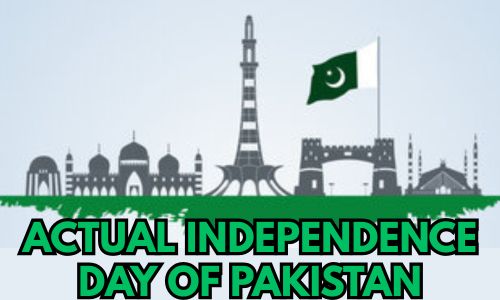
Independence Day of Pakistan
Qasim Waseem2026-08-15T12:24:49+00:00Millions of people in Pakistan and around the world celebrate August 14 as Pakistan’s Independence Day with great patriotic enthusiasm. However, historical records reveal an often-overlooked fact: the law that created Pakistan established August 15, 1947, as the country’s independence date. This article examines why Pakistan originally recognized August 15, why its leaders later moved the official celebration to August 14, and what credible historical evidence explains this change.
The Legal Reality: What the Indian Independence Act of 1947 Stated
The British Parliament formally established Pakistan through the Indian Independence Act of 1947. This act laid out the definitive legal framework for the end of British rule and the creation of two new nations. The key evidence lies directly in the text of the Act:
“1. (i) As from the 15th day of August, 1947, two independent Dominions shall be set up in Dominions, to be known respectively as India and Pakistan.”
The Act further clarifies that “the said fifteenth day of August is, hereafter, in this Act referred to as ‘the Appointed day'” . This was not a matter of interpretation; it was the letter of the law. The British had designated August 15, 1947, as the official date for the transfer of power for both Dominions. This is also confirmed by the Mountbatten Plan, the partition blueprint, which set “August 15, 1947, as the date for the transfer of power” .
Why Pakistan Celebrates on August 14th
If the law says the 15th, why does the nation celebrate on the 14th? The answer lies in a last-minute logistical and ceremonial adjustment.
The British government scheduled the official transfer of power for August 15. Lord Mountbatten, the last Viceroy of British India, planned to administer the oath of office to Muhammad Ali Jinnah as Pakistan’s Governor-General in Karachi and Jawaharlal Nehru as India’s Prime Minister in New Delhi. However, Mountbatten could not attend both ceremonies on the same day. To fulfill his ceremonial duties in both dominions, he moved Pakistan’s transfer-of-power ceremony to August 14.
As a result, the formal transfer of power for Pakistan occurred a few minutes before midnight on the night of August 14, 1947, allowing Mountbatten to attend the ceremony in Karachi before flying to New Delhi for India’s ceremony on the 15th . Pakistan was thus “born” at 11:59 PM on the 14th, with India achieving independence one minute later, on the 15th. Since the new date (August 15th) legally began at midnight, the actual transfer of power happened a single minute before, on August 14th.
The discrepancy between the legal date and the observed date arises from a practical administrative decision. Lord Mountbatten, the last Viceroy of India, was responsible for personally transferring power to both new dominions. He needed to be present in Karachi for Pakistan and New Delhi for India. Since he could not be in both places simultaneously on August 15, he transferred power to Pakistan on August 14, 1947, while still serving as Viceroy of India .
Renowned historian K.K. Aziz in his book Murder of History (page 180) explains:
“The Indian Independence Bill… laid down that the two new Dominions of India and Pakistan shall become free at the midnight of 14-15 August. The power had to be personally transferred to the new countries by the Viceroy… Lord Mountbatten could not be present in person in Karachi and New Delhi at the same moment. So the only practicable thing was for him to transfer power to Pakistan on 14th August when he was still the Viceroy of India. But that does not mean that Pakistan gained its independence on 14th August. The Indian Independence Act did not provide for it” .
Strong and Credible References
The fact that August 15th was the intended official date is supported by multiple credible sources:
-
The Indian Independence Act of 1947: The primary legal document, a matter of public record, explicitly names August 15, 1947, as the appointed day for independence .
-
First Commemorative Postal Stamps: Pakistan’s first commemorative postal stamps, released in July 1948, are a powerful piece of primary evidence. They clearly state August 15, 1947, as Independence Day .
-
Historical Accounts from Dawn: In a 2021 article, the Pakistani newspaper Dawn directly examines the evidence, stating that the legal reality is that the true Independence Day is on the 15th of August and that “to claim otherwise is to start off on a false premise” .
-
First-Hand Accounts: As a schoolboy in 1947, one Pakistani recalls that “nothing happened during the day of Aug 14, 1947.” He remembers that it was on the “morning of Aug 15 when all offices started working under the government of Pakistan” and recounts that the ceremonial handover and the first stamps all pointed to August 15 .
Muhammad Ali Jinnah’s Position and the Subsequent “Revision”
Muhammad Ali Jinnah, Pakistan’s founder, was well aware of this fact and firmly believed that the country should celebrate its independence on August 15th . He reportedly rejected the suggestion to celebrate the 14th simply because it fell on the last Friday of Ramadan (Jumatul Wida). According to historical accounts, “the old man left us the communal parties, who anyway had opposed Pakistan, prevailed” in establishing August 14th as the date of celebration .
After Jinnah’s death, the political landscape shifted. Leaders likely chose August 14 for the celebrations because the transfer of power ceremony took place just before midnight on August 14, giving the date strong emotional and symbolic significance. Over time, this practical adjustment became the established tradition. However, it is crucial to understand that this was an alteration of the official date of celebration, not a change to the actual legal reality of the Indian Independence Act.
The Revision: How August 14 Became the Official Celebration
The official celebration of Independence Day on August 14 was a later decision. Chaudhry Muhammad Ali, former Prime Minister of Pakistan, in his book The Emergence of Pakistan (1967), confirms that the Quaid-i-Azam himself referred to August 15 as the birth date of Pakistan.
In the Urdu translation of his book, Zahoor-i-Pakistan (page 287), Chaudhry Muhammad Ali writes:
“Fifteenth August 1947 was the last Friday of Ramadan-ul-Mubarak, one of the holiest days in Islam. On that auspicious day, Quaid-i-Azam became the Governor-General of Pakistan and the cabinet was sworn in, the star-and-crescent flag was hoisted, and Pakistan emerged on the world map” .
Moreover, Quaid-i-Azam Muhammad Ali Jinnah’s own speech on August 15, 1947, inaugurating the Pakistan Broadcasting Service, begins with:
“August 15 is the birth day of the independent and sovereign state of Pakistan”.
One of the most important findings comes from the State Bank of Pakistan Museum.
According to its historical account, Pakistan’s first commemorative stamps carried “15th August 1947”, but:
“It wasn’t until early 1949, that this confusion was cleared by declaring 14 August as Independence Day.”
This provides particularly strong evidence for the frequently asked question:
“When did Pakistan change Independence Day from 15 August to 14 August?”
The safest historically supported answer is:
Pakistan’s official commemorative date was settled as 14 August by early 1949.
It is therefore more accurate to say that the official celebration date was revised or settled as 14 August, rather than claiming that the legal date in the Indian Independence Act itself was retroactively amended from 15 August to 14 August.
That distinction is often missing from online discussions.
Was the Date Changed in 1948 or 1949?
This is where historical discussions sometimes become confusing.
Pakistan was already celebrating independence-related events on 14 August 1948, as demonstrated by contemporary newspaper evidence.
At the same time, the State Bank of Pakistan’s museum records that the confusion surrounding the date was cleared by early 1949 through the adoption of 14 August as Independence Day.
Therefore, it would be misleading to state simply:
“Pakistan changed its independence date on one specific day in 1949.”
A more historically responsible formulation is:
Pakistan began observing 14 August as Independence Day during the first anniversary period and formally established it as the official Independence Day in early 1949.
This reconciles the contemporary evidence rather than forcing all historical documents into a single date.
The Religious Significance: 27th Ramadan and Lailatul Qadr
The revision to celebrate Pakistan’s Independence Day on August 14 was not arbitrary. It was given profound Islamic significance by the Pakistani establishment because in 1947, August 14 corresponded to the 27th night of Ramadan—the night that many Muslims believe to be Lailatul Qadr (the Night of Power), the holiest night in Islam when the first verses of the Holy Quran were revealed to Prophet Muhammad (PBUH) .
Sadia Rashid, President of Hamdard Foundation Pakistan, emphasized this connection, stating:
“Pakistan came into being on this very night of Ramazan 27, 1366 Hijra, which is the Hijri equivalent of August 14, 1947. It was not a mere coincidence but the will of Allah Almighty that this country be blessed and should grow according to ideals of Quaid-i-Azam, so that it could become a role model for the entire Muslim Ummah” .
The 27th night of Ramadan, known as Shab-i-Qadr, is described in the Quran as “better than a thousand months” (Surah Al-Qadr, 97:3) . By aligning Pakistan’s independence with this blessed night, the Pakistani establishment sought to reinforce the nation’s Islamic identity and present its creation as divinely ordained—a sacred moment in Islamic history.
Why Was 14 August Chosen?
Several explanations have been offered for Pakistan’s adoption of 14 August.
The Islamic Touch by the Pakistani Establishment
The Pakistani establishment deliberately incorporated the Islamic narrative into the nation’s founding story:
-
Spiritual Significance: Celebrating independence on 27th Ramadan transformed the date from a political event into a religious milestone.
-
Divine Blessing: The timing reflected Allah’s will and established Pakistan as a homeland where Muslims could freely practice their faith and promote Islamic values.
-
Authenticity of Purpose: This narrative reinforced the idea that Pakistan’s founders envisioned the country not merely as a secular nation-state but as an Islamic project.
According to some reports, Hakim Said (founder of Hamdard Foundation) wished that Ramazan 27 should be recognized as Pakistan’s Independence Day and celebrated as such.
The Irony
Pakistan is the only country whose independence occurred during Ramadan, that claim would be incorrect. If we want to be conservative and historically defensible, I would divide the examples into two groups:
Formal independence/declaration during Ramadan
- Haiti — 1 January 1804 — Ramadan 1218
- Indonesia — 17 August 1945 — 9 Ramadan 1364
- India — 15 August 1947 — 28 Ramadan 1366
- Vietnam — 2 September 1945 — 25 Ramadan 1364
- Vanuatu — 30 July 1980 — 18 Ramadan 1400
National liberation during Ramadan
- South Korea — 15 August 1945 — 7 Ramadan 1364
- North Korea — 15 August 1945 — 7 Ramadan 1364
The Transfer-of-Power Ceremony Took Place on 14 August
The most directly documented explanation is the transfer-of-power ceremony in Karachi on 14 August 1947.
Pakistan’s National Assembly confirms that Lord Mountbatten addressed Pakistan’s Constituent Assembly on that date.
The ceremony therefore gave 14 August enormous symbolic importance from the very beginning of Pakistan’s existence.
Pakistan and India Had Separate Ceremonial Arrangements
The transfer of authority involved a sequence of ceremonies in Karachi and Delhi.
Mountbatten could not physically conduct both ceremonies at precisely the same place and time. Pakistan held its independence ceremony in Karachi on 14 August, while India held its formal independence ceremonies on 15 August.
This created a distinction between the legal appointed date and the ceremonial date associated with Pakistan’s transfer of power.
Religious and Symbolic Considerations
Some historical accounts have also associated 14 August 1947 with 27 Ramadan, giving the date additional religious significance for many Muslims.
However, we should consider this a possible contributing factor rather than the sole explanation. The strongest documentary evidence concerns the transfer-of-power ceremony and the subsequent official adoption of 14 August.
What Does Pakistan’s National Assembly Say About Independence?
Pakistan’s own parliamentary historical record is particularly important.
The National Assembly’s account states that Pakistan was created under the Indian Independence Act of 1947, that its Constituent Assembly began functioning in Karachi before independence, and that the transfer of power took place on 14 August 1947. It then records Jinnah’s oath as Governor-General on 15 August.
This official record effectively captures the central historical paradox:
Pakistan’s transfer of power occurred on 14 August, while the legal framework identified 15 August as the appointed day.
This is why simplistic claims that one date is entirely “correct” and the other is entirely “wrong” fail to capture the historical record.
Was Pakistan Legally Independent on 14 August or 15 August?
If we prioritize the wording of the Indian Independence Act, the answer is 15 August 1947.
If we ask when the formal transfer-of-power ceremony for Pakistan’s Constituent Assembly occurred, the answer is 14 August 1947.
If we ask which date Pakistan officially recognizes and celebrates today, the answer is 14 August.
All three statements can therefore be true without contradiction because they refer to different aspects of the transition from British rule to Pakistani sovereignty.
What Is the Strongest Evidence for the 15 August Argument?
The strongest evidence includes:
- The Indian Independence Act, 1947, which expressly identifies 15 August as the appointed day.
- Pakistan’s earliest commemorative postage stamps, which carried “15th August 1947.”
- Jinnah’s reference to 15 August as the birthday of the independent and sovereign state of Pakistan.
- Contemporary newspaper material from August 1947 and 1948 showing the continued use of 15 August in some contexts.
- Historical scholarship noting that the legal creation of the two Dominions was tied to 15 August.
What Is the Strongest Evidence for the 14 August Argument?
The strongest evidence for 14 August includes:
- The 14 August 1947 transfer-of-power ceremony in Karachi.
- Pakistan’s official commemorative practice from 1948 onward.
- The State Bank of Pakistan Museum’s historical account, which says the date was settled as 14 August by early 1949.
- Contemporary Pakistani records documenting 14 August celebrations.
Did Pakistan’s Independence Day Really Change from 15 August to 14 August?
Yes, in terms of the officially observed anniversary date, but the wording requires care.
It is inaccurate to suggest that the British Parliament’s Indian Independence Act originally said 14 August and that someone subsequently changed it to 15 August. The opposite is true: the Act expressly named 15 August 1947 as the appointed day.
What changed was Pakistan’s official commemorative practice.
The transfer-of-power ceremony on 14 August became central to Pakistan’s national historical narrative. By the first anniversary, Pakistanis had already begun celebrating 14 August. The State Bank of Pakistan’s historical record states that the government resolved the confusion in early 1949 by officially declaring 14 August as Independence Day
Thus, the most accurate historical conclusion is not that Pakistan “lost” one independence date and “gained” another. Instead, two dates emerged from two related but distinct events in the transition to independence.
14 August vs. 15 August: The Historical Verdict
The evidence allows us to state the matter clearly:
Pakistan celebrates its Independence Day on 14 August.
The transfer of power to Pakistan’s Constituent Assembly took place in Karachi on 14 August 1947.
The Indian Independence Act legally designated 15 August 1947 as the appointed day for the establishment of India and Pakistan as independent Dominions.
Jinnah was sworn in as Pakistan’s first Governor-General on 15 August 1947.
Pakistan initially recognized 15 August 1947 in its official commemorative stamps, using the date on some of its earliest stamps.
By early 1949, Pakistan had settled 14 August as its Independence Day.
Why the Historical Distinction Matters
The debate over Pakistan Independence Day 14 August or 15 August is more than a question of a calendar date. It shows how governments and societies construct national histories through legal documents, political ceremonies, public memory, and subsequent state practices.
The creation of Pakistan was not a single event occurring at one isolated moment. The transition involved complex constitutional and political changes led by the British Parliament, the Viceroy, the Constituent Assembly, Muhammad Ali Jinnah, the Muslim League, and the emerging governments of India and Pakistan.
Consequently, the historical record naturally contains several significant moments.
The Indian Independence Act established the legal framework.
The 14 August Karachi ceremony represented the transfer of authority to Pakistan’s Constituent Assembly.
The 15 August oath of Jinnah marked another crucial constitutional milestone.
The subsequent adoption of 14 August as Pakistan’s annual Independence Day established the date that Pakistanis have commemorated for generations.
Final Answer: What Is the Actual Independence Day of Pakistan?
If the question is “What date does Pakistan officially celebrate as its Independence Day?”, the answer is unequivocally:
14 August
If the question is “What date did the Indian Independence Act specify as the appointed day for the creation of Pakistan?”, the answer is:
15 August 1947
If the question is “When did the transfer-of-power ceremony for Pakistan take place?”, the answer is:
14 August 1947
Early 1949
The historical record therefore does not justify dismissing either date. 14 August is Pakistan’s official Independence Day today, while 15 August is the date specified in the original legal instrument establishing the two Dominions.
For anyone researching Pakistan’s actual Independence Day, the most credible approach is to examine and acknowledge both historical facts rather than relying on a simplified account.
Strong and Credible References
- National Assembly of Pakistan — Constitutional and parliamentary history: The official National Assembly record documents the 14 August 1947 transfer of power and Jinnah’s 15 August oath as Governor-General.
- Indian Independence Act, 1947: The primary legal document explicitly identifies 15 August 1947 as the appointed day for establishing India and Pakistan as independent Dominions.
- State Bank of Pakistan Museum & Art Gallery: Its historical account records that Pakistan’s first commemorative stamps carried 15 August 1947 and states that the date confusion was cleared by early 1949 through the adoption of 14 August.
- Punjab Digital Library: Its archival collection contains a record of the 14 August 1947 transfer-of-power ceremony in Karachi, involving Jinnah, Fatima Jinnah and Lord Mountbatten.
- Dawn Archives: Contemporary newspaper material provides valuable evidence of how Pakistan’s Independence Day was being commemorated during the country’s first years.
- Official Records: Quaid-i-Azam Muhammad Ali Jinnah: Speeches and Statements as Governor-General of Pakistan 1947-48 (Published by The Directorate of Films and Publications, Ministry of Information and Broadcasting, 1989) – Contains Jinnah’s August 15 message .
- Academic Source: Springer academic publication confirms Pakistan’s independence as part of the British India independence process in August 1947.
- Historical Works:
-
K.K. Aziz, Murder of History (page 180) – Explains the Mountbatten logistics .
-
Chaudhry Muhammad Ali, The Emergence of Pakistan (1967) – Confirms August 15 as the actual date .
Final Words
Pakistan’s independence legally occurred on August 15, 1947, as established by the Indian Independence Act. The celebration on August 14 was a practical adjustment due to Lord Mountbatten’s scheduling constraints. However, this date acquired deep religious significance because it coincided with the 27th night of Ramadan—Lailatul Qadr—the holiest night in Islam.











LEAVE A COMMENT