
Badr Pact
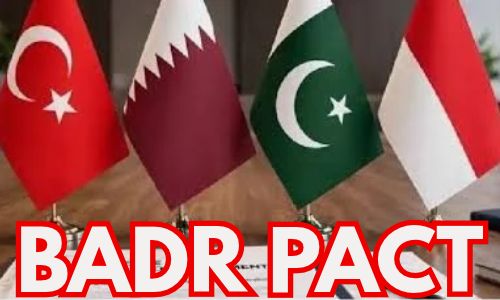
Qasim Waseem2026-10-30T13:20:40+00:00The Badr Pact, signed on October 21, 2026, in Doha, is not a mutual defense treaty. It is a defense-industrial integration framework among Türkiye, Pakistan, Qatar, and Indonesia designed to pool manufacturing capacity, reduce dependence on Western arms suppliers, and build a self-sustaining Islamic military-industrial complex . Unlike the Mecca Pact’s collective security guarantee, Badr focuses on supply chains, joint production, and technology transfer—making it a long-term industrial play rather than an immediate military alliance .
What Is the Badr Pact?
The Badr Memorandum of Understanding (MoU) is a four-nation defense cooperation framework signed by Türkiye, Pakistan, Qatar, and Indonesia in Doha on October 21, 2026. The agreement focuses on four pillars: joint defense manufacturing, research and development, technical military training, and defense industrial capacity building .
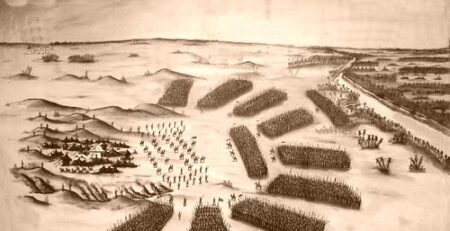
The name “Badr” carries dual symbolism. It references the Arabic word for “full moon,” suggesting how the complementary strengths of the four nations form a complete circle. It also evokes the Battle of Badr (624 CE), a pivotal early Islamic military victory—though analysts note the pact itself is industrial rather than martial in character .
The signatories bring distinct assets to the table:
-
Türkiye: The most advanced defense industry among the four, with proven drone (Bayraktar TB2), armored vehicle, and naval shipbuilding capabilities .
-
Pakistan: Manufacturing capacity, manpower, technical training expertise, and existing experience in joint production with China (JF-17 fighter) and Türkiye (Babur-class corvettes) .
-
Qatar: Substantial investment capital through Barzan Holdings and a track record of procuring Turkish defense systems .
-
Indonesia: Industrial scale, manpower, and a growing defense modernization budget, including submarine construction with French technology transfers .
Background: Why Now?
The Badr Pact did not emerge in a vacuum. It is the product of three converging pressures.
First, the unreliability of traditional security guarantors. The U.S.-Iran war and Houthi attacks on Gulf infrastructure exposed the limits of relying on external suppliers for critical weapons and maintenance. When Washington can restrict spare parts or suspend entire programs—as it did with Türkiye’s F-35 removal and Indonesia’s F-16 embargoes—buyers face existential vulnerabilities . As one analyst put it, Badr is partly “to escape precisely this vulnerability” .
Second, Pakistan’s expanding defense diplomacy. Islamabad has spent the past year stitching together a network of defense agreements: a Strategic Mutual Defense Agreement with Saudi Arabia (September 2025), the Mecca Joint Defense Agreement with Saudi Arabia and Türkiye (August 2026), a protocol with Kuwait, and now Badr . Each pact includes provisions for joint defense production, reflecting Pakistan’s long-term goal of moving from buyer-seller relationships to co-production partnerships .
Third, Türkiye’s defense export surge. Ankara sealed $15 billion in fresh defense contracts in 2026 and is streamlining domestic orders. The Badr framework serves as a gateway for overseas markets and helps consolidate Qatar’s defense indigenization drive alongside Turkish export strategy .
How It Differs from the Mecca Pact
The most common confusion surrounding Badr is its relationship to the Mecca Pact. They are fundamentally different instruments.
| Dimension | Mecca Pact (August 2026) | Badr Pact (October 2026) |
|---|---|---|
| Core principle | Collective defense: attack on one is attack on all | Defense industrial cooperation |
| Members | Saudi Arabia, Pakistan, Türkiye | Türkiye, Pakistan, Qatar, Indonesia |
| Primary function | Deterrence through mutual security commitment | Supply chain integration, joint production, R&D |
| Time horizon | Immediate security guarantee | Long-term industrial capacity building |
| Strategic logic | Political promise of deterrence | Material means to sustain deterrence |
As defense analyst Andreas Krieg summarized: the Mecca Pact “offers a political promise of deterrence, while [Badr] could eventually help supply the means to sustain it” . The two agreements are complementary rather than competitive—Mecca provides the security umbrella, Badr builds the industrial foundation underneath it.
Workability: Can It Actually Deliver?
The Badr Pact’s workability depends on whether the four nations can translate complementary strengths into functioning supply chains. There are reasons for both optimism and caution.
Evidence supporting workability:
The signatories already have a track record of bilateral defense production. Türkiye and Indonesia jointly developed the Kaplan/Harimau medium tank, now in service with both countries. Pakistan’s Babur-class corvettes are based on Türkiye’s MILGEM design, with two built in Türkiye and two in Karachi. Türkiye’s Bayraktar TB2 drones have been acquired by Pakistan and are operational . Qatar’s BARQ joint venture with Turkish defense giants Aselsan, STM, and MKE is already thriving . Badr essentially formalizes and multilateralizes existing bilateral arrangements.
Constraints and risks:
Western technology remains indispensable for advanced propulsion, avionics, sensors, and certain electronic components. Access to these is frequently subject to export controls and political restrictions . The pact cannot instantly substitute for decades of Western and Chinese industrial dominance. Additionally, the four nations have divergent threat perceptions: Qatar’s primary concern is Iran, Pakistan’s is India, Indonesia seeks strategic autonomy without an imminent threat, and Türkiye balances NATO membership with independent defense ambitions . Managing these differences will require sustained diplomatic coordination.
The MoU’s language is deliberately non-binding on military action. It is an industrial work-share agreement, not a mutual defense pledge . This lowers the political cost of participation but also means its impact will be measured in factories and supply chains, not battlefields.
Impact on Regional Countries Not Yet in the Pact
India views the pact with concern on two fronts: Pakistan’s ability to diversify its weapons sources beyond China, and Indonesia’s participation months after signing a $630 million deal with New Delhi for BrahMos missiles . However, Indian experts note that an MoU is not a military alliance, and the BrahMos deal contains strict data protection clauses . The larger worry is long-term: if Pakistan gains access to Indonesian manufacturing scale and Turkish technology, its defense industrial base could become more resilient against sanctions or supply disruptions.
Iran sees Badr as part of an emerging interconnected defense-industrial network around it. While Qatar remains committed to dialogue with Tehran, the pact creates an additional deterrent and “the risk that Iran interprets greater Gulf military cooperation as a form of strategic encirclement” .
Saudi Arabia and other Gulf states are not signatories, but the Badr framework is open in principle. The Mecca Pact already binds Saudi Arabia, Pakistan, and Türkiye in a collective defense arrangement. If Badr proves workable, Gulf states seeking to reduce dependence on U.S. and European suppliers may seek entry—particularly if the pact produces credible alternatives for maintenance, ammunition, and mid-tier systems .
Israel is watching Türkiye’s growing ability to organize defense-industrial relationships beyond NATO with particular concern, given rising tensions over Syria .
What’s in It for the Stakeholders?
Türkiye gains access to Qatari capital, Pakistani and Indonesian manufacturing capacity, and new export markets for its defense industry. The pact also reduces Ankara’s vulnerability to Western supply chain restrictions—a lesson learned from its F-35 expulsion .
Pakistan secures foreign investment, technology transfer, and a pathway to elevate its defense industry from licensed production to co-development. The Badr framework supports Islamabad’s broader strategic goal of becoming a competitive arms exporter and sustaining credible conventional deterrence against India .
Qatar advances its defense indigenization ambitions by linking Qatari investment to Turkish technological expertise and Pakistani/Indonesian production capacity. Doha’s BARQ joint venture and its decade of investments in Türkiye’s defense sector position it as the financial backbone of the pact .
Indonesia gains access to Turkish defense technology and a multilateral framework that supports its strategic autonomy goals. Jakarta’s participation does not require it to abandon existing partnerships with India, France, or South Korea—Badr is an industrial cooperation platform, not an exclusive alliance .
Scope: What Badr Covers and What It Doesn’t
Covered: Joint research and development, technology transfer, co-production of defense hardware (including drones, armored vehicles, naval vessels, precision missiles, air defense systems, and potentially next-generation fighter components), technical training, and supply chain integration . The pact also includes mutual support clauses under which member states facing external aggression would receive military supplies from fellow signatories—though this falls short of a binding military intervention commitment .
Not covered: Automatic military intervention, joint command structures, or a collective defense guarantee equivalent to NATO’s Article 5. The Badr MoU is an industrial and technical framework, not a war-fighting alliance .
Final Words
The Badr Pact represents a pragmatic shift in Islamic-world security cooperation: from symbolic declarations to supply chain integration. Its success will depend not on battlefield coordination but on factory floors, technology transfer agreements, and the willingness of four diverse nations to subordinate bilateral rivalries and external partnerships to a shared industrial project. If it works, it could fundamentally alter the arms procurement landscape from the Gulf to Southeast Asia. If it stalls, it will join the long list of ambitious multilateral frameworks that never moved beyond the signing ceremony.











LEAVE A COMMENT