
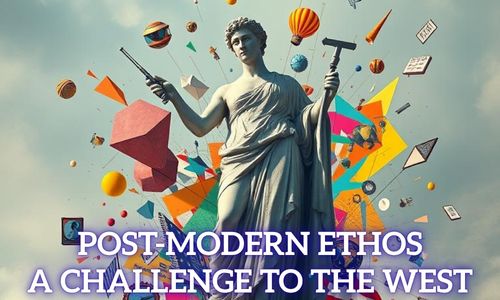
Post-Modern Ethos – A Challenge to the West
ESSAY OUTLINE
1. Introduction
- Opening Thought: Begin by explaining how Western civilization has long been rooted in modernist ideals like rationality, progress, and objective truth.
- Context: Introduce post-modernism as a movement that questions these foundational beliefs, emphasizing relativism, subjectivity, and cultural pluralism.
- Relevance: Highlight how post-modern ethos challenges the West’s intellectual, moral, and political traditions.
- Thesis Statement: Post-modernism challenges the Western worldview by rejecting universal truths, questioning authority, and redefining morality, culture, and knowledge.
2. Understanding the Post-Modern Ethos
- Definition and Origins:
- Explain post-modernism as a reaction against Enlightenment rationalism and modernist certainty.
- Mention thinkers like Foucault, Derrida, and Lyotard.
- Core Beliefs:
- Relativism, pluralism, deconstruction of grand narratives, and skepticism toward objectivity.
- Contrast with Modernism:
- Modernism values reason, science, and progress; post-modernism values diversity, irony, and critique.
3. Post-Modernism’s Challenge to Western Thought
- Rejection of Absolute Truth:
- Explain how post-modernism undermines Western belief in universal truth and reason.
- Critique of Power and Authority:
- Discuss how it exposes hidden power structures in politics, religion, and academia.
- Redefinition of Morality:
- Show how moral relativism challenges Western ethical traditions based on Christian or Enlightenment values.
- Impact on Culture and Art:
- Highlight how post-modern aesthetics favor fragmentation, parody, and experimentation over order and harmony.
4. Political and Social Implications
- Identity Politics:
- Explain how post-modernism fuels movements focused on race, gender, and sexuality.
- Globalization and Multiculturalism:
- Discuss how post-modern ethos promotes cultural diversity but challenges Western dominance.
- Crisis of Authority:
- Analyze how trust in traditional institutions—governments, media, religion—has weakened.
5. The Western Response
- Adaptation:
- Describe how Western societies have integrated post-modern values through liberalism and inclusivity.
- Resistance:
- Note how conservatives and traditionalists push back, calling for the restoration of reason, order, and faith.
- Intellectual Debate:
- Mention ongoing tensions between rational modernists and relativist post-modernists.
6. Conclusion
- Restate Thesis: Post-modern ethos has fundamentally challenged the intellectual and moral foundations of the West.
- Summary of Key Points: Revisit its impact on truth, authority, culture, and politics.
- Final Thought: The challenge of post-modernism forces the West to reexamine its values—balancing freedom and diversity with coherence and truth.
ESSAY
Western civilization has long built its identity on the pillars of modernism — reason, progress, and the pursuit of objective truth. Thinkers from the Enlightenment, such as Descartes, Locke, and Kant, shaped a worldview that trusted human rationality to uncover universal laws governing nature, society, and morality. The West advanced science, democracy, and technology under the belief that reason could lead humanity toward perfection. This faith in logic and progress became the foundation of Western dominance in global thought and development.
However, post-modernism emerged as a critical response to these modernist assumptions. Post-modern thinkers began to question whether universal truth or objective knowledge truly exists. They argued that what societies call “truth” is often constructed by power, language, and culture rather than discovered through reason. Post-modernism values subjective experiences, diversity of perspectives, and cultural pluralism. It challenges the idea that a single rational framework can explain all aspects of human life. Instead, it promotes the belief that meaning is relative and context-dependent.
This shift in thinking directly challenges the intellectual and moral foundations of the West. The post-modern ethos undermines the Western belief in absolute morality, rational progress, and institutional authority. It compels Western societies to reexamine their confidence in science, religion, and politics as sources of truth. By promoting relativism and skepticism, post-modernism reshapes how people interpret justice, identity, and cultural values. As a result, it transforms not only Western thought but also its influence on global politics, education, and media.
Post-modernism challenges the Western worldview by rejecting universal truths, questioning authority, and redefining morality, culture, and knowledge. It does not merely oppose Western ideals; it compels the West to confront its assumptions about truth, progress, and power. Through its critique, post-modernism becomes both a philosophical challenge and a cultural turning point—forcing the West to balance reason with relativism and progress with pluralism.
Post-modernism emerged as a reaction against the Enlightenment ideals and the rigid certainties of modernism. Thinkers began to question the belief that reason and science could explain all aspects of human experience. They argued that modernist ideas of progress and universal truth often ignored cultural diversity and subjective perspectives. Philosophers like Michel Foucault, Jacques Derrida, and Jean-François Lyotard led this intellectual shift.
- Foucault examined how power and knowledge are intertwined, showing that truth often serves those in authority.
- Derrida introduced deconstruction, a method of analyzing texts to reveal hidden biases and contradictions.
- Lyotard famously declared that post-modernism marks “incredulity toward metanarratives,” meaning skepticism toward any overarching explanation of history or reality.
Through their ideas, these thinkers challenged the notion that there is a single, objective reality. Instead, they encouraged people to see truth as socially constructed and context-dependent.
Post-modernism rests on several central ideas that redefine how individuals interpret the world.
- Relativism asserts that truth and morality vary across cultures and situations rather than existing as absolute concepts.
- Pluralism celebrates diversity of thought, culture, and identity, rejecting the dominance of any one worldview.
- Deconstruction of Grand Narratives urges society to question sweeping ideologies—such as progress, nationalism, or religion—that claim universal validity.
- Skepticism Toward Objectivity challenges the belief that knowledge can ever be completely neutral or unbiased.
Post-modern thinkers argue that language, media, and institutions shape human understanding. By exposing hidden assumptions and power dynamics, they empower people to think critically and embrace multiple perspectives.
Modernism and post-modernism represent two distinct worldviews. Modernism, rooted in Enlightenment thought, values reason, science, and progress as the guiding forces of civilization. It believes that humanity can achieve improvement and order through logic, technology, and universal principles. Post-modernism, by contrast, questions these assumptions. It values diversity, irony, and critique, emphasizing that progress is not linear and that truth varies across contexts.
While modernism seeks certainty and structure, post-modernism celebrates ambiguity and open interpretation. Modernists build systems; post-modernists dismantle them to expose their limitations. This contrast defines the post-modern ethos—it does not reject knowledge altogether but reframes it as something fluid, shaped by human experience and culture.
Post-modernism directly challenges the Western belief in universal truth and objective reason. It rejects the idea that one single, rational explanation can define reality for all people and cultures. Post-modern thinkers argue that truth is not discovered but constructed through language, culture, and social context. By doing so, they undermine the Enlightenment ideal that reason and science can provide ultimate answers. Instead, post-modernism promotes multiple perspectives and subjective interpretations, encouraging individuals to question authority and established knowledge systems. This shift weakens the Western notion of a stable, shared truth and replaces it with a fluid, interpretive understanding of reality.
Post-modernism exposes and critiques the hidden power structures embedded in Western institutions such as politics, religion, and academia. Thinkers like Michel Foucault argue that knowledge is closely tied to power—those who control discourse also shape what society accepts as truth. Post-modernists actively deconstruct dominant narratives to reveal how authority manipulates language, norms, and beliefs to maintain control. By questioning the legitimacy of institutions that claim moral or intellectual superiority, post-modernism forces the West to confront issues of inequality, exclusion, and oppression. This critical approach encourages marginalized voices to challenge systems that have historically silenced them.
Post-modernism redefines morality by replacing universal moral codes with context-based ethical relativism. It rejects the Western tradition of deriving moral values from absolute sources such as Christian doctrine or Enlightenment rationality. Instead, post-modern thought asserts that moral judgments depend on individual perspectives, cultural norms, and situational factors. This shift disrupts the West’s long-standing confidence in a shared moral foundation. While it empowers people to question outdated or oppressive moral systems, it also raises concerns about moral ambiguity and the absence of shared ethical standards. Post-modernism, therefore, compels Western society to rethink how it defines justice, virtue, and responsibility in a pluralistic world.
Post-modernism revolutionizes Western culture and art by rejecting order, harmony, and singular meaning. Artists, writers, and architects embrace fragmentation, parody, and irony as ways to reflect the complexity of modern life. They challenge the modernist belief that art must convey universal beauty or truth. Instead, post-modern creators mix styles, borrow from history, and blur the boundaries between high and popular culture. This approach encourages audiences to interpret meaning individually rather than rely on established norms. Through its embrace of diversity, experimentation, and playfulness, post-modern art mirrors the philosophical shift toward uncertainty and pluralism that defines the broader post-modern ethos.
Post-modernism fuels identity-based movements by emphasizing the importance of personal experience, cultural background, and social identity over universal norms. It challenges the Western idea of a single, unified human experience by arguing that people’s realities differ based on race, gender, sexuality, and class. Thinkers influenced by post-modern thought encourage individuals to reclaim their narratives and resist dominant cultural or political structures that have historically silenced them. As a result, movements such as feminism, LGBTQ+ rights, and anti-racism have gained stronger intellectual foundations. Post-modernism empowers marginalized groups to question systemic oppression and to redefine what justice and equality mean in contemporary society. By rejecting universal truths, it creates space for multiple perspectives, though this also leads to growing political polarization and fragmented social discourse in Western societies.
Post-modern ethos promotes globalization and multiculturalism by celebrating diversity and rejecting the idea of Western cultural superiority. It encourages societies to recognize the value of all cultural expressions and to move away from Eurocentric worldviews that dominated much of modern history. Post-modern thinkers advocate for cultural pluralism, where no single culture claims authority over truth, morality, or beauty. This perspective has led to a more interconnected world where ideas, traditions, and art forms from non-Western societies gain visibility and respect. However, it also challenges Western dominance by questioning the moral legitimacy of its political, economic, and cultural influence. As Western nations engage with this ethos, they face the complex task of balancing global inclusivity with preserving their own cultural identity. In doing so, post-modernism reshapes global relationships by promoting equality and dialogue, but it also contributes to ideological uncertainty about Western values and leadership.
Post-modernism creates a profound crisis of authority by eroding trust in traditional institutions such as governments, media, religion, and academia. It questions the legitimacy of all power structures, arguing that authority often serves hidden interests rather than objective truth or public good. This skepticism leads individuals to view institutions not as protectors of order but as systems of control and manipulation. In the political sphere, people increasingly doubt the credibility of leaders and experts, often turning to alternative sources of information, including social media and grassroots movements. The media, once seen as the voice of truth, now faces accusations of bias and misinformation. Similarly, religious and moral institutions lose influence as post-modern relativism challenges absolute moral values. Consequently, Western societies experience a decline in collective trust, moral coherence, and civic engagement. While this questioning spirit promotes critical thinking and freedom, it also risks destabilizing the social fabric that holds communities together.
Western societies have actively integrated post-modern values into their political, social, and cultural systems. Governments and institutions promote liberalism, inclusivity, and diversity, reflecting a shift from rigid modernist ideals toward acceptance of multiple perspectives. Universities encourage interdisciplinary studies and critical thinking that question traditional hierarchies of knowledge. Media and popular culture also celebrate pluralism, individuality, and identity expression.
By embracing post-modern ideals, the West has broadened its understanding of equality and human rights, ensuring that marginalized voices gain representation in politics, art, and education. This adaptation demonstrates how Western civilization continues to evolve—absorbing critique rather than rejecting it outright.
While many embrace post-modern ideals, conservative and traditionalist groups in the West have strongly resisted these changes. They argue that post-modernism undermines objective truth, moral stability, and social cohesion. These groups promote a return to classical values based on reason, faith, and structured ethics, claiming that relativism weakens society’s moral compass.
Religious institutions, political conservatives, and cultural critics often defend traditional Western ideals such as rationalism, family integrity, and spiritual belief. They believe that the post-modern emphasis on subjectivity and deconstruction leads to confusion and moral decay. Thus, the resistance reflects a broader cultural struggle—a clash between maintaining order and embracing change.
The Western world continues to witness an intense intellectual debate between modernists and post-modernists. Modernist thinkers defend rational inquiry, science, and universal values as the foundation of progress. In contrast, post-modernists argue that truth is constructed, not discovered, and that all knowledge depends on perspective and power relations.
This ongoing tension fuels academic, philosophical, and political discussions about the nature of truth, freedom, and identity. Universities and think tanks often become battlegrounds where these ideologies collide. The debate encourages critical reflection within Western culture, forcing it to question whether absolute truth can coexist with pluralism. Ultimately, this intellectual struggle demonstrates that post-modernism has not destroyed the West’s foundations—it has reinvigorated its self-examination and compelled it to redefine what progress truly means.
Post-modern ethos has fundamentally challenged the intellectual and moral foundations of the West by questioning the very principles upon which Western civilization has stood for centuries. It has dismantled the long-held belief in universal truth, objective knowledge, and rational progress—values that once defined the Enlightenment and modernist thought. By rejecting absolute certainty and embracing pluralism, post-modernism has forced Western philosophy, politics, and culture to reconsider their assumptions about truth, morality, and authority. The West can no longer rely solely on rationalism and science as the ultimate arbiters of knowledge because post-modern thought exposes their limits and inherent biases.
Post-modernism has reshaped the Western worldview in multiple dimensions. In philosophy, it has undermined the supremacy of reason and truth by replacing them with interpretation and perspective. In politics, it has challenged established power structures and given rise to identity-based movements that demand recognition and justice. In culture and art, it has encouraged diversity, creativity, and experimentation while rejecting rigid aesthetic norms. In ethics and morality, it has eroded the dominance of absolute moral codes, promoting instead a contextual and situational approach. Through these changes, post-modernism has both expanded intellectual freedom and destabilized traditional Western coherence.
The challenge of post-modernism compels the West to look inward and reexamine its values. Western societies must learn to balance freedom and diversity with coherence and shared meaning. If the West embraces the richness of post-modern pluralism without abandoning its moral and intellectual anchor, it can achieve a more inclusive yet stable civilization. However, if it continues to drift toward complete relativism, it risks losing the sense of direction that once fueled its progress. Ultimately, the post-modern challenge is not a threat to be feared but an opportunity to rebuild the foundations of Western thought on a more self-aware, equitable, and human-centered basis.












LEAVE A COMMENT