
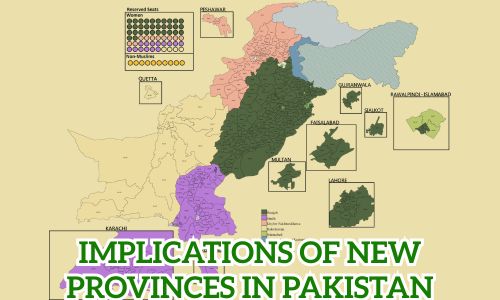
Implications of New Provinces in Pakistan
ESSAY OUTLINE
1. Introduction
- Hook: Pakistan’s current provincial structure, largely inherited from British administrative divisions, struggles to manage the governance, population, and resource needs of the 21st century.
- Context: The demand for new provinces—such as South Punjab, Bahawalpur, Hazara, or a unified Karachi division—stems from perceptions of administrative neglect, economic underdevelopment, and political marginalization within large, heterogeneous provinces.
- Thesis Statement: While the creation of new provinces in Pakistan offers a powerful mechanism for improving administrative efficiency, decentralizing power, and addressing grievances of sub-national groups, it simultaneously poses significant risks to national integration by exacerbating ethnic fractionalization, complicating resource distribution, and potentially undermining the federal structure if not implemented with a cohesive, constitutionally sound strategy.
2. The Case for New Provinces: Drivers and Potential Benefits
- A. Administrative Efficiency and Good Governance:
- Argues that smaller administrative units allow for more focused governance, shorter supply chains for public services, and greater responsiveness to local issues compared to the unwieldy current provinces (e.g., Punjab’s massive population versus Balochistan’s geographic expanse).
- B. Addressing Perceived Marginalization:
- Highlights that identity-based movements (Seraiki in South Punjab, Hindko in Hazara) argue that their regions suffer from “internal colonialism,” where resources and development focus on the dominant ethnic or urban hub (e.g., Lahore). New provinces promise a fairer distribution of political power and economic resources to peripheral regions.
- C. Devolution and Proximity to the People:
- Explains that creating new provinces deepens the principle of devolution by bringing decision-makers closer to the electorate, potentially strengthening local accountability and democratic participation.
3. The Risks and Challenges to an Integrated Country
- A. Ethnic and Linguistic Fragmentation:
- Warns that carving provinces along ethnic or linguistic lines could harden identities, leading to a “balkanization” of the state. It may create isolated ethnic enclaves rather than fostering a cohesive Pakistani identity, potentially igniting similar demands from other groups and destabilizing the federal compact.
- B. The Politics of Resource Distribution:
- Addresses the contentious issue of the National Finance Commission (NFC) Award. Creating new provinces would radically alter the revenue-sharing formula. Existing provinces would resist losing their share of resources, leading to intense inter-provincial rivalries over water, natural resources (like gas in Sindh/Balochistan), and fiscal space that could paralyze the federation.
- C. Logistical and Constitutional Complexities:
- Discusses the practical hurdles: the constitutional requirement for a two-thirds parliamentary majority and provincial assembly consent, the massive financial cost of establishing new bureaucratic and infrastructure systems, and the lack of a clear, agreed-upon criteria (population, ethnicity, or geography) for the creation of new units.
4. The Crucial Role of the Federal Framework and Policy
- A. Constitutional Mechanisms and Consensus:
- Argues that unilateral creation of provinces by a dominant federal government would breed distrust and resistance. A successful restructuring requires a national consensus—through the Council of Common Interests (CCI)—that prioritizes the unity of the federation over short-term political gains.
- B. Moving Beyond Ethnicity: A Model for Integration:
- Proposes that the criteria for new provinces must avoid purely ethnic delineations. Instead, provinces should be created based on a combination of administrative viability, economic sustainability, and geographic contiguity. For instance, a “South Punjab” province, while having a Seraiki-speaking majority, is ethnically diverse; framing it as an administrative solution rather than an ethnic one is key to maintaining integration.
- C. Strengthening Local Government as an Alternative:
- Suggests that before undertaking the monumental task of provincial restructuring, Pakistan must first genuinely empower local governments. Strong, autonomous, and well-funded local bodies can resolve many issues of administrative neglect and marginalization without the constitutional upheaval and integration risks that accompany creating entirely new provinces.
5. Conclusion
- Restate Thesis (in new words): The debate over new provinces forces Pakistan to confront a fundamental tension: the need for administrative justice and local autonomy must be carefully balanced against the imperative of maintaining a unified, integrated federation. Creating new provinces is not inherently divisive or unifying; its outcome depends entirely on the intent and structure behind it.
- Summarize Key Points: Creating new provinces promises to cure administrative inefficiency and regional neglect, but it threatens to ignite ethnic rivalries and paralyze the federation through resource wars. History shows that decentralization can strengthen a state if done through consensus, but it can break it if pursued unilaterally along purely ethnic lines.
- Concluding Thought: Pakistan must approach provincial restructuring not as a tool for short-term political appeasement but as a strategic exercise in statecraft. The path forward requires a national dialogue that prioritizes constitutional consensus, establishes non-ethnic criteria for new units, and simultaneously strengthens local governments. Only by prioritizing integration within the framework of administrative reform can Pakistan ensure that the creation of new provinces strengthens, rather than severs, the bonds of the nation.
ESSAY
Pakistan’s current provincial structure, a relic of British administrative divisions, struggles to govern a 21st-century nation of over 240 million people. These inherited boundaries, designed for colonial control rather than democratic representation, creak under the weight of massive population disparities and geographically concentrated economic activity. They fail to deliver basic services efficiently, leaving sprawling provinces like Punjab with a population larger than that of many countries, while smaller provinces grapple with their own internal peripheries. This outdated framework consequently fuels administrative paralysis, as distant secretariats remain disconnected from the unique needs of far-flung districts, from the deserts of Cholistan to the mountains of Kohistan.
Demands for new provinces—such as South Punjab, Bahawalpur, Hazara, or a unified Karachi division—emerge directly from widespread perceptions of administrative neglect, economic underdevelopment, and political marginalization. Citizens in South Punjab argue that a distant Lahore consumes the region’s resources while ignoring its infrastructure and agricultural crises. In Khyber Pakhtunkhwa, the Hazara region asserts its distinct identity and demands a separate province to escape what it views as political subjugation by the Pashtun-majority south. Similarly, the demand for a unified Karachi division reflects the city’s unique status as Pakistan’s economic engine, where residents believe fragmented local governments and interference from the provincial government in Sindh stifle its potential and deny its diverse population effective urban governance.
Creating new provinces in Pakistan offers a powerful mechanism for improving administrative efficiency, decentralizing power, and addressing long-held grievances of sub-national groups. However, this process simultaneously poses significant risks to national integration by exacerbating ethnic fractionalization, complicating resource distribution, and potentially undermining the federal structure if we do not implement it with a cohesive, constitutionally sound strategy. Success demands a deliberate approach that balances the legitimate aspirations for self-governance with the overarching need to maintain a unified, stable, and economically cohesive Pakistani federation.
Proponents of new provinces argue that breaking up gargantuan administrative units like Punjab, with its population exceeding that of many countries, or geographically sprawling Balochistan, allows for more focused and efficient governance. Smaller provinces streamline bureaucratic supply chains, enabling them to deliver public services—such as healthcare, education, and infrastructure maintenance—with greater speed and precision. Administrators in a smaller province can concentrate their limited resources on a more cohesive geographic area and population, directly addressing local needs without the bottlenecks inherent in managing a massive, diverse territory from a distant, overburdened capital. This restructuring ultimately fosters good governance by replacing an unwieldy system with manageable units where officials maintain closer oversight and citizens experience more direct, responsive administration.
Identity-based movements, such as the Seraiki struggle in South Punjab and the Hindko movement in Hazara, articulate a clear narrative of “internal colonialism,” charging that the current provincial structure systematically neglects their regions. These movements argue that dominant ethnic or urban centers—most notably Lahore in Punjab—consistently siphon development funds, political appointments, and infrastructure projects, leaving peripheral areas impoverished and voiceless. Creating new provinces directly confronts this imbalance by dismantling the centralized power structure that perpetuates it. A new province would empower local leadership, establish a new political and economic hub within the region, and mandate a fairer distribution of resources, thereby transforming historically marginalized communities into centers of decision-making and investment.
Creating new provinces advances the principle of devolution by fundamentally shortening the distance between citizens and their government. When we establish a new province, we move decision-making authority for key sectors like health, education, and local policing from a remote central secretariat to a capital located within the community itself. This proximity makes the electorate more capable of holding their elected representatives and appointed officials directly accountable for results. Citizens gain easier access to government offices, can more effectively organize around local issues, and possess a clearer understanding of the political processes shaping their daily lives. Consequently, this structural change strengthens democratic participation by transforming governance from a distant, abstract concept into a tangible, responsive, and locally-owned enterprise.
Carving provinces along ethnic or linguistic lines hardens identities, transforming fluid cultural differences into rigid political battlelines. This approach actively undermines the goal of a cohesive Pakistani identity by replacing it with isolated ethnic enclaves, each demanding exclusive political control over its territory. We risk igniting a chain reaction of similar demands, as every distinct group—from the Saraiki-speaking belt in Punjab to the Hazara community in Khyber Pakhtunkhwa—will justifiably demand its own province, arguing for parity with the newly created units. This fragmentation ultimately destabilizes the federal compact, weakening the center’s authority and pulling the state toward a destructive “balkanization” where national unity gives way to competing, inward-looking regional fiefdoms.
Creating new provinces radically alters the National Finance Commission (NFC) Award, the critical formula that distributes fiscal resources among federating units. Existing provinces fiercely resist losing their share, turning the NFC negotiations from a fiscal exercise into a zero-sum political brawl. New provinces will demand a larger slice of the pie, directly threatening the budgets of established ones like Punjab and Sindh, which will fight to protect their revenue streams. Beyond fiscal transfers, new provincial boundaries intensify inter-provincial rivalries over physical resources; we will see renewed and more complex conflicts over the distribution of Indus River water and bitter disputes over natural resources such as Sindh’s natural gas or Balochistan’s minerals. This contentious politics paralyzes the federation, consuming governmental energy in perpetual squabbles over revenue rather than focusing on national development.
The constitutional path to creating new provinces imposes nearly insurmountable procedural hurdles. We require a two-thirds supermajority in both houses of parliament, a formidable political feat, but we also need the consent of each existing provincial assembly—a requirement that gives the very provinces we seek to divide a powerful veto over their own dismemberment. Simultaneously, we face the massive financial cost of establishing entirely new bureaucratic infrastructures, including new secretariats, high courts, police forces, and public service commissions for each new province, diverting billions of rupees from development to administrative duplication. Furthermore, we lack a clear, agreed-upon criteria for the creation of new units, leaving us without a coherent framework to decide whether to prioritize population, ethnic homogeneity, geography, or administrative efficiency, thereby making any proposal vulnerable to accusations of political favoritism or gerrymandering.
Pakistan’s federal framework, enshrined in the Constitution, establishes the Council of Common Interests (CCI) as the supreme forum for harmonizing center-province relations. The framers of the Constitution deliberately designed the CCI to operate on the principle of consensus, ensuring that no single actor—including a dominant federal government—can unilaterally alter the federation’s territorial architecture. A federal government that bypasses this constitutional mechanism to create new provinces unilaterally would actively breed deep-seated distrust and provoke fierce resistance from existing provincial governments, who would view such an act as a power grab rather than a reform. Therefore, a successful restructuring must originate within the CCI, where the federal government and all provincial chief ministers must forge a genuine national consensus. Such an approach prioritizes the unity of the federation, ensuring that any decision to create new provinces emerges not from short-term political calculations or electoral ambitions, but from a shared, constitutionally grounded commitment to long-term national stability and equitable governance.
To preserve national cohesion, we must define the criteria for new provinces by explicitly rejecting purely ethnic delineations. Instead, we should establish provinces based on the objective, integrated criteria of administrative viability, economic sustainability, and geographic contiguity. The proposed creation of a “South Punjab” province serves as a clear example of this principle. While the region does have a Seraiki-speaking majority, we should frame its creation not as an ethnic demand but as a necessary administrative solution to address the region’s vast distances, historical underdevelopment, and governance deficits. By emphasizing that such a province would bring governance closer to the people and improve service delivery, we can counter the risk of fostering ethnic polarization. This model of integration—focusing on functional governance rather than ethnic identity—provides a blueprint for maintaining a unified Pakistani identity even as we reorganize the administrative map.
Before undertaking the monumental and constitutionally complex task of creating new provinces, we must first genuinely empower local governments as a more agile and less disruptive alternative. Strong, autonomous, and well-funded local bodies can resolve the core issues of administrative neglect and marginalization at their source—the district and community level. Devoting resources to devolving power to local governments allows us to address grievances over service delivery, resource distribution, and political representation without triggering the intense constitutional upheaval and integration risks that accompany provincial restructuring. Empowering local governments provides a practical, scalable path to reform: it decentralizes power, diffuses ethnic and regional tensions by focusing on local issues, and strengthens the federation from the ground up. By making local governance genuinely effective, we can often satisfy the public’s demand for greater autonomy and representation, potentially rendering the more drastic step of creating new provinces unnecessary in many cases.
Pakistan’s ongoing debate over creating new provinces exposes a core national dilemma: we cannot pursue administrative justice and local autonomy without simultaneously safeguarding a unified federation. This tension does not present an insurmountable contradiction. We determine the outcome—whether division or unity—not through the act of creation itself, but through the intent guiding the process and the constitutional structure we build around it. Therefore, we must judge proposals not by their rhetoric but by their capacity to balance these competing yet essential priorities.
New provinces promise significant benefits: they cure administrative inefficiency by bringing governance closer to the people, and they directly address decades of regional neglect by redistributing political and economic power. However, these promises come with severe risks. We risk igniting destructive ethnic rivalries if we draw borders solely along linguistic or cultural lines, and we could paralyze the federation through unending “resource wars” over fiscal distribution. History offers a clear lesson: decentralization strengthens a state when we pursue it through broad national consensus and a spirit of cooperation. Conversely, decentralization breaks a state when we pursue it unilaterally or through a purely ethnic lens, as such actions invite fragmentation rather than reform.
We must fundamentally shift our approach to provincial restructuring, rejecting it as a tool for short-term political appeasement and embracing it instead as a strategic exercise in long-term statecraft. To do this, we must first initiate a genuine national dialogue that prioritizes achieving a broad constitutional consensus over satisfying narrow partisan interests. We must then establish clear, non-ethnic criteria—such as administrative viability, economic sustainability, and geographic contiguity—for creating any new unit. Simultaneously, we must strengthen local governments, ensuring that decentralization empowers communities at all levels rather than merely creating another layer of elite politics. Ultimately, we secure Pakistan’s future by embedding integration within administrative reform. Only by pursuing this balanced path can we ensure that creating new provinces strengthens, rather than severs, the bonds of the nation.











LEAVE A COMMENT