
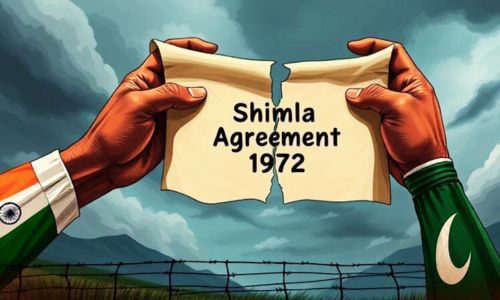
Shimla Agreement Suspension
Pakistan suspended the Shimla Agreement as a direct response to India’s decision to freeze the Indus Waters Treaty. This escalation followed a terror attack in Pahalgam, Jammu and Kashmir, which heightened tensions between the two nations. Pakistan’s government stated that it would hold all bilateral agreements with India, including the Shimla Agreement, in abeyance until India ceased what Pakistan described as “fomenting terrorism inside Pakistan” and other actions it deemed hostile.
The Shimla Agreement, signed in 1972, was a peace treaty that emphasized bilateral dispute resolution, respect for the Line of Control (LoC), and non-interference in each other’s affairs. Its suspension marks a significant shift in India-Pakistan relations, raising concerns about regional stability.
Birds Eye View of Shimla Agreement of 1972
The Shimla Agreement was signed on July 2, 1972, between the then Indian Prime Minister Indira Gandhi and Pakistan’s President Zulfikar Ali Bhutto following the Indo-Pakistani War of 1971. The agreement laid the groundwork for peaceful coexistence and a mutual commitment to resolve all disputes, especially Kashmir, through bilateral negotiations. Its primary principles included:
- Respect for each other’s sovereignty and territorial integrity.
- Non-aggression and non-interference in each other’s internal affairs.
- Peaceful resolution of disputes.
With its suspension, Pakistan effectively discards decades of established diplomatic norms, setting a precedent with far-reaching consequences.
Immediate Implications for Bilateral Relations
The revocation of the Shimla Agreement could have significant consequences for both India and Pakistan, particularly in terms of diplomacy, security, and regional stability:
1. Diplomatic Relations: The Shimla Agreement emphasized bilateral resolution of disputes, particularly regarding Kashmir, without third-party intervention. Its suspension could lead to increased internationalization of the Kashmir issue, with Pakistan seeking support from global organizations like the United Nations.
2. Line of Control (LoC): The agreement established the LoC as the de facto border in Jammu and Kashmir. Without the Shimla Agreement, the commitment to respect the LoC might weaken, potentially leading to more frequent cross-border skirmishes.
3. Security Concerns: The absence of a framework for peaceful dispute resolution could escalate military tensions, increasing the risk of misunderstandings and conflicts between the two nuclear-armed nations.
4. Economic and Trade Impact: The suspension of the agreement could further strain economic ties, as Pakistan has already announced measures like closing the Wagah border and halting trade with India.
5. Regional Stability: The Shimla Agreement was a cornerstone for maintaining peace in South Asia. Its revocation could destabilize the region, affecting neighboring countries and international relations.
These developments highlight the fragile nature of India-Pakistan relations and the potential for heightened tensions.
Impact on the Kashmir Dispute
One of the most sensitive elements of the Shimla Agreement was its implicit understanding that Kashmir would be resolved bilaterally. By suspending the agreement, Pakistan opens the door to internationalizing the Kashmir issue more actively in:
- United Nations forums
- International Court of Justice (ICJ)
- Organisation of Islamic Cooperation (OIC)
This is a strategic pivot from a closed bilateral approach to globalizing the Kashmir narrative, potentially garnering international sympathy and pressure on India. For India, this could mean increased diplomatic strain and defense challenges in Kashmir.
Regional Stability and Security Risks
The suspension increases regional volatility, not just between the two nuclear-armed nations but also across South Asia. It raises concerns about:
- Increased arms race in the subcontinent.
- Greater military mobilization along sensitive borders.
- Escalation in proxy warfare, especially in Afghanistan and Kashmir.
- Risk of accidental confrontation due to deteriorated communication channels.
Nations like China, the United States, and Russia, with vested interests in the region, may be forced to reassess their strategic postures and alliances.
As The suspension of the Shimla Agreement by Pakistan could have far-reaching regional consequences, particularly in South Asia. Here are some potential impacts:
1. Increased Border Tensions: The agreement played a key role in maintaining the Line of Control (LoC) as a de facto border in Jammu and Kashmir. Its suspension might lead to more frequent cross-border skirmishes and heightened military activity along the LoC.
2. Destabilization of Regional Peace: The absence of a framework for peaceful dispute resolution could destabilize South Asia, affecting neighboring countries like Afghanistan, China, and Bangladesh, and potentially drawing them into the conflict.
3. Internationalization of Disputes: With the bilateral framework of the Shimla Agreement in abeyance, Pakistan may push for international mediation in disputes like Kashmir. This could lead to increased involvement of global powers, potentially complicating the situation further.
4. Economic and Trade Disruptions: The suspension could exacerbate economic tensions, as both nations might impose stricter trade restrictions, impacting regional trade and economic cooperation.
5. Impact on Water Security: The suspension of the Shimla Agreement, coupled with India’s earlier suspension of the Indus Waters Treaty, could lead to disputes over water resources, affecting agriculture and livelihoods, particularly in Pakistan’s Punjab region.
6. Rise in Nationalistic Sentiments: Both nations might see a surge in nationalistic rhetoric, which could further polarize public opinion and reduce the likelihood of diplomatic engagement.
These developments underscore the fragile nature of India-Pakistan relations and the broader implications for South Asia’s stability.
Effects on International Mediation and Third-Party Involvement
While India has consistently opposed third-party mediation, citing the Shimla Agreement, Pakistan’s suspension clears the path for renewed international diplomacy. This may lead to:
- Greater U.N. involvement in regional peacekeeping or monitoring.
- Mediation offers from neutral countries or entities such as Switzerland, Turkey, or the European Union.
- An uptick in global human rights organizations scrutinizing conditions in Jammu & Kashmir.
India may now face greater pressure from international watchdogs, potentially affecting its global image and foreign relations.
Economic Repercussions and Trade Relations
Although formal trade ties between India and Pakistan have been minimal in recent years, the suspension of the Shimla Agreement further:
- Erases hope of reviving trade talks.
- Disrupts border commerce and people-to-people connectivity.
- Increases economic uncertainty in border regions.
- Deters foreign investors wary of regional instability.
Both economies, already facing inflation and economic downturns, may see further erosion in investor confidence due to heightened risk perceptions.
Shift in Diplomatic Narratives and National Rhetoric
With the Shimla Agreement voided, both countries may shift toward hardline nationalist rhetoric to mobilize internal political support. Consequences include:
- Increased anti-India sentiment in Pakistan’s political discourse.
- More Hawkish postures in Indian media and political circles.
- Strengthening of military influence in policy-making on both sides.
- Reduction in people-to-people exchanges, such as sports, culture, and education.
This heightens ideological polarization, limiting avenues for soft diplomacy or reconciliatory initiatives.
Long-Term Strategic Consequences
Suspension of such a significant agreement has multi-layered long-term implications:
- Undermines the credibility of diplomatic agreements in the region.
- Fuels geopolitical realignment as Pakistan may lean more towards China, while India strengthens ties with the U.S. and Western allies.
- Encourages non-state actors and extremist elements, who may see the diplomatic vacuum as an opportunity to exploit.
- Increases the nuclear risk factor due to breakdown of crisis communication protocols.
Without a structured peace mechanism, future conflicts may escalate more quickly, making it difficult for global actors to de-escalate tensions.
Post Suspension of Shimla Agreement
The suspension of the Shimla Agreement by Pakistan could lead to several post-scenarios that may shape the future of India-Pakistan relations and the broader South Asian region:
1: Increased Internationalization: Pakistan might push for greater involvement of international organizations like the United Nations in resolving disputes, particularly over Kashmir, which could lead to diplomatic standoffs.
2: Heightened Military Tensions: The absence of a bilateral framework for dispute resolution could result in more frequent skirmishes along the Line of Control (LoC), increasing the risk of escalation.
3: Economic Isolation: Both nations might impose stricter trade restrictions, further straining economic ties and impacting regional trade initiatives.
4: Impact on Water Resources: The suspension of the Shimla Agreement, coupled with India’s earlier suspension of the Indus Waters Treaty, could lead to disputes over water sharing, affecting agriculture and livelihoods in both countries.
5: Regional Instability: The strained relations could destabilize South Asia, affecting neighboring countries and regional alliances.
6: Shift in Diplomatic Strategies: Both nations might explore new alliances and partnerships to strengthen their positions, potentially altering the geopolitical landscape of the region.
Pakistan’s suspension of the Shimla Agreement is more than a diplomatic maneuver—it is a signal of deep disillusionment and strategic recalibration. It redefines the regional power balance, alters international perceptions, and reshapes the future of Indo-Pak relations. Both nations now stand at a critical crossroad, where miscalculation or rigidity could lead to irreversible consequences.
Diplomatic innovation, mutual respect, and global responsibility must guide the way forward if peace is to be preserved in South Asia.











LEAVE A COMMENT