
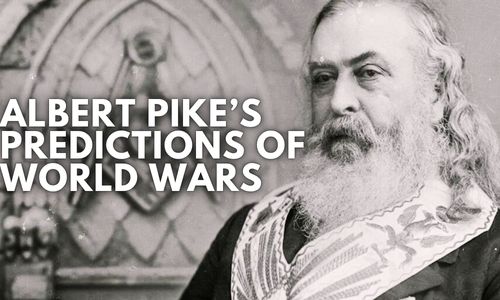
World War 3 Prediction By Albert Pike
Albert Pike: The Man Behind the Masonic Legend
Albert Pike was one of the most enigmatic figures of the 19th century. He was born on December 29, 1809, in Boston, Massachusetts, mastered many roles—lawyer, poet, soldier, linguist, and philosopher. However, he made his deepest mark in Freemasonry. He rose to its highest ranks and left a legacy filled with mystery, speculation, and controversy.
Pike is best known for his monumental work, “Morals and Dogma of the Ancient and Accepted Scottish Rite of Freemasonry”, published in 1871. This dense and esoteric volume is still regarded as a foundational Masonic text. It blends philosophy, theology, and esotericism, embodying Pike’s deep intellectual pursuits and his attempt to decode ancient mysteries for modern initiates.
Albert Pike and the Masonic Lodges
Albert Pike’s affiliation with Freemasonry began in 1850, and by 1859, he had risen to the position of Sovereign Grand Commander of the Scottish Rite’s Southern Jurisdiction in the United States, a role he held for 32 years until his death in 1891.
Pike’s influence reshaped the structure and doctrine of the Scottish Rite. Under his leadership, the Rite expanded and systematized its teachings, placing heavy emphasis on the symbolic, moral, and philosophical dimensions of the order. His literary contributions served as spiritual guides for Masonic initiates, setting him apart as the preeminent intellectual authority within the fraternity.
His philosophical teachings included interpretations of ancient religions, occult symbolism, and metaphysical concepts. He drew heavily from Kabbalah, Hermeticism, and Eastern mysticism, embedding these threads into the Masonic structure. Pike maintained that Freemasonry was not merely a fraternal organization but a path toward spiritual enlightenment and societal transformation.
The Three World Wars Letter: Fact or Fiction?
One of the most persistent and controversial elements tied to Albert Pike’s name is a letter he allegedly wrote to Italian revolutionary Giuseppe Mazzini in 1871. This so-called “Three World Wars” letter outlines a detailed plan for three global conflicts, supposedly orchestrated to usher in a New World Order.
World War I Prediction
According to the letter, the planners of World War I intended to overthrow the Tsars in Russia and establish Communism. They designed the conflict to weaken monarchies and shift global power dynamics, especially in Europe.
World War II Prediction
The second war, as described, would pit Fascists against Zionists, leading to the establishment of Israel in Palestine. This prediction aligns with the post-World War II creation of the state of Israel in 1948 and the collapse of Nazi Germany.
World War III Prediction
The most chilling aspect of the letter describes a final, massive confrontation between Islam and the political Zionists, resulting in global chaos. From the ashes of this conflict, a new ideological system—presumably Luciferian or occultist in nature—would emerge as a universal religion.
William Guy Carr, a Canadian naval officer and conspiracy theorist, first mentioned the letter publicly in the mid-20th century. Scholars and historians strongly dispute its authenticity. Critics note no evidence of the letter exists before 1925. The British Museum, where Carr claimed it was kept, denies ever having it.
Lucifer and the Masonic Misinterpretation
Another enduring controversy tied to Pike is the Luciferian doctrine allegedly promoted within Freemasonry. In certain quotes attributed to Pike, he refers to Lucifer as the “bearer of light,” which some interpret as evidence of Satanic influence within the Masonic hierarchy.
However, serious Masonic scholars contend that these quotes are misattributed, taken out of context, or completely fabricated. In esoteric traditions, “Lucifer” often symbolizes intellectual illumination and enlightenment, rather than a literal endorsement of Satanism. Pike’s reference was philosophical, aligning with interpretations from ancient Gnosticism, not a call to worship the devil.
Albert Pike’s Monument and Public Backlash
In 1901, a bronze statue of Albert Pike was erected in Judiciary Square, Washington, D.C., commissioned by the Scottish Rite as a tribute to his contributions. This monument remained one of the few statues in the capital commemorating a Confederate general.
In June 2020, amidst global protests against systemic racism and historical injustice, protesters toppled the statue, citing Pike’s role as a Confederate officer. Despite his Masonic achievements, the association with the Confederacy cast a shadow over his legacy in the public eye.
Legacy of Albert Pike in Modern Freemasonry
To this day, Pike is regarded as one of the most influential minds in Freemasonry, especially within the Scottish Rite. His writings continue to be studied, dissected, and revered by those within the Masonic fold. He is often credited with revitalizing American Freemasonry and imbuing it with profound philosophical depth.
The Albert Pike Memorial Temple in Little Rock, Arkansas, and various Masonic institutions continue to bear his name, ensuring that his intellectual contributions endure.
Despite the controversies and conspiracies, Albert Pike remains an enduring symbol of esoteric wisdom, intellectual rigor, and transformative influence within one of the world’s most secretive societies.
Books By Albert Pike
Albert Pike wrote the following books, gaining recognition for his deep involvement in Freemasonry, philosophy, and esoteric studies. His works remain influential among Masonic scholars and students of metaphysical traditions.
1. Morals and Dogma of the Ancient and Accepted Scottish Rite of Freemasonry (1871)
This is Pike’s most famous and influential work. A philosophical guide for the 32 degrees of the Scottish Rite, it combines symbolism, comparative religion, mysticism, and morality. It is not a ritual book but a commentary on the lessons and ethics of Freemasonry.
2. Esoterika: The Symbolism of the Blue Degrees of Freemasonry
Edited and published posthumously, this book focuses on the symbolic meanings behind the first three degrees of Masonry (Entered Apprentice, Fellowcraft, and Master Mason). It reveals Pike’s deep esoteric interpretations of Masonic ritual.
3. Lectures of the Arya
A lesser-known work where Pike explores Eastern philosophy, particularly Hindu and Aryan traditions. He draws parallels between Eastern religious systems and the esoteric teachings of Western traditions.
4. The Book of the Words
This is a philological and symbolic analysis of the words used in Masonic rituals, exploring their etymology, history, and spiritual significance.
5. Magnum Opus (The Great Work)
This is a compilation of Masonic teachings and writings assembled from Pike’s papers. It includes commentaries, ritual explanations, and discussions on Freemasonry’s ancient roots.
6. Indo-Aryan Deities and Worship as Contained in the Rig-Veda
A scholarly and esoteric analysis of the Vedic scriptures, reflecting Pike’s interest in comparative religion and the spiritual lineage of humanity.
7. Liturgy of the Ancient and Accepted Scottish Rite of Freemasonry
This book contains rituals, prayers, and ceremonial practices for Masonic use, written or revised by Pike during his leadership of the Scottish Rite.
8. Legenda and Readings for the 30°, 31°, and 32°
A set of interpretive texts for the higher degrees of Freemasonry, these readings were meant for internal Masonic instruction and reflection.
9. Sepher H’Debarim: The Book of the Words
An early philological work, this is a detailed examination of the origins and meanings of key Hebrew, Greek, and Latin words used in Masonic rituals.
10. Revision of the Rituals of the Scottish Rite
Though not a single published volume, Pike devoted extensive effort to revising and codifying the rituals of the Scottish Rite during his tenure. These works were foundational for American Freemasonry.
Note: The Supreme Council of the Scottish Rite published some of Pike’s writings after his death. He wrote many other texts for internal Masonic use and never meant them for the general public.
Myth, Mystery, and Enduring Influence
Albert Pike deeply influenced Freemasonry and American esotericism through his writings, leadership, and symbols. Many question the truth of his alleged world war predictions, but they still spark debate. Admirers and critics agree that Pike helped shape modern Masonry’s spiritual and philosophical base, securing a lasting and complex legacy.











LEAVE A COMMENT