
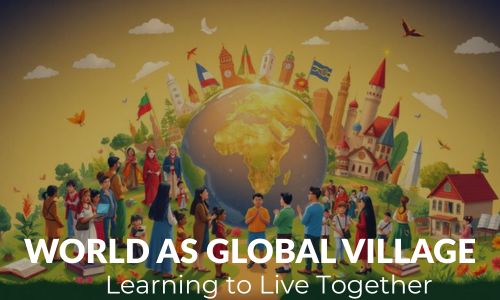
World as a global village – Learning to live together
ESSAY OUTLINE
1. Introduction
- Hook: Begin with the concept of “global village,” coined by Marshall McLuhan, highlighting how technology has shrunk the world, making distant nations as interconnected as neighbors in a small community.
- Context: Acknowledge that while globalization connects us through trade, communication, and culture, it also brings us face-to-face with deep differences in values, beliefs, and traditions.
- Thesis Statement: To thrive in this global village, humanity must embrace intercultural dialogue, cultivate mutual respect, and build inclusive structures that transform diversity from a source of conflict into a foundation for collective progress.
2. The Reality of Interconnection
- Describe how technology, media, migration, and global economies bind us together.
- Explain that our fates are intertwined—economic crises, pandemics, and environmental issues transcend borders.
- Conclude that proximity alone does not guarantee harmony; connection without understanding breeds friction.
3. The Challenge of Difference
- Identify the tensions arising from cultural, religious, and ideological diversity.
- Discuss how fear of the “other,” historical grievances, and competing interests often lead to polarization and conflict.
- Emphasize that retreating into isolation or imposing uniformity are neither feasible nor ethical solutions.
4. The Path to Coexistence: Learning to Live Together
- Intercultural Dialogue
- Advocate for open, respectful exchange that moves beyond tolerance toward genuine understanding.
- Highlight the role of education in teaching critical thinking, empathy, and global citizenship.
- Shared Values and Common Humanity
- Emphasize that beneath cultural differences lie universal values such as dignity, justice, and compassion.
- Show how focusing on shared aspirations—peace, prosperity, well-being—builds common ground.
- Inclusive Institutions and Collaborative Action
- Argue that governments, civil society, and international organizations must create spaces for diverse voices.
- Call for cooperative efforts to address global challenges (climate change, inequality, migration) as shared responsibilities.
5. Conclusion
- Restate Thesis: Successfully learning to live together in the global village requires deliberate commitment to dialogue, mutual respect, and inclusive cooperation.
- Summarize Key Points: Interconnection is an undeniable reality; difference poses real challenges; intentional strategies of engagement, shared values, and collaborative action offer the way forward.
- Final Thought: The global village will either become a space of perpetual friction or a thriving community of coexistence—the choice rests on our willingness to see our neighbor’s humanity as inseparable from our own.
ESSAY
Marshall McLuhan introduced the idea of the “global village” to show how technology brings people, places, and events closer together. Modern communication tools now let nations interact instantly, making the world feel like a small, connected community.
Globalization connects people through trade, media, migration, and digital communication, but it also exposes sharp differences in culture, religion, and social values. As societies interact more often, they must face these differences directly and learn how to respond to them with understanding rather than fear. UNESCO notes that intercultural dialogue helps communities turn diversity into strength and supports trust, social cohesion, and peaceful coexistence.
To succeed in this global village, humanity must promote intercultural dialogue, practice mutual respect, and create inclusive institutions. These efforts can reduce conflict, strengthen cooperation, and transform diversity into a powerful force for shared progress and lasting peace.
Technology connects people instantly across continents through phones, social media, digital platforms, and online markets. News, ideas, and cultural trends now travel in seconds, shaping public opinion far beyond national borders. Migration also strengthens this interconnection as people move for work, safety, education, and family, carrying languages, traditions, and skills into new societies. At the same time, global trade and supply chains link national economies so tightly that production, consumption, and employment in one country often depend on events in many others.
A financial shock in one major economy can spread rapidly through trade, banking systems, investment flows, and job markets around the world. The COVID-19 pandemic proved that disease does not respect borders; international travel and dense global networks allowed the virus and its economic consequences to move quickly across countries. Environmental crises work the same way. Climate change, extreme weather, and resource stress affect food systems, migration patterns, supply chains, and public health on a global scale, which means no nation can fully isolate itself from shared risk.
Although people, nations, and cultures now interact more often than ever, frequent contact does not automatically produce trust or peace. Misunderstanding, prejudice, misinformation, and competition over jobs, resources, and political influence can intensify tension instead of reducing it. Media and technology can connect societies, but they can also spread fear, stereotypes, and hostility at high speed. Real harmony requires empathy, dialogue, and mutual respect; without them, interdependence can expose differences more sharply and turn connection into conflict.
Cultural, religious, and ideological diversity enriches societies, but it also creates tensions when people hold different values, traditions, and worldviews. These differences often shape how communities understand morality, authority, identity, and social order. When groups fail to communicate openly or respect one another’s perspectives, misunderstandings deepen and divisions become more visible. As a result, diversity can become a source of conflict instead of mutual growth.
Fear of the “other” often drives individuals and groups to view those who are different as threats rather than neighbors or partners. Historical grievances, such as past violence, discrimination, or political domination, continue to influence present relationships and keep resentment alive across generations. At the same time, competing interests over power, land, resources, or recognition intensify these tensions and push groups further apart. Together, fear, memory, and rivalry often fuel polarization and make peaceful coexistence more difficult.
Retreating into isolation does not solve the challenges of diversity because modern societies are deeply interconnected through migration, communication, economics, and politics. Likewise, imposing uniformity ignores human dignity and suppresses the identities, beliefs, and freedoms that people value most. Both responses fail to address the real need for dialogue, justice, and coexistence. Instead of separating people or forcing sameness, societies must build systems that respect difference while promoting shared responsibility and peace.
Human societies naturally produce differences in language, religion, customs, values, and worldviews. While diversity enriches communities, it also creates tension when people fear what they do not understand. Individuals and groups often protect their own identities by drawing sharp boundaries between “us” and “them,” which can lead to prejudice, exclusion, and conflict. Political leaders, media, and institutions sometimes deepen these divisions when they exploit cultural differences for power or influence. As globalization brings people into closer contact, societies must confront these differences more directly. This challenge does not come from diversity itself, but from the failure to respond to diversity with wisdom, fairness, and mutual respect.
Societies build peaceful coexistence when they encourage open and respectful intercultural dialogue. People move beyond mere tolerance when they actively listen to one another, ask honest questions, and seek to understand different beliefs and traditions. This kind of dialogue reduces stereotypes and replaces suspicion with human connection. Education plays a central role in this process because schools and universities shape how future generations understand difference. By teaching critical thinking, empathy, and global citizenship, education helps people challenge prejudice and appreciate complexity. Through dialogue and learning, communities create stronger relationships and a deeper culture of respect.
People often focus too heavily on cultural differences and overlook the values they share as human beings. Across societies, individuals seek dignity, justice, compassion, safety, and belonging. These universal values provide a strong foundation for coexistence because they remind people that humanity connects them more deeply than culture divides them. When communities emphasize shared aspirations such as peace, prosperity, and well-being, they create common ground for cooperation. This perspective does not erase difference; instead, it places difference within a broader moral framework of mutual respect. By recognizing common humanity, societies strengthen solidarity and reduce division.
Governments, civil society, and international organizations must build inclusive institutions that welcome diverse voices and protect equal participation. Strong institutions do more than manage difference; they create fair opportunities for representation, dialogue, and justice. When political and social systems exclude certain groups, resentment and instability often grow. In contrast, inclusive structures allow communities to solve problems together and build trust across cultural lines. Cooperative action also becomes essential when societies face global challenges such as climate change, inequality, and migration. No nation or community can solve these problems alone. By treating these issues as shared responsibilities, people learn to work across differences and turn coexistence into collective progress.
Successfully learning to live together in the global village requires more than passive tolerance. It demands a deliberate commitment to honest dialogue, mutual respect, and inclusive cooperation. As societies become more interconnected, individuals and nations must actively choose understanding over division and collaboration over isolation.
This essay has shown that global interconnection is no longer optional; it shapes our economies, cultures, communication, and daily lives. At the same time, cultural, religious, political, and social differences continue to create real tensions and misunderstandings. However, people and communities can overcome these challenges by promoting meaningful engagement, embracing shared human values, and working together through practical, cooperative action.
The global village can develop into either a space of constant conflict or a thriving community built on peaceful coexistence. That outcome depends on the choices people make every day in their attitudes, policies, and relationships. When we recognize our neighbor’s humanity as inseparable from our own, we lay the foundation for a more just, compassionate, and united world.









LEAVE A COMMENT