
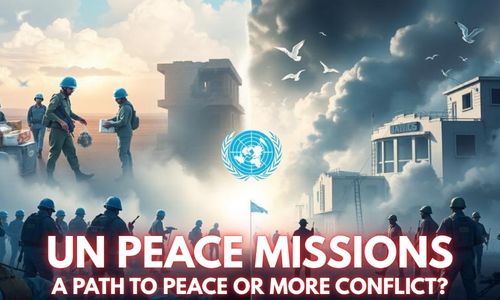
UN Peace Missions – A Path to Peace or More Conflict
ESSAY OUTLINE
1. Introduction
- Hook: The 21st century has seen a surge in UN-authorized peacekeeping and robust military interventions, from the Congo to Mali, contrasting sharply with the static ceasefires of the Cold War.
- Define Terms: Clarify that “international military engagements” range from traditional peacekeeping (monitoring truces) to robust peace-enforcement (combating rebels, protecting civilians).
- Thesis Statement: While the increase in UN military engagements suggests a world plagued by rising chaos, it paradoxically signals a move towards a functional, interventionist international order. However, this is a fragile “negative peace” (absence of war) rather than a durable “positive peace” (justice and human security).
2. The Case for Moving Towards Peace (The “Security First” Argument)
- A. Preventing Genocide & Atrocities: The shift from Cold War inaction to interventions (e.g., Libya’s no-fly zone 2011, UNSC Resolution 1973) shows a willingness to stop mass killings under R2P (Responsibility to Protect).
- B. Stabilizing Failed States: Engagements in Sierra Leone and Liberia successfully disarmed rebels and restored sovereign governments.
- C. Evidence: Statistical declines in interstate wars and battle deaths since 1945; UN missions act as a costlier but more legitimate alternative to unilateral invasions (e.g., Iraq 2003).
3. The Counterargument – A World Still at War (The “Escalating Chaos” Argument)
- A. Rise in Intrastate & Proxy Wars: The increase in UN missions reflects a fragmentation of conflict (civil wars, terrorism), not fewer wars. Examples: Ongoing failures in South Sudan and the DRC.
- B. Mission Creep & Failure: Robust engagements often lack resources or clear mandates (e.g., Srebrenica 1995, Somalia 1993). More blue helmets deployed does not equal less violence.
- C. The Peace vs. Justice Dilemma: Some UN “peace” operations have frozen conflicts in place (Cyprus, Kashmir), suppressing violence but preventing political resolution—a “cold peace” that is not true peace.
4. The Nuanced Conclusion – A New Definition of Peace
- A. Moving from Inter-state to Intra-state Peace: The world is not moving towards a perfect, war-free peace. Instead, it is moving towards managed violence.
- B. The Legitimacy Factor: More UN military engagements mean that the international community is increasingly using a rule-based system to contain violence, even if imperfectly. This is progress in governance, not progress in human nature.
- C. Limitation: The UN is reactive, not proactive. Rising engagements also signal the failure of diplomacy and early warning systems.
5. Conclusion
- Restate Thesis: The rising number of UN military engagements is a double-edged sword. It indicates the world is not moving towards an idealistic peace, but it is moving towards an institutionalized, collective security system.
- Final Judgment: We are moving towards a “peace of process” – a world where violence triggers a global response, which is historically unprecedented and cautiously hopeful. However, true peace will only arrive when UN military boots on the ground become rare, not routine.
ESSAY
The world witnesses a fundamental shift in how the international community responds to conflict. As of 2023, the United Nations has authorized and deployed 72 peacekeeping operations since its founding, not including major military interventions such as the Korean War and the Gulf War that the Security Council also sanctioned. The 1990s saw the most UN peacekeeping operations to date. This trend continues today, with 11 active peacekeeping operations currently in the field, supported by a $5.38 billion budget for the 2025–2026 fiscal year. These missions deploy approximately 118,000 personnel, including 103,000 military troops, 9,700 police officers, and 5,850 civilian staff. In a stark departure from Cold War-era static ceasefires, the UN now authorizes robust enforcement actions. For instance, UN Security Council Resolution 1973 (2011) authorized a no-fly zone and “all necessary measures” to protect civilians in Libya, marking a decisive intervention under Chapter VII of the UN Charter. Similarly, in 2013, the Council created the Force Intervention Brigade (FIB) in the Democratic Republic of the Congo, a 3,069-strong unit within MONUSCO authorized to conduct “targeted offensive operations” against armed groups—a clear departure from traditional peacekeeping.
UN military engagements span a broad spectrum. Traditional peacekeeping, exemplified by the UN Truce Supervision Organization (UNTSO)—the first UN peacekeeping mission, deployed in 1948—focuses on monitoring ceasefires with unarmed military observers. The UN Peacekeeping Force in Cyprus (UNFICYP), operating since 1964, represents another long-standing traditional mission. At the opposite end, robust peace-enforcement involves active combat operations. The UN’s Intervention Brigade in the DRC actively neutralizes armed groups, marking “new territory” for peacekeeping, as the Security Council itself recognized. The UN also authorizes non-UN forces to use military power; Resolution 678 (1990) authorized UN member states to use “all necessary means” to expel Iraqi forces from Kuwait, leading to the Gulf War.
The expansion of UN military action reveals a paradox. On one hand, data shows that UN peacekeeping missions significantly reduce civilian casualties, shorten conflicts, and help make peace agreements stick. The UN Secretary-General notes that, compared to pre-deployment levels, peacekeeping operations typically reduce civilian killings by more than 90%. Since 1948, millions of lives have been spared. This represents progress toward negative peace—the absence of active, organized violence. However, the UN’s approach often prioritizes maintaining existing power structures over addressing deep-rooted injustice, and many missions fail to achieve positive peace, which requires social justice and the resolution of underlying conflict causes. The Intervention Brigade in the DRC, despite five years of military campaigns, failed to eradicate targeted rebel groups and instead provoked deadly attacks on peacekeepers and escalated violence to its highest levels in a decade. Similarly, the UN has deployed no new peacekeeping missions since 2014, and funding shortfalls now force a 25 percent troop reduction across nine of 11 missions, underscoring the fragility of this system. Thus, the world moves toward a managed “negative peace” within an institutionalized security framework—not a durable, just peace.
The 2011 intervention in Libya marked a historic turning point for the Responsibility to Protect (R2P) doctrine. Facing an imminent massacre as Gaddafi’s forces marched on Benghazi, the UN Security Council adopted Resolution 1973, authorizing “all necessary measures” to protect civilians. The swift NATO-led intervention reversed Gaddafi’s advance and, by removing his regime from power, helped save countless civilian lives. While the exact number of lives saved remains impossible to calculate, scholars note that had the Council acted with similar speed in the 1990s, the 8,000 men and boys massacred at Srebrenica and the nearly 800,000 men, women, and children killed in Rwanda might still be alive today. Furthermore, the international community had already affirmed Libya’s R2P obligation under Resolution 1970, referring the case to the International Criminal Court before resorting to military action. This sequence of escalating responses—from diplomatic condemnation to judicial referral to military protection—demonstrates a new international willingness to intervene multilaterally when national authorities manifestly fail to protect their own citizens.
Two of the most compelling UN peacekeeping success stories come from West Africa. In Sierra Leone, the UN Mission in Sierra Leone (UNAMSIL) established in 1999 became one of the largest peacekeeping operations in history, deploying tens of thousands of troops. Over the mission’s five-year span, UNAMSIL disarmed and demobilized over 72,000 combatants, collected and destroyed more than 30,000 weapons, and helped restore government control across the country. The mission’s comprehensive disarmament, demobilization, and reintegration (DDR) program included former child soldiers and was backed by credible security guarantees, laying the foundation for national recovery and democratic transition.
In neighboring Liberia, the UN Mission in Liberia (UNMIL) achieved even more dramatic results. Operating between 2003 and 2018, UNMIL disarmed over 100,000 former combatants, secured approximately 21,000 weapons, and enabled about one million refugees and displaced persons to return home. Beyond disarmament, UNMIL supported three peaceful presidential and legislative elections and helped rebuild the country’s armed forces and police, leaving a nation that no longer faces threats from warlords or marauding militias.
The long-term data on armed conflict points toward a more peaceful world. Global battle deaths per 100,000 people peaked at 23 in 1953 and fell by approximately 95 percent by 2016. The average annual battle death toll per conflict dropped from nearly 10,000 in the 1950s to less than 1,000 in the 21st century, and the number of deadliest wars (those killing at least 1,000 people per year) fell by 78 percent since 1988. Researchers attribute this decline to multiple factors, including the spread of democracy, falling fertility rates that make societies more averse to war casualties, and—crucially—the growing effectiveness of multilateral peacekeeping.
Systematic studies confirm that UN peacekeeping works. Across 16 peer-reviewed studies, researchers find that peacekeepers significantly reduce civilian casualties, shorten conflicts, and help make peace agreements stick, with the majority of UN peacekeeping missions succeeding in their primary goal of stabilizing societies and ending war. In fact, since the end of the Cold War, two-thirds of completed missions successfully implemented their mandates and departed, leaving countries no longer at war.
The legitimacy and cost-effectiveness of UN missions contrast sharply with unilateral interventions. The UN peacekeeping budget for 2024-2025 stands at $5.6 billion—less than 0.3 percent of annual global military spending. By comparison, the 2003 Iraq War, which lacked UN Security Council authorization, cost the United States an estimated $540 billion annually at its peak, while Iraq’s post-invasion reconstruction bill alone reached $88 billion. Unlike unilateral invasions, which often undermine international legitimacy and trigger prolonged instability, UN missions deploy with the consent of belligerents, operate impartially, and work to implement negotiated peace agreements. This multilateral approach, while slower and more constrained, offers a more sustainable and legitimate path to post-conflict recovery.
The surge in UN military engagements does not signify a world at peace but rather one plagued by the fragmentation of conflict. Modern warfare has shifted from traditional interstate battles to complex intrastate wars fueled by ethnic clashes, civil strife, and terrorism. This trend directly correlates with the UN’s expanding role, as missions struggle to contain violence that is decentralized, politically fractured, and resistant to traditional peacekeeping approaches.
South Sudan (UNMISS): In South Sudan, the UN Mission in South Sudan (UNMISS) operates in a nation that has lurched from crisis to crisis since its independence in 2011, including a brutal five-year civil war that left nearly 400,000 people dead. Despite the presence of one of the world’s most expensive peacekeeping operations, with an annual budget of $1.2 billion and roughly 17,000 soldiers, the mission documents horrifying levels of violence. For instance, between January and March 2023 alone, UNMISS documented 920 incidents of violence against civilians, leading to 405 civilians killed, 235 injured, 266 abducted, and 14 subjected to conflict-related sexual violence. A UN report covering late 2022 documented at least 884 civilian casualties, of which 594 were killed and 290 injured, with over 62,000 people displaced.
DRC (MONUSCO): The situation in the Democratic Republic of the Congo further illustrates this point. The UN’s longest-running civilian protection operation, MONUSCO, has been deployed for 25 years. Yet, the mission is withdrawing amid widespread accusations of failure. A MONUSCO report from October 2024 revealed that between June and September of that year, armed groups killed 663 civilians. In the Beni region alone, residents counted five attacks by the Allied Democratic Forces (ADF) in a single year, killing roughly 200 people, some in close proximity to UN camps. The mission’s failure to provide security has led to widespread resentment, with locals expressing readiness for the peacekeepers to leave. These examples demonstrate that the proliferation of UN missions reflects the escalating chaos of civil wars and insurgencies, not a movement toward global peace.
The expansion of UN mandates has led to “mission creep,” where operations become overextended without the necessary resources or clear political directives. This phenomenon is vividly illustrated by two of the most catastrophic failures in UN peacekeeping history, where the presence of peacekeepers did not prevent—and in some cases may have exacerbated—mass violence.
Srebrenica (1995): The Srebrenica massacre stands as the most infamous example of mission creep ending in disaster. The UN had declared the town a “safe area” to be “free from any armed attack or any other hostile act,” yet stationed only 600 lightly armed Dutch infantry to protect thousands of civilians. When Bosnian Serb forces swept into the enclave in July 1995, the Dutch peacekeepers were obliged to watch as the killings began. The internal UN study later found that peacekeeping missions routinely avoid using force to protect civilians under attack, intervening in only 20 percent of cases despite Security Council authorization. The result was the massacre of more than 8,000 Bosnian Muslim men and boys—the worst atrocity in Europe since World War II. A UN report later admitted, “Through error, misjudgment and an inability to recognize the scope of the evil confronting us, we failed to do our part to save the people of Srebrenica”.
Somalia (1993): The UN Operation in Somalia II (UNOSOM II) provides another cautionary tale. Launched in March 1993 with a strength of 28,000 personnel, including 22,000 troops, the mission aimed to create a secure environment for humanitarian operations in a famine-stricken, lawless country. However, the mission’s mandate quickly expanded from humanitarian aid to active nation-building and the disarming of warlords. The turning point came with the Battle of Mogadishu in October 1993, where a U.S. task force operating under the UN flag suffered heavy casualties in a failed raid. The battle, immortalized in Black Hawk Down, exposed critical failures in planning, resources, and command and control. The Somali population, disappointed by the UN’s failure to disarm the warlords, increasingly supported them in an “us versus them” mentality. The debacle led to the mission’s withdrawal and haunted U.S. policy for years, contributing to its failure to intervene in the 1994 Rwandan genocide. These historical examples confirm that deploying more peacekeepers does not automatically translate into less violence; without clear mandates and adequate resources, missions can become catalysts for greater bloodshed.
A growing critique of UN peacekeeping is that some operations have inadvertently perpetuated the very conflicts they were designed to resolve. By prioritizing the suppression of violence over the pursuit of political solutions, these missions have frozen disputes in place, creating a “cold peace” where violence is contained but not eliminated, and political grievances remain unaddressed.
Cyprus (UNFICYP): The UN Peacekeeping Force in Cyprus (UNFICYP) has been deployed for over six decades, with more than 150,000 military and police personnel from 45 countries having served, and 187 peacekeepers having lost their lives. The mission patrols a buffer zone separating the Greek Cypriot and Turkish Cypriot communities. While UNFICYP has successfully prevented large-scale conflict, it has not resolved the underlying political division of the island. The mission continues to document “military violations on both sides” with concern, including 227 military violations in a recent reporting period. Critics argue that monitoring the separation of military forces has also led to the preservation of ethnic division, freezing the conflict rather than facilitating a resolution.
Kashmir (UNMOGIP): The UN Observer Group in India and Pakistan (UNMOGIP) represents an even more extreme case. Created by Security Council resolutions in 1948 and deployed in January 1949, the mission has observed the ceasefire line in Kashmir for over 75 years. Yet, the underlying dispute between India and Pakistan remains as intractable as ever. India stopped reporting ceasefire violations to UNMOGIP in 1972, treating the mission as irrelevant, while Pakistan continues to lodge complaints. In 2023, only two ceasefire violations were reported officially, but this statistic reflects political stalemate and the mission’s limited effectiveness rather than genuine peace. As one peacekeeping official acknowledged, these missions remain “frozen because of the dynamics that are going on at the local, regional, sub-regional (levels), which have to do with politics”. A senior official further noted that a number of UN peacekeeping missions “have been very expensive, they’ve gone on a long time, and they’ve served to create a frozen conflict rather than to solve a conflict”. The “peace” maintained by such operations is thus a negative one—an absence of open warfare achieved at the expense of justice and political resolution.
Modern warfare has fundamentally shifted away from traditional armies clashing on battlefields toward messy internal fragmentation. In 2024, 61 state-based armed conflicts erupted across 36 countries, marking the highest number of such conflicts recorded in over seven decades. However, more than half of all conflict-affected states now face two or more separate state-based conflicts within their own borders. Nine countries confront three or more simultaneous state-based conflicts, reflecting a deepening complexity where state fragility, transnational actors, and local grievances feed into overlapping crises. In Myanmar alone, armed violence claimed nearly 17,000 lives during the reporting period, while Sudan saw over 20,000 fatalities from its internal civil war. Africa bore the brunt of this trend, recording 28 state-based conflicts in 2024—nearly double the number from a decade earlier. This fragmentation means the international community now manages persistent, low-level violence across multiple theaters rather than resolving discrete, declarable wars.
Despite global turbulence, the UN continues to institutionalize its crisis response. For the 2025-2026 fiscal year, the UN General Assembly approved a $5.38 billion peacekeeping budget, maintaining 12 active missions staffed by nearly 70,000 military, police, and civilian personnel deployed across Africa, the Middle East, and Europe. This financial commitment—though modest compared to global military spending—represents a deliberate collective effort to contain violence through multilateral mechanisms rather than unilateral action. The Responsibility to Protect (R2P) doctrine celebrated its 20th anniversary in 2025; despite persistent implementation gaps, the principle now stands as “a moral imperative, rooted in our shared humanity and the UN Charter,” with prevention and protection strategies integrated across peacekeeping operations. Even as P5 divisions generated eight vetoes in 2024—the highest number since 1986—the Security Council continues to debate, mandate, and fund responses, sustaining a rules-based framework for international security. This constitutes genuine progress in governance: the very fact that nations convene to authorize blue-helmet missions, rather than acting purely on national interest, signals an evolving international order.
However, the UN consistently acts after crises explode, not before. UN peacekeeping arrears exceeded $2 billion at the start of the 2025 budget cycle, forcing the organization to cut 25 percent of its peacekeeping troops and police—roughly 13,000 to 14,000 personnel out of more than 50,000 deployed across nine missions. These cuts forced peacekeeping missions to close field offices, scale back patrols, and ground helicopters that served as early-warning tools in countries like South Sudan, where UN peacekeeping chief Jean-Pierre Lacroix warned that stripping away early-warning tools “would snap the backbone of its civilian-protection mandate”. The humanitarian sector faced a $32 billion funding shortfall in 2025, and the humanitarian, development, and peace support missions shuttered as overseas assistance budgets shrank dramatically. Early warnings repeatedly fail to trigger timely action due to limited political will, institutional inertia, and fragmented accountability. As UN Secretary-General António Guterres stated at the R2P anniversary, “too often, early warnings go unheeded,” and “responses are often too little, too late, inconsistent or undermined by double standards”. The Security Council adopted only 44 resolutions in 2025, the lowest number since 1991, and only 61.4 percent received unanimous support, confirming that deep divisions prevent meaningful proactive responses. The international system simply cannot absorb new crises effectively.
The data presents a clear contradiction. On one hand, the UN oversees 11 active peacekeeping operations and deploys more than 60,000 military, police, and civilian personnel from 119 countries worldwide. The organization approved a $5.38 billion peacekeeping budget for the 2025–2026 fiscal year, a figure that reflects significant global investment in collective security infrastructure.
However, this institutional growth occurs against a backdrop of worsening global violence. The Global Peace Index 2025 reports that global peacefulness has deteriorated for the sixth consecutive year. In 2025, more than 185,000 violent events occurred globally, killing over 240,000 people—nearly twice as many as in 2021. The International Institute for Security Studies reports a 23% increase in armed conflict in 2025 alone. The number of active state-based conflicts now stands at its highest level since World War II.
Thus, the rise in UN military engagements does not signal a world moving toward a peaceful utopia. Rather, it reflects the international community’s collective, institutionalized, and increasingly costly response to a more violent world. The UN’s growing operational footprint—from the 58 missions deployed in the decade following the Cold War to the 11 active missions today, with a cumulative total of over 70 peacekeeping operations since 1948—demonstrates a system that has become more systematic and rule-based in its interventions. The establishment of the Department of Peace Operations (DPO) in 2019, which replaced the Department for Peacekeeping Operations (DPKO), reflects this institutional maturation—the UN has professionalized and systematized its approach to collective security, even as the underlying threats have multiplied.
The current global security architecture embodies what we might call a “peace of process”—a system where armed conflict reliably triggers a multilateral, institutionalized response. This represents genuine historical progress. In the 1990s, the Security Council authorized 20 new peacekeeping operations between 1989 and 1994 alone, raising peacekeeper numbers from 11,000 to 75,000. The Responsibility to Protect (R2P) doctrine, unanimously adopted by UN member states in 2005, codified the principle that the international community has a residual responsibility to intervene when states fail to protect their populations from mass atrocities. In 2025, the Security Council authorized the transition of the Kenyan-led support mission in Haiti into a new Gang Suppression Force, demonstrating the continued evolution of R2P-based intervention mechanisms.
Yet a “peace of process” remains a fragile achievement. The success rate of UN peacekeeping missions has declined significantly over time, from 61% prior to 1990 to just 31% after 2000. Notable failures persist: UN peacekeepers failed to prevent the 1994 Rwanda genocide, which killed at least 800,000 ethnic Tutsis and Hutus, and the 1995 Srebrenica massacre of at least 8,000 Bosnian Muslims. The sheer scale of ongoing violence underscores the limitations of the current system: approximately 240,000 people died from violent conflict in 2025, and global peacefulness has deteriorated for six consecutive years. The UN currently plans to cut 13,000 to 14,000 military and police personnel—about 25% of its global peacekeeping force—due to funding shortfalls, further straining its capacity to respond effectively.
True peace—a durable, positive peace built on justice, human security, and the absence of structural violence—remains distant. The world has moved decisively toward an institutionalized, rule-based collective security system. The UN has built unprecedented machinery for responding to conflict: over 70 peacekeeping missions deployed since 1948, more than 4,400 peacekeepers killed in the line of duty, and a global network of personnel from 119 contributing nations. This machinery demonstrates the international community’s growing capacity to act collectively.
However, the continued routine deployment of UN military forces—with more than 60,000 personnel still on the ground today—reveals the persistence of the underlying disease. As long as UN blue helmets remain a routine presence on the ground, the world will remain trapped in a “peace of process” rather than having achieved genuine, lasting peace. The ultimate measure of success will be the day when UN military boots become rare, not routine—a day that current trends suggest remains far in the future.








LEAVE A COMMENT