

Moral Standards In International Relations
OUTLINE
1: Introduction
(a) Explanation of moral standards in international relations
(b) Importance of moral standards in international relations
2: Historical Perspective on Moral Standards in International Relations
(a) Ancient Greek philosophy and morality
(b) Christian Just War Theory
(c) Enlightenment-era moral universalism
3: Theoretical Approaches to Moral Standards in International Relations
(a) Realism
(b) Liberalism
(c) Constructivism
4: Moral Standards in International Law
(a) Sources of international law
(b) International criminal law
(c) International human rights law
5: The Challenge of Applying Moral Standards in International Relations
(a) The problem of sovereignty
(b) The problem of cultural relativism
(c) The problem of power imbalances
6: Conclusion
ESSAY
Moral standards in international relations refer to the ethical principles and values that guide the behavior of states and international actors in their interactions with each other. These standards provide a framework for addressing issues such as human rights, peace, justice, and the protection of vulnerable populations in the global community. They are important in promoting a more just and equitable world order, and in preventing conflict and violence. This essay will explore the historical perspective and theoretical approaches to moral standards in international relations, as well as their application in international law and the challenges of applying them in practice.
Moral standards in international relations refer to a set of principles and values that guide the behavior of states and international actors in their interactions with each other. These principles are derived from ethical theories and practices, and are intended to promote a more just and equitable global community. Examples of moral standards in international relations include respect for human rights, the prohibition of genocide and crimes against humanity, the promotion of peace and security, and the protection of vulnerable populations such as refugees and internally displaced persons. These moral standards provide a framework for evaluating the behavior of states and international actors, and for promoting accountability and responsibility in their actions. They are essential for building trust and cooperation among states and for promoting a more peaceful and just world order.
The importance of moral standards in international relations lies in their ability to promote a more just and equitable world order. Without these standards, international interactions would be guided solely by power and self-interest, which could lead to conflict and violence. By establishing moral principles and values, states and international actors are able to work towards common goals such as the promotion of human rights, peace, and justice. Moral standards also serve as a framework for evaluating the behavior of states and international actors. They provide a basis for accountability and responsibility, and help to prevent abuses of power. In addition, moral standards can promote cooperation and trust among states, which can lead to greater stability and security.
Furthermore, moral standards in international relations are important in promoting the protection of vulnerable populations such as refugees and internally displaced persons. Without these standards, such populations could be subject to exploitation and abuse. In short, moral standards in international relations are essential for promoting a more just and equitable global community, for evaluating the behavior of states and international actors, and for protecting vulnerable populations.
Throughout history, moral standards have played a significant role in shaping international relations. From ancient Greek philosophy to Christian Just War Theory and Enlightenment-era moral universalism, ethical principles and values have guided the behavior of states and international actors in their interactions with each other. Ancient Greek philosophy and morality played a significant role in shaping the moral standards in international relations. The Greeks believed in the importance of justice, wisdom, and virtue in political life, and these concepts were central to their notions of international relations.

The concept of justice was seen as essential for maintaining peace and stability among city-states. The Greeks believed that justice was based on the principle of reciprocity, and that it required treating others as one would like to be treated oneself. This idea was reflected in their system of alliances, which were based on mutual benefit and respect. The concept of wisdom was also important in Greek political thought. Wisdom was seen as the ability to make good judgments based on knowledge and experience, and was seen as essential for effective governance and diplomacy. Diplomats were expected to possess wisdom and to use it in their negotiations with other states.
Finally, the Greeks believed in the importance of virtue, which included courage, self-control, and temperance. These virtues were seen as essential for maintaining good relations with other states and for promoting the common good. Diplomats were expected to exhibit these virtues in their interactions with other states. In summary, the ancient Greeks believed in the importance of justice, wisdom, and virtue in international relations. These concepts provided a moral foundation for diplomacy and governance, and helped to establish a framework for promoting peace, stability, and cooperation among city-states.
Christian Just War Theory is a set of moral guidelines for the conduct of warfare that emerged in the Middle Ages. The theory emphasizes the importance of proportionality, discrimination, and the protection of non-combatants. These principles were based on the idea that war should only be waged as a last resort, and that its aim should be to restore justice and order. The theory was developed by theologians such as St. Augustine and St. Thomas Aquinas, who sought to reconcile the Christian doctrine of love and peace with the realities of war and conflict. They argued that war could be justified if it met certain conditions, such as a just cause, a legitimate authority, and a proportionate response. They also emphasized the importance of discrimination in warfare, and argued that non-combatants should be protected from harm.

The principles of Just War Theory were further developed during the Renaissance and Enlightenment periods. Thinkers such as Hugo Grotius and Emer de Vattel sought to apply these principles to the emerging field of international law. They argued that states had a duty to respect the principles of Just War Theory in their interactions with each other, and that international law should reflect these principles. Today, Just War Theory continues to influence the moral standards in international relations. The principles of proportionality, discrimination, and the protection of non-combatants are enshrined in international law, and are recognized as essential for promoting the common good and the protection of human rights. However, the application of these principles in practice remains a challenge, and the ethical dilemmas posed by modern warfare continue to test the limits of Just War Theory.
Enlightenment-era moral universalism challenged the traditional view of international relations as a struggle for power and territory. Thinkers such as Immanuel Kant argued that moral principles such as freedom, equality, and human dignity should be applied universally and that states had a duty to respect these principles in their interactions with each other. This approach paved the way for the development of international law and the establishment of institutions such as the United Nations.
Kant believed that the principles of moral universalism were essential for promoting peace, stability, and cooperation among states. He argued that states should be guided by the principle of the “categorical imperative,” which required them to act in ways that respected the dignity and autonomy of other states. He believed that this principle could be applied universally, and that it could form the basis of a system of international law and diplomacy. Kant’s ideas were influential in the development of international institutions such as the League of Nations and the United Nations. These institutions were founded on the principle of collective security, which sought to prevent war and promote international cooperation through diplomacy and international law. The principles of moral universalism were enshrined in the UN Charter, which affirmed the right of all nations to self-determination and the duty of states to respect the sovereignty and territorial integrity of other states.
Today, the principles of moral universalism continue to shape the moral standards in international relations. The UN system provides a framework for promoting human rights, peace, and development, and the principles of freedom, equality, and human dignity are recognized as essential for promoting the common good. However, the implementation of these principles remains a challenge, and the ethical dilemmas posed by issues such as humanitarian intervention and global inequality continue to test the limits of moral universalism in international relations. There are several theoretical approaches to moral standards in international relations, including liberalism, constructivism, critical theory, and postcolonialism.
Liberalism emphasizes the importance of individual rights, democracy, and the rule of law in international relations. Liberals believe that states can cooperate and promote common interests through the establishment of international institutions and the use of diplomacy and negotiation. Liberalism also emphasizes the importance of human rights and individual freedom, and advocates for the protection of non-combatants in armed conflicts.
Liberalism is a theoretical approach in international relations that emphasizes the importance of individual rights, democracy, and the rule of law in promoting peace and stability in the international system. Liberalism assumes that states can cooperate and promote common interests through the establishment of international institutions, the use of diplomacy and negotiation, and the protection of human rights.
One of the key principles of liberalism is the importance of individual freedom and human rights. Liberals believe that all individuals should be entitled to certain rights, such as freedom of speech, assembly, and religion, and that these rights should be protected by the state. Liberals also advocate for the protection of non-combatants in armed conflicts and the prevention of human rights abuses.
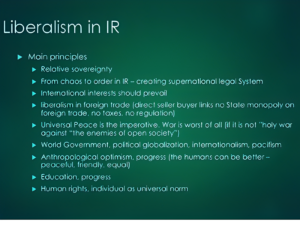
Another key principle of liberalism is the importance of democracy and the rule of law. Liberals believe that democratic governance and the rule of law can promote peace and stability by providing a framework for resolving conflicts peacefully and protecting individual rights. They also believe that international institutions, such as the United Nations and the International Criminal Court, can play a role in promoting democracy and the rule of law on a global scale.
Liberalism has been influential in shaping the moral standards in international relations, particularly in areas such as human rights, democracy, and the use of force. Liberals argue that the use of force should be a last resort, and that it should be used only to protect human rights or in response to an imminent threat. They also advocate for the protection of non-combatants in armed conflicts, and for the establishment of international institutions to promote peace and stability.
Critics of liberalism argue that its emphasis on individual rights and democracy can lead to an overly idealistic approach to international relations, and that it ignores the role of power and self-interest in shaping state behavior. They also argue that liberalism can be culturally insensitive, as it tends to promote Western norms and ideas as universal. Despite these criticisms, liberalism remains a powerful and influential school of thought in international relations. Its emphasis on human rights, democracy, and the rule of law has shaped the behavior of states and influenced the development of international institutions. However, its influence has also been tempered by competing approaches such as realism, constructivism, and critical theory, which emphasize the importance of power, identity, and ethical considerations in international relations.
Constructivism focuses on the role of ideas, norms, and identity in shaping international relations. Constructivists argue that moral standards are not fixed or universal, but rather are constructed through the interactions of individuals and groups. They believe that moral standards can evolve over time as new ideas and norms emerge, and that actors in international relations can play a role in shaping these norms. Constructivism is a theoretical approach in international relations that emphasizes the role of ideas, norms, and identity in shaping state behavior and international relations. Unlike realism, which emphasizes the role of power and self-interest, and liberalism, which emphasizes the importance of individual rights and democracy, constructivism argues that the international system is socially constructed and shaped by the interactions of actors.
According to constructivism, actors in international relations are not just influenced by objective factors such as military power or economic interests, but also by subjective factors such as norms, ideas, and identities. Constructivists argue that the way in which actors perceive the world and define their interests is shaped by their social context and by the norms and ideas that exist within that context. They also argue that these norms and ideas can change over time as new actors enter the system or as existing actors adapt to changing circumstances. One of the key principles of constructivism is the idea that international norms are not fixed or universal, but rather are constructed through the interactions of actors. Constructivists argue that norms can evolve over time as new ideas and norms emerge, and that actors in international relations can play a role in shaping these norms. For example, the norm against the use of chemical weapons in warfare has evolved over time, and is now widely accepted as a norm of international behavior.

Another key principle of constructivism is the importance of identity in shaping state behavior. Constructivists argue that state behavior is not just a function of their material interests, but also of their identities as members of a particular community or nation. They also argue that identities can change over time, as new ideas and norms emerge and as actors redefine their interests and identities. Critics of constructivism argue that it is too focused on the role of ideas and norms, and that it ignores the importance of power and self-interest in shaping state behavior. They also argue that constructivism can be too culturally relativistic, as it tends to downplay the importance of objective factors such as military power or economic interests in international relations.
Despite these criticisms, constructivism has had a significant impact on the study of international relations, particularly in the areas of norms and identity. Its emphasis on the socially constructed nature of international relations has led to a greater understanding of the role of ideas and norms in shaping state behavior, and has helped to broaden the field beyond the traditional focus on power and self-interest.
Critical theory emphasizes the role of power and inequality in international relations. Critical theorists argue that moral standards are often used to legitimize and maintain existing power structures, and that dominant actors in international relations use moral language to justify their actions. Critical theory also critiques the role of international institutions and the unequal distribution of power in the international system.

Postcolonialism emphasizes the legacy of colonialism and imperialism in shaping international relations. Postcolonial theorists argue that moral standards in international relations are often shaped by colonial history, and that the legacy of colonialism has contributed to ongoing global inequalities and power imbalances.

Postcolonialism also critiques the role of Western norms and ideas in shaping international relations, and advocates for the inclusion of diverse perspectives and voices in the global conversation about moral standards. Each of these theoretical approaches offers a unique perspective on the role of moral standards in international relations, and each has contributed to the ongoing debate about how to promote peace, stability, and cooperation in a rapidly changing global context.
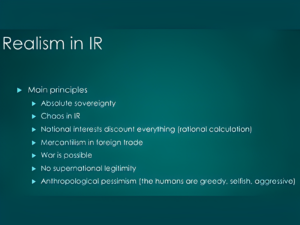
Realism is a school of thought in international relations that emphasizes the importance of power, national interest, and the balance of power in the conduct of international affairs. Realism assumes that states are the primary actors in international relations, and that their behavior is driven by a desire to maximize their power and security.
According to realists, international politics is a zero-sum game, where the gains of one state come at the expense of others. States are in a constant struggle for power and resources, and this struggle is driven by a combination of fear and greed. Realists believe that states are rational actors, and that they make decisions based on a careful calculation of their interests and capabilities.
Realism has been influential in shaping the moral standards in international relations, particularly in areas such as war and peace. Realists argue that war is a natural and inevitable aspect of international politics, and that states must be prepared to use force to protect their interests and security. They also argue that the use of force should be proportional to the threat, and that non-combatants should be protected as much as possible.
Realism has been criticized for its narrow focus on power and its disregard for moral considerations. Critics argue that realism ignores the role of international law and institutions in promoting peace and stability, and that it is overly pessimistic about the possibilities for cooperation and dialogue among states. They also argue that realism neglects the importance of human rights and the well-being of individuals in the conduct of international affairs.
Despite these criticisms, realism remains a powerful and influential school of thought in international relations. Its emphasis on power and national interest has shaped the behavior of states and influenced the development of international institutions such as the United Nations. However, its influence has also been tempered by competing approaches such as liberalism, constructivism, and critical theory, which emphasize the importance of cooperation, dialogue, and ethical considerations in international relations.
Moral standards play an important role in international law, which is a set of rules and principles that govern the conduct of states and other actors in the international system. International law is based on a number of sources, including treaties, customary law, and general principles of law, but it also reflects moral standards and values that are shared by the international community.
One of the key ways in which moral standards influence international law is through the development of human rights law. Human rights are a set of universal standards that apply to all individuals, regardless of their nationality or other characteristics. The development of human rights law has been driven in large part by moral considerations, such as the recognition of the inherent dignity and worth of every human being. Human rights law is now a well-established part of international law, and is enforced by international institutions such as the United Nations.
Another way in which moral standards influence international law is through the development of laws governing the use of force. International law recognizes the right of states to defend themselves against aggression, but also places limits on the use of force in other circumstances. These limits are based in part on moral considerations, such as the protection of non-combatants and the avoidance of unnecessary harm. Moral considerations also play a role in the development of international criminal law. International criminal law is a relatively new area of international law that focuses on the prosecution of individuals for serious crimes such as genocide, war crimes, and crimes against humanity. The development of international criminal law has been driven in large part by moral considerations, such as the recognition that individuals who commit these crimes must be held accountable for their actions.
Critics of the role of moral standards in international law argue that international law should be based solely on objective criteria, such as state practice and custom. They also argue that the role of moral considerations in international law can lead to inconsistency and subjectivity in the application of the law. Despite these criticisms, the role of moral standards in international law is likely to continue to be an important area of debate and development in the field of international relations. As the international community continues to grapple with issues such as human rights, the use of force, and international criminal law, the role of moral standards and values is likely to remain a central concern.
There are several sources of international law, which are recognized by the international community and form the basis for the development and enforcement of international law. These sources include:
1: Treaties: Treaties are agreements between states or other international actors that establish obligations and rights under international law. Treaties can be bilateral, between two states, or multilateral, involving multiple states.
2: Customary International Law: Customary international law is a body of unwritten rules and practices that have developed over time through the consistent practice of states. Customary international law is binding on all states that have accepted it, regardless of whether they have ratified specific treaties or not.
3: General Principles of Law: General principles of law are fundamental legal principles that are recognized by the international community as a basis for international law. These principles are based on concepts such as fairness, equity, and justice.
4: Judicial Decisions: Decisions made by international courts and tribunals can also be considered sources of international law. These decisions can establish legal precedent and help to clarify the interpretation of existing international legal norms.
5: Scholarly Writing: Scholarly writing, including legal scholarship and academic commentary, can also influence the development of international law. Scholarly writing can help to shape legal interpretation and understanding, and can also influence the development of new legal norms.
These sources of international law are not mutually exclusive and can be used in combination to establish legal obligations and rights. The development and interpretation of international law is a complex process that involves a range of actors, including states, international organizations, and legal experts. As the international system continues to evolve, the sources and interpretation of international law are likely to remain important areas of debate and development.
International criminal law is a relatively new field of international law that focuses on the prosecution of individuals for serious crimes that have international implications. These crimes include genocide, crimes against humanity, war crimes, and aggression. International criminal law is based on the principle of individual criminal responsibility, which holds individuals accountable for their actions under international law. This principle is grounded in the recognition that some crimes are so serious that they are not just offenses against the state, but also offenses against the international community as a whole. The development of international criminal law has been driven by a number of factors, including the recognition that the international community has a responsibility to protect individuals from mass atrocities, the need to hold individuals accountable for serious crimes committed during armed conflicts, and the growing awareness of the need for justice and accountability for victims of international crimes.
The most important international criminal tribunal is the International Criminal Court (ICC), which was established in 2002 by the Rome Statute. The ICC is a permanent court that has jurisdiction over individuals accused of committing the most serious crimes of international concern, including genocide, crimes against humanity, war crimes, and the crime of aggression. The ICC is an independent institution that operates under the principle of complementarity, which means that it will only prosecute cases when national courts are unable or unwilling to do so. Other international criminal tribunals have been established to address specific conflicts or situations, including the International Criminal Tribunal for the former Yugoslavia (ICTY) and the International Criminal Tribunal for Rwanda (ICTR). These tribunals were established by the United Nations Security Council and were responsible for prosecuting individuals for crimes committed during the conflicts in the former Yugoslavia and Rwanda.
The development of international criminal law has not been without controversy, and there are ongoing debates over issues such as the role of the ICC in international affairs, the effectiveness of international criminal justice, and the relationship between international criminal law and national sovereignty. Nevertheless, international criminal law represents an important step forward in the development of international law and the protection of human rights. International human rights law is a body of international law that aims to promote and protect human rights at the national and international level. Human rights are those rights that belong to all individuals, regardless of their nationality, race, gender, or other status, and that are essential to the protection of human dignity and well-being.
International human rights law is based on a number of key documents and treaties, including the Universal Declaration of Human Rights (UDHR), the International Covenant on Civil and Political Rights (ICCPR), and the International Covenant on Economic, Social and Cultural Rights (ICESCR). These documents outline a broad range of human rights, including civil and political rights, such as the right to free speech and the right to a fair trial, and economic, social, and cultural rights, such as the right to education and the right to adequate housing.
International human rights law is enforced through a number of mechanisms, including international and regional courts, national courts, and other bodies such as the United Nations Human Rights Council. These bodies are responsible for investigating and adjudicating human rights abuses, and for holding governments and individuals accountable for violations of international human rights law.
There are a number of challenges to the effective enforcement of international human rights law, including the fact that many countries do not recognize the authority of international human rights bodies, and that some countries have weak or ineffective legal systems that make it difficult to hold individuals and governments accountable for human rights abuses. Additionally, some governments may prioritize their own national interests over human rights, which can lead to violations of international law.
Despite these challenges, international human rights law remains an important tool for promoting and protecting human rights around the world. It provides a framework for holding governments and individuals accountable for human rights abuses, and for ensuring that individuals are able to live with dignity and freedom, free from fear and oppression. Applying moral standards in international relations can be challenging for a number of reasons. One of the main challenges is that there is often a tension between the principles of morality and the interests of states. States are primarily concerned with protecting their own national interests, and may be willing to compromise moral principles in order to do so.
Another challenge is that there is often a lack of consensus about what constitutes moral behavior in international relations. Different cultures and societies may have different values and norms, and these may not always be compatible with each other. This can make it difficult to develop a shared understanding of what constitutes ethical behavior in international relations. Furthermore, there are often significant power imbalances between states, which can make it difficult to enforce moral standards. Powerful states may be able to act with impunity, while weaker states may be subject to greater scrutiny and pressure to adhere to moral standards. This can create a sense of inequality and injustice in the international system, which can undermine the legitimacy of moral standards.
In addition, there is often a lack of effective mechanisms for enforcing moral standards in international relations. While there are a number of international institutions and bodies that are designed to promote and enforce moral standards, such as the United Nations, these institutions may be limited in their effectiveness by the political interests of member states. Finally, there is often a tension between the principle of sovereignty and the application of moral standards in international relations. States are generally considered to be sovereign entities, with the right to govern themselves without interference from other states. This can make it difficult to hold states accountable for human rights abuses or other violations of moral standards, particularly if these violations occur within a state’s own borders.
Despite these challenges, there are still many advocates for the application of moral standards in international relations. They argue that moral principles are essential for maintaining a just and stable international system, and that the promotion of human rights and other ethical values is a responsibility that all states share. However, realizing these principles in practice will require ongoing dialogue and cooperation between states, as well as the development of effective mechanisms for promoting and enforcing moral standards.
Sovereignty is a fundamental principle of international relations, which holds that each state is sovereign and has the right to govern itself without interference from other states. This principle has been enshrined in the United Nations Charter and is widely accepted as a key tenet of the international system. However, the principle of sovereignty can also be a barrier to the application of moral standards in international relations. One of the main challenges associated with the principle of sovereignty is that it can make it difficult to hold states accountable for human rights abuses or other violations of moral standards. If a state commits human rights violations within its own borders, it can claim that these are internal matters and that other states have no right to intervene. This can make it difficult for the international community to take action to protect the rights of individuals within that state.
Furthermore, the principle of sovereignty can sometimes be used as a shield by states that engage in unethical behavior. These states may argue that their actions are justified by their national interests, and that other states have no right to question their behavior. This can make it difficult to promote and enforce moral standards in international relations, as states may be reluctant to criticize or challenge one another. Another problem with the principle of sovereignty is that it can create a sense of inequality and injustice in the international system. Some states may be more powerful than others, and may use their power to impose their will on weaker states. This can lead to violations of moral standards, as weaker states may be subject to pressure or coercion to act against their own interests or the interests of their citizens.
Despite these challenges, there are still many advocates for the application of moral standards in international relations. They argue that while sovereignty is an important principle, it should not be used as a shield for unethical behavior. Instead, the international community should work to promote and enforce ethical principles, such as human rights, while also respecting the sovereignty of individual states. This may require the development of new mechanisms for promoting and enforcing moral standards, as well as ongoing dialogue and cooperation between states.
Cultural relativism is the idea that moral standards and ethical principles are culturally determined, and that what is considered right or wrong may vary across different cultures and societies. While cultural relativism can be a valuable tool for understanding different cultures and promoting cultural diversity, it can also present challenges for the application of moral standards in international relations.
One of the main challenges associated with cultural relativism is that it can make it difficult to develop a shared understanding of what constitutes ethical behavior in international relations. Different cultures and societies may have different values and norms, and these may not always be compatible with each other. This can make it difficult to develop a set of universal ethical principles that can be applied across all cultures and societies. Furthermore, cultural relativism can sometimes be used to justify practices that violate human rights or other moral standards. For example, some cultures may practice female genital mutilation or honor killings, which are widely considered to be violations of human rights. If these practices are justified on the grounds of cultural relativism, it can make it difficult to challenge or criticize them, even if they are clearly unethical.
Another problem with cultural relativism is that it can create a sense of moral relativism, where there are no absolute moral standards or ethical principles. This can lead to a situation where anything goes, and there are no clear guidelines for ethical behavior. This can make it difficult to promote and enforce moral standards in international relations, as there may be no agreement on what constitutes ethical behavior in the first place.
Despite these challenges, there are still many advocates for the application of moral standards in international relations. They argue that while cultural diversity is important, there are certain universal values and ethical principles that should be upheld across all cultures and societies. This may require the development of new mechanisms for promoting and enforcing moral standards, as well as ongoing dialogue and cooperation between cultures and societies. Ultimately, the challenge of cultural relativism requires a balance between respecting cultural diversity and upholding universal ethical principles.
Power imbalances present a significant challenge to the application of moral standards in international relations. When one state or group of states holds significantly more power than others, they may be able to act with impunity, and may not be held accountable for their actions, even if they violate moral standards. One of the main challenges associated with power imbalances is that they can lead to a situation where weaker states or groups are subject to pressure or coercion from stronger states. For example, powerful states may use economic sanctions or military force to achieve their objectives, even if these actions violate the human rights of citizens in weaker states. This can make it difficult for weaker states to resist these actions or to hold powerful states accountable for their behavior.
Furthermore, power imbalances can also lead to a situation where powerful states dominate international institutions and shape the international system to their own advantage. This can result in policies and practices that are not consistent with moral standards or ethical principles, and can create a sense of injustice and inequality in the international system. Another problem with power imbalances is that they can lead to a situation where weaker states are excluded from important decision-making processes. This can make it difficult for their voices to be heard, and can result in policies and practices that are not in their interests or that violate their rights.
Despite these challenges, there are still many advocates for the application of moral standards in international relations, and for the promotion of a more equitable and just international system. They argue that power imbalances can be addressed through the development of new mechanisms for promoting and enforcing moral standards, as well as through ongoing dialogue and cooperation between states and groups. This may require the development of new international institutions and the redistribution of power within existing institutions, as well as ongoing efforts to address the underlying causes of power imbalances, such as poverty and inequality. In conclusion, the application of moral standards in international relations is a complex and challenging issue. While there is widespread agreement on the importance of upholding ethical principles and promoting human rights, there are many challenges associated with implementing these standards in practice.
One of the main challenges is the problem of sovereignty, which can make it difficult to hold states accountable for their actions. Another challenge is the problem of cultural relativism, which can create disagreements about what constitutes ethical behavior across different cultures and societies. Finally, power imbalances can also present significant challenges to the promotion and enforcement of moral standards, as weaker states may be subject to pressure and coercion from more powerful states.
Despite these challenges, there are still many potential benefits to the application of moral standards in international relations. By promoting ethical behavior and upholding human rights, it is possible to create a more just and equitable international system that benefits all members of the global community. This may require the development of new mechanisms for promoting and enforcing moral standards, as well as ongoing dialogue and cooperation between different cultures and societies. Overall, the challenges associated with the application of moral standards in international relations should not discourage us from striving towards a more ethical and just international system. By working together and continuing to promote ethical behavior and uphold human rights, it is possible to create a more peaceful and prosperous world for all.











LEAVE A COMMENT