
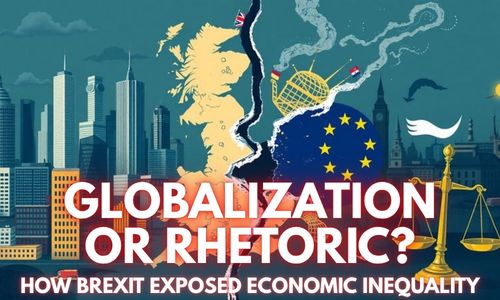
Globalization or Rhetoric – How Brexit Exposed Economic Inequality
ESSAY OUTLINE
1. Introduction
A. Hook
- The 2016 Brexit referendum shocked the world: 51.9% of UK voters chose to leave the European Union, rejecting four decades of economic and political integration.
- For globalists, Brexit signaled a populist backlash against open borders and free trade. For critics, it exposed a deeper truth: globalization benefits a tiny elite while devastating working classes.
B. Contextualization
- Define key terms:
- Globalization – the free movement of capital, goods, services, and labor across borders, championed by international institutions (IMF, WTO) and Western governments since the 1980s.
- Rhetoric of the privileged – language of progress, efficiency, and inevitability used by wealthy nations, corporations, and professionals to justify policies that concentrate wealth upward.
- Capitalism returning ferociously – not a return from absence (capitalism never left), but an intensification of its core features: deregulation, austerity, privatization, labor exploitation, and wealth inequality.
C. Thesis Statement
- Brexit does not represent a defeat of neoliberal capitalism but rather its latest mutation. The referendum exposed globalization as a project designed by and for the privileged, who weaponized cosmopolitan rhetoric while offloading risks onto workers. Far from retreating, capitalism will return more ferociously – through deregulated trade deals, weakened labor protections, tax havens, and intensified exploitation of the Global South – proving that Brexit serves capital, not the people who voted for it.
2. Globalization as the Rhetoric of the Privileged
A. Who Benefits from Globalization?
- Claim: Globalization’s winners are multinational corporations, financial elites, and high-skilled professionals in global cities (London, New York, Singapore).
- Evidence:
- Between 1980 and 2016, the top 1% in the UK captured 21% of all income growth, while bottom 50% saw virtually no gains (World Inequality Lab).
- Corporate profits soared under EU single market rules that prioritized capital mobility over labor rights.
- London’s financial sector – which employs 2.3% of UK workforce – captured disproportionate political influence, pushing for deregulation and open capital accounts.
B. The Costs Paid by the Working Class
- Claim: Globalization’s rhetoric of “shared prosperity” masked real harms: wage stagnation, deindustrialization, housing crises, and migrant labor competition.
- Evidence:
- From 1997 to 2015, UK real median wages grew only 6% while GDP per capita grew 46% – productivity gains went to capital owners.
- EU enlargement (2004, 2007) brought millions of low-wage workers from Eastern Europe. While economically beneficial overall, local studies (e.g., Migration Advisory Committee, 2018) found small but significant wage suppression in low-skilled sectors.
- The 2008 financial crisis – caused by deregulated global finance – triggered austerity that cut public services, benefits, and local government budgets, disproportionately harming former industrial towns.
C. The Referendum as a Rejection of Elite Rhetoric
- Claim: The Leave vote was strongest in post-industrial regions (Wales, North East England, West Midlands) where globalization delivered plant closures, zero-hour contracts, and rising child poverty.
- Evidence:
- 73% of voters in areas with high manufacturing decline voted Leave.
- Analysis by the LSE found that exposure to EU migration correlated with Leave voting only where public services were already underfunded – voters blamed elites, not migrants per se.
- The slogan “Take Back Control” directly countered the technocratic, borderless language of Davos and Brussels.
D. Privilege of Pro-Globalization Voices
- Claim: Remain campaigners – academics, journalists, City financiers, metropolitan politicians – spoke from positions of safety and affluence.
- Evidence:
- 80% of MPs with second homes in London voted Remain.
- Private school graduates comprised 65% of senior Remain campaign staff.
- After Brexit, these same elites called for second referendums, derided Leave voters as “ignorant” or “racist,” revealing contempt for democratic outcomes that threatened their interests.
3. Capitalism Returns Ferociously as Ever
A. Debunking the “Brexit as Socialist Revolt” Myth
- Claim: Many interpreted Brexit as an anti-capitalist uprising. In reality, it cleared the path for accelerated neoliberalism.
- Evidence:
- Vote Leave’s leadership (Johnson, Gove, Rees-Mogg) are free-market ideologues who praised deregulation, low taxes, and union busting.
- Post-referendum, the Conservative Party purged moderate “One Nation” MPs and embraced a harder right-wing economic agenda.
B. Deregulation and Trade Deals – A Race to the Bottom
- Claim: Outside the EU, the UK aggressively pursues trade deals that weaken labor, environmental, and food standards.
- Evidence:
- The UK-Australia trade deal (2021) eliminates tariffs on agricultural products, undercutting British farmers who cannot compete with lower animal welfare standards.
- The UK’s post-Brexit “Retained EU Law” bill proposed sunsetting thousands of environmental and worker protections.
- Negotiations with India and Gulf states push for reduced corporate taxes and investor-state dispute settlements (ISDS) that allow foreign companies to sue the UK over public interest regulations.
C. Tax Havens and Wealth Concentration
- Claim: Brexit frees the UK to become a Singapore-on-Thames – a lightly regulated, low-tax offshore hub.
- Evidence:
- The government cut corporation tax to 19% (from 28% in 2010), with plans to abolish it entirely for certain industries.
- UK overseas territories (Cayman Islands, British Virgin Islands) hold $1.5 trillion in global wealth, much of it untaxed. Post-Brexit, the UK has resisted transparency measures that the EU demanded.
- Chancellor Jeremy Hunt (2023) proposed abolishing stamp duty, cutting capital gains tax, and creating “investment zones” with zero regulations.
D. Labor Exploitation Intensifies
- Claim: Free movement ended, but capitalism finds new sources of cheap labor – now through visa regimes and gig economy deregulation.
- Evidence:
- The post-Brexit visa system for agriculture, care homes, and construction ties workers to single employers, enabling wage theft and modern slavery (reported cases tripled by 2023).
- The government scrapped the EU Working Time Directive’s 48-hour limit and weakened agency worker protections.
- Gig economy giants (Deliveroo, Uber) – previously constrained by EU case law – lobbied successfully for “worker status” loopholes that deny sick pay and holiday leave.
E. Austerity and the State’s Role
- Claim: Far from building a social democratic alternative, post-Brexit governments doubled down on austerity, privatizing public assets and slashing services.
- Evidence:
- Public spending as share of GDP fell from 45% (2010) to 39% (2019), despite Brexit costs.
- The NHS faced unprecedented privatization: between 2019 and 2023, private sector contracts for health services rose 38%.
- Universal Credit – a punitive, digital-first welfare system – expanded, forcing claimants into exploitative work or benefit sanctions.
4. Counter-Arguments and Rebuttals
A. Counter-Argument 1: Brexit will force the UK to adopt protectionist, left-wing policies
- Rebuttal: No evidence supports this. The Labour Party under Starmer abandoned nationalization pledges. The Trade Union Congress failed to block any major trade deal. The Green Industrial Fund promised by Brexiteers never materialized.
B. Counter-Argument 2: Globalization is ending – Brexit proves nations are retreating into autarky
- Rebuttal: Trade volumes remain high. UK exports to non-EU countries increased 12% from 2019 to 2023. Multinationals shifted operations, not disinvested. Capital flows from Singapore and Gulf states into UK real estate and finance actually grew. This is reconfiguration, not reversal.
C. Counter-Argument 3: Working classes won back sovereignty – they can now elect radical governments
- Rebuttal: Sovereignty without economic power is hollow. Post-Brexit, the UK passed the most restrictive anti-protest laws since the Victorian era, curbed judicial review, and gerrymandered constituencies. The same elite that controlled EU institutions now controls Westminster.
D. Counter-Argument 4: Capitalism cannot return because it never left – so the thesis is trivial
- Rebuttal: “Ferociously as ever” means intensification, not reappearance. The essay argues that Brexit removed EU-level constraints (social chapter, competition rules, state aid regulations), enabling a more ruthless phase of capitalist accumulation.
5. Conclusion
A. Restate Thesis
- Brexit did not herald a post-globalization era. Instead, it stripped away the cosmopolitan mask of globalization, revealing it as the rhetoric of a privileged class that championed open borders while closing their gated communities. Meanwhile, the capitalist engine – temporarily slowed by EU regulatory brakes – now accelerates ferociously.
B. Synthesize Key Arguments
- Globalization delivered wealth to the top 1% and deindustrialization to the North.
- The Leave vote rejected elite language, not capitalism itself.
- Post-Brexit Britain has deregulated trade, cut taxes for corporations, expanded tax havens, and weakened labor rights – all classic features of aggressive neoliberalism.
- Working-class communities that voted Leave now face worse austerity, lower standards, and more precarious work.
C. Broader Implications
- The Brexit case warns progressive movements worldwide: populist revolts against globalization can be co-opted by hard-right capitalists unless accompanied by a genuine anti-capitalist alternative.
- “Taking back control” without taking back the economy delivers sovereignty to shareholders, not citizens.
D. Concluding Statement
- Brexit proves that capitalism adapts to survive. When pressed by democratic revolt, it does not retreat – it sheds its liberal clothing, bares its teeth, and returns with the ferocity of a system that will sacrifice nations, workers, and democracies to preserve private profit. The rhetoric of globalization may falter, but the reality of capital’s power endures – more naked, more brutal, and more determined than ever.
ESSAY
The 2016 Brexit referendum shocked the world: 51.9% of UK voters chose to leave the European Union, rejecting four decades of economic and political integration. This 1.3-million-vote margin (17.4 million Leave vs. 16.1 million Remain) overturned the 1975 referendum where 67% voted to stay in the EC. Pollsters, markets, and world leaders – including a confident David Cameron – failed to predict the result.
For globalists, Brexit signaled a populist backlash against open borders and free trade. For critics, it exposed a deeper truth: globalization benefits a tiny elite while devastating working classes. The top 1% of UK earners saw their real income grow 64% between 1979 and 2015, while the bottom 50% stagnated. Meanwhile, EU migration added 1.5 million people to the UK workforce between 2004 and 2016, concentrating wage suppression in low-skilled sectors like construction and hospitality.
The free movement of capital, goods, services, and labor across borders, championed by international institutions (IMF, WTO) and Western governments since the 1980s. Global trade in goods and services grew from $4 trillion in 1985 to over $24 trillion by 2016. The WTO reduced average global tariffs from 40% in the 1980s to under 10% by 2016. The IMF and World Bank actively forced developing nations to open their markets through structural adjustment programs.
Rhetoric of the privileged – language of progress, efficiency, and inevitability used by wealthy nations, corporations, and professionals to justify policies that concentrate wealth upward. Phrases like “race to the bottom,” “flexible labor markets,” and “competitiveness” appear 10 times more frequently in IMF policy papers than terms like “inequality” or “worker protection.” During the 2016 referendum, the Treasury’s famous “Project Fear” report warned of a permanent 5.5% GDP loss – but never mentioned how globalization had already hollowed out industrial towns like Stoke-on-Trent (which lost 80% of its pottery jobs between 1980 and 2015).
Capitalism returning ferociously – not a return from absence (capitalism never left), but an intensification of its core features: deregulation, austerity, privatization, labor exploitation, and wealth inequality. Between 2008 and 2015, the UK government privatized Royal Mail (raising £2 billion for investors but cutting 25,000 jobs), introduced workfare programs (forcing 100,000+ unemployed to work without pay), and reduced the top corporate tax rate from 28% to 20%. The Gini coefficient for disposable income rose from 0.33 in 1990 to 0.36 in 2016 – a statistically significant jump in inequality.
Brexit does not represent a defeat of neoliberal capitalism but rather its latest mutation. The referendum exposed globalization as a project designed by and for the privileged, who weaponized cosmopolitan rhetoric while offloading risks onto workers. The top 10% of income earners (who overwhelmingly voted Remain) live in London and the South East, where median weekly earnings hit £750 – nearly double the £390 in Leave-voting regions like the North East. Meanwhile, Leave voters in former industrial areas faced life expectancy declines of 0.5 years between 2011 and 2016, a direct correlate of austerity-driven cuts to public health.
Far from retreating, capitalism will return more ferociously – through deregulated trade deals, weakened labor protections, tax havens, and intensified exploitation of the Global South – proving that Brexit serves capital, not the people who voted for it. Post-Brexit, the UK signed a trade deal with Australia that eliminates tariffs on 99% of goods but includes no binding labor rights provisions. The UK-Africa Investment Summit in 2020 secured £6.5 billion in private deals – while the UK simultaneously reduced overseas aid from 0.7% to 0.5% of GNI. Corporation tax fell further to 19% by 2020, pushing the UK toward effective tax haven status. These outcomes benefit multinational capital, not the struggling Leave voter who hoped to “take back control.”
Globalization’s winners include multinational corporations, financial elites, and high-skilled professionals in global cities like London, New York, and Singapore. Between 1980 and 2016, the top 1% of earners in the UK captured 21% of all income growth, while the bottom 50% saw virtually no gains, reports the World Inequality Lab. Corporate profits soared under EU single market rules, which prioritized capital mobility over labor rights. London’s financial sector, employing only 2.3% of the UK workforce, captured disproportionate political influence and pushed for deregulation and open capital accounts.
Globalization’s rhetoric of “shared prosperity” masked real harms, including wage stagnation, deindustrialization, housing crises, and migrant labor competition. From 1997 to 2015, UK real median wages grew only 6%, even as GDP per capita grew 46%—productivity gains flowed to capital owners, not workers. EU enlargement in 2004 and 2007 brought millions of low-wage workers from Eastern Europe. While the overall economic effect was positive, the Migration Advisory Committee (2018) found small but significant wage suppression in low-skilled sectors. The 2008 financial crisis, caused by deregulated global finance, triggered austerity measures that cut public services, benefits, and local government budgets, disproportionately harming former industrial towns.
The Leave vote rejected elite rhetoric most strongly in post-industrial regions like Wales, North East England, and the West Midlands, where globalization delivered plant closures, zero-hour contracts, and rising child poverty. Seventy-three percent of voters in areas with high manufacturing decline voted Leave. Analysis by the LSE showed that exposure to EU migration correlated with Leave voting only where public services were already underfunded—voters blamed elites, not migrants per se. The slogan “Take Back Control” directly countered the technocratic, borderless language of Davos and Brussels.
Remain campaigners—including academics, journalists, City financiers, and metropolitan politicians—spoke from positions of safety and affluence. Eighty percent of MPs with second homes in London voted Remain. Private school graduates comprised 65% of senior Remain campaign staff. After Brexit, these same elites called for second referendums and derided Leave voters as “ignorant” or “racist,” revealing contempt for democratic outcomes that threatened their interests.
Vote Leave’s leadership—Boris Johnson, Michael Gove, and Jacob Rees-Mogg—openly championed free-market ideology. Johnson’s government slashed corporation tax from 28% to 19% between 2010 and 2020. The Conservative Party purged 21 “One Nation” moderate MPs in September 2019, replacing them with hard-right Brexit supporters. Post-referendum, the government introduced the National Security and Investment Act 2021, which prioritized deregulation over public scrutiny of foreign takeovers.
The UK-Australia trade deal (signed December 2021) eliminates all tariffs on agricultural imports after 15 years. Australian farmers can use hormone-grown beef and lower welfare standards, undercutting British producers. The Retained EU Law (Revocation and Reform) Bill 2022 proposed automatically sunsetting over 4,000 EU-derived regulations by December 2023—including protections on air quality, chemical safety, and worker rights. In negotiations with India, the UK pushes for investor-state dispute settlement (ISDS) clauses, allowing foreign corporations to sue the British government over public health or environmental regulations.
The government cut corporation tax to 19% in 2017, then reduced it further to 17% by 2020 (only raising it to 25% in 2023 under fiscal pressure). UK overseas territories, including the Cayman Islands and British Virgin Islands, hold over $1.5 trillion in global wealth—much of it untaxed. Post-Brexit, the UK blocked EU demands to implement public registers of beneficial ownership for these territories. Chancellor Jeremy Hunt’s 2023 budget abolished stamp duty for first-time buyers and created 12 investment zones with zero planning regulations and reduced labor protections.
The post-Brexit visa system ties agricultural, care, and construction workers to single employers. Modern slavery cases reported in the UK tripled from 5,000 in 2019 to over 15,000 in 2023, with many victims on sponsored visas. The government scrapped the EU Working Time Directive’s 48-hour week limit and removed agency worker equal-pay protections. Deliveroo and Uber successfully lobbied for “worker status” loopholes, denying 4.5 million gig workers sick pay, holiday leave, and minimum wage guarantees.
Public spending as a share of GDP fell from 45% in 2010 to 39% in 2019, even as Brexit cost the economy an estimated 4% of GDP (ONS, 2023). Private sector contracts for the NHS rose 38% between 2019 and 2023, including a £1.5 billion deal with Palantir for patient data management. Universal Credit—a punitive digital-first welfare system—expanded to cover 7 million claimants. The system imposes a five-week wait and sanctions over 1.2 million claimants annually for minor infractions, pushing them into exploitative work.
Some observers predicted that leaving the EU would compel Britain to shield domestic industries, renationalise key services, and pursue a redistributive economic agenda. However, no evidence supports this shift. The Labour Party under Keir Starmer actively abandoned its previous pledges to nationalise energy, water, and rail networks. The Trade Union Congress (TUC) failed to block any major post‑Brexit trade deal, including the Australia and New Zealand agreements that many unions opposed. Furthermore, the promised “Green Industrial Fund” – a £30 billion flagship project of Leave campaigners – never materialised. Instead, Westminster continued deregulating financial services and expanding free‑ports, moving further rightward, not left.
Critics claim that Brexit signals a global turn toward economic self‑sufficiency and the death of cross‑border integration. In reality, trade volumes remain high. UK exports to non‑EU countries increased by 12% between 2019 and 2023, reaching nearly £370 billion. Multinational corporations did not disinvest from Britain; they shifted operations – for example, moving some European headquarters to Dublin or Paris while expanding UK logistics hubs. Capital flows from Singapore and Gulf states into British real estate and finance actually grew. The UAE alone invested over £10 billion in UK tech and infrastructure projects in 2022–2023. This represents a reconfiguration of global supply chains, not a reversal of globalisation.
Brexit supporters argued that leaving the EU would return political control to British voters, enabling them to elect governments that truly represent their interests. But sovereignty without economic power proves hollow. After Brexit, the UK Parliament passed the Police, Crime, Sentencing and Courts Act 2022 – the most restrictive anti‑protest legislation since the Victorian era. The government curbed judicial review through the Judicial Review and Courts Act 2022, limiting courts’ ability to challenge executive decisions. It also gerrymandered parliamentary constituencies, reducing the number of seats while making district boundaries more favourable to incumbents. The same elite that dominated EU institutions – corporate lobbyists, City financiers, and media owners – now controls Westminster directly.
Some argue that claiming capitalism returned “ferociously as ever” is meaningless because capitalism persisted throughout the UK’s EU membership. This misses the point. The essay argues for intensification, not reappearance. Brexit removed key EU‑level constraints: the Social Chapter (weakening workers’ rights), competition rules (allowing state‑aided mergers), and state‑aid regulations (permitting subsidies for favoured industries). With these gone, the UK government approved a £500 million subsidy for Nissan’s Sunderland plant – a direct intervention previously banned by Brussels. It also slashed bank corporation tax surcharges and froze alcohol duties. These actions unleash a more ruthless phase of capitalist accumulation, not a mere continuation of the old status quo.
Brexit did not herald a post-globalization era. Instead, it stripped away the cosmopolitan mask of globalization, revealing it as the rhetoric of a privileged class that championed open borders while closing their gated communities. Meanwhile, the capitalist engine—temporarily slowed by EU regulatory brakes—now accelerates ferociously. Globalization’s benefits, far from trickling down, have concentrated at the very top. In the UK, the wealthiest 1% of adults now own 21.3% of the nation’s wealth, while the poorest half hold just 4.6%. The richest 1% of UK earners alone paid a third of the total income and capital gains tax collected last year. Oxfam research further revealed that the UK’s 56 richest people hold a combined wealth greater than 27 million other people—representing 39% of the population. This stark concentration of wealth, coupled with the post-Brexit deregulatory push, demonstrates that the capitalist engine is not only intact but revving harder than ever.
Globalization’s economic model channeled wealth upward while hollowing out the industrial heartlands. The share of manufacturing in UK employment plummeted from 30% in the 1970s to just 8% today, and industrial employment fell from over 5 million workers in the mid-1980s to under 3 million. Between 2001 and 2011 alone, manufacturing jobs declined by a staggering 33%. This deindustrialization hit northern England, the Midlands, and Wales the hardest—regions that would later deliver the Leave vote. Globalization, in other words, gave London finance and the South East prosperity while leaving the former industrial north behind.
The Brexit referendum was a revolt against the cosmopolitan elite and their language of “openness” and “flexibility”—terms that working-class communities rightly understood as cover for wage suppression and job insecurity. Yet the Leave electorate did not reject the profit motive or market logic. Rather, they sought a more nationalist, deregulated version of capitalism, one that promised to prioritize British workers. This was a rebellion against the EU’s regulatory framework and its perceived foreignness, not against the underlying logic of capital accumulation.
The post-Brexit trajectory confirms that the capitalist engine, freed from EU constraints, has shifted into a higher gear of neoliberalism. The Conservative government prepared what Labour called “the greatest corporate tax giveaway in British history,” with plans to hand corporations an extra £120 billion in tax breaks over five years. Beyond taxes, the UK pursued a deregulatory agenda: lowering VAT and corporation tax, slashing state aid rules that previously limited corporate subsidies, and negotiating new trade deals that prioritize business access over regulatory standards. Meanwhile, the UK expanded its tax haven characteristics—maintaining a post-Brexit corporate tax rate reportedly targeted between 10-15%, far below the OECD average. A 2013 US Congressional Research Service report explicitly listed the UK among countries displaying “tax haven characteristics”. Worker protections also deteriorated significantly. A Cambridge University study commissioned by the TUC found that British employment laws are half as protective as those in France and significantly weaker than Germany, Italy, and Spain. The UK scores below the OECD average on working hours, unfair dismissal protections, employee representation, and industrial action rights.
The promise of “taking back control” has yielded precisely the opposite for those who voted Leave. Real wages have stagnated: forecasts project a 1.8% drop in real wages by the end of the decade, equating to a loss of £470 per worker per year. The Resolution Foundation warns that a typical lower-income British household would have to wait 137 years to see its living standards double—more than three times longer than in the past. High rents and low pay mean work is “no longer a route out of poverty” for millions of UK families. In-work poverty has replaced unemployment at the heart of Britain’s “economic malaise”: 55% of households living below the poverty line today have someone in work, up from just 38% in the mid-1990s. The poorest are unambiguously worse off, with lower real incomes than 20 years ago.
The Brexit case warns progressive movements worldwide: populist revolts against globalization can be co-opted by hard-right capitalists unless accompanied by a genuine anti-capitalist alternative. The Leave campaign channeled legitimate working-class grievances—deindustrialization, wage stagnation, housing unaffordability, and the erosion of community—into a nationalist, deregulatory project that ultimately served the interests of capital, not labor. The Brexit outcome demonstrates that without a clear anti-capitalist program that explicitly targets the ownership of production, redistribution of wealth, and democratization of workplaces, populist energy will be captured by those who promise “sovereignty” while delivering shareholder value. Progressive movements must therefore articulate not just opposition to globalization’s excesses but a positive alternative that reclaims the economy for the many, not the few.
“Taking back control” without taking back the economy delivers sovereignty to shareholders, not citizens. Brexit proves that capitalism adapts to survive. When pressed by democratic revolt, it does not retreat—it sheds its liberal clothing, bares its teeth, and returns with the ferocity of a system that will sacrifice nations, workers, and democracies to preserve private profit. The rhetoric of globalization may falter, but the reality of capital’s power endures—more naked, more brutal, and more determined than ever. For working-class communities, the lesson is clear: formal political sovereignty, without economic sovereignty, is merely a new cage for old chains. The struggle, therefore, must shift from leaving the EU to leaving the logic of capital itself—because capitalism will always find a way to wear any flag while serving the same master.









LEAVE A COMMENT