
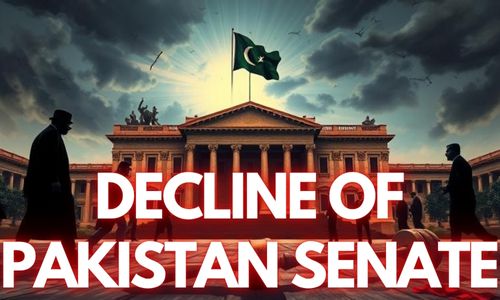
Decline of Pakistan Senate
The Senate of Pakistan, intended as the apex legislative chamber designed to reflect federal parity, has long held the responsibility of stabilizing democracy and protecting provincial interests. Political engineering, horse trading, questionable seat adjustments, and party manipulation have actively compromised the constitutional sanctity of this institution. These practices have transformed the Senate from a body of sober second thought to a hotbed of political bargains.
The Foundational Purpose of the Senate in Pakistan
The framers of the 1973 Constitution created the Senate to provide equal representation to all federating units, regardless of population. It serves as a counterbalance to the National Assembly, where representation is based on population. The framers intended the upper house to promote harmony, enhance legislation, and ensure that minority provinces have a decisive voice in national affairs.
Unfortunately, the ground reality stands in stark contrast to the constitutional vision. Political maneuvering has warped the institution into a space for backdoor deals and manipulated loyalties, undermining democratic norms.
Horse Trading: The Death Knell of Parliamentary Integrity
Horse trading, the unethical buying and selling of votes, has plagued Senate elections in Pakistan for decades. The indirect method of Senate elections, where provincial assembly members elect Senators, creates fertile ground for corruption.
The Modus Operandi of Vote Selling
Observers have alleged that legislators, often under no legal compulsion to vote in line with their party, accept massive bribes in exchange for their votes. Hidden camera recordings, leaks, and judicial inquiries have exposed how individuals exchange millions of rupees in briefcases. Influential actors make these deals in luxury hotels, private residences, or even foreign locations.
Such blatant trading not only defiles the constitutional role of legislators but also taints the credibility of the entire electoral process. This culture of monetized votes erodes public trust, reduces political parties to mere syndicates, and ultimately compromises legislation.
Seat Adjustment Tactics: Democracy for Sale
Seat adjustments, though presented as strategic political alliances, often act as cloaks for undemocratic power-sharing arrangements. Parties with conflicting ideologies often forge coalitions during Senate elections to maximize seat wins without voter accountability.
Behind-the-Scenes Bargains
These arrangements are seldom based on ideology. Powerful actors construct them to serve vested interests and ensure political survival, including military appeasement, money laundering protections, and immunity for corrupt leaders. They distribute key portfolios based on political settlements rather than performance.
This undermines the concept of transparent representation, dilutes the Senate’s role as a legislative body, and turns it into an auction house for political influence.
The Role of Compromised Members: Trojan Horses in Parliament
Another glaring concern is the infiltration of compromised individuals into the Senate—members who are beholden not to their electorate or party, but to external handlers. These individuals operate as Trojan horses, pushing foreign agendas, protecting criminal elements, or advancing the personal interests of their patrons.
Political Nomads and Silent Saboteurs
Many Senators have a history of party switching, indifference to parliamentary proceedings, or sudden ideological shifts that defy logic. They remain absent in critical legislative debates, yet actively participate in covert lobbying, secretive voting alliances, and manipulative political schemes.
Their presence in the Senate hijacks policymaking, stalls reforms, and blocks genuine democratic development. Worse, it signals to the masses that the upper house is not a sanctuary of intellect and patriotism, but a den of opportunists.
Judicial Silence and the ECP’s Inefficacy
The Election Commission of Pakistan (ECP) and the judiciary have largely failed to cleanse the Senate’s electoral rot. Although some members have been disqualified post-facto, the legal loopholes and political hesitancy prevent meaningful reform.
Ineffective Regulations and No Transparency
Corrupt elements exploit vote secrecy because lawmakers have refused to implement open balloting, despite repeated public demands. Political elites who benefit from the current opaque system have repeatedly stonewalled reform efforts.
Judicial proceedings are often delayed or dismissed on technical grounds. This institutional inaction emboldens manipulators, further weakening the Senate’s democratic essence.
Media Manipulation and Narrative Engineering
Media houses, often aligned with political interests or under financial duress, fail to highlight the systemic corruption embedded in the Senate’s structure. Instead, controlled narratives dominate airtime, celebrating electoral “successes” that are little more than managed outcomes.
Controlled Celebrations, Ignored Realities
The public is bombarded with talk shows, speeches, and headlines celebrating victories without context. Rarely does the media explore the money trails, hidden compromises, or foreign lobbying involved in securing Senate seats.
This information blackout is strategic—aimed at diverting public attention and normalizing fraudulent practices within the political sphere.
Militarization and the Deep State’s Shadow
The interference of unelected institutions, particularly the military establishment, cannot be overlooked. Senate elections have often been steered, influenced, or even dictated by agencies working behind the scenes.
Strings Attached to Senators
Several Senators, especially independents or those from smaller parties, are believed to act under pressure or direction from security agencies. Their voting patterns, silence on critical issues, and sudden alignments hint at a deeper power game—where the true legislative power lies outside the Parliament.
Such interference destroys the balance of power, turning the Senate into an appendage of non-civilian actors, rather than a sovereign legislative body.
The Way Forward: Structural Reforms and Political Courage
Rehabilitating the Senate requires bold, structural reforms and uncompromising political will. Key initiatives must include:
-
Open ballot system for Senate elections to curb horse trading.
-
Stringent financial disclosures and live telecasts of election proceedings.
-
Constitutional amendments to ensure party discipline in voting.
-
Strict penalties for vote-selling and political bribery.
-
Judicial activism to monitor and penalize illegal practices.
Without these changes, the Senate will remain a shell of constitutional intent, unfit to serve its foundational purpose.
Restoring Dignity to a Damaged Institution
The Pakistani Senate, once envisioned as the pillar of democratic stability, is now under siege from monetary influences, ideological compromises, and shadowy power brokers. It no longer echoes the voice of the federation but amplifies the whispers of backroom deals.
Unless urgent reforms are enacted, we risk losing not just the credibility of an institution, but the future of democratic governance in Pakistan.










LEAVE A COMMENT