
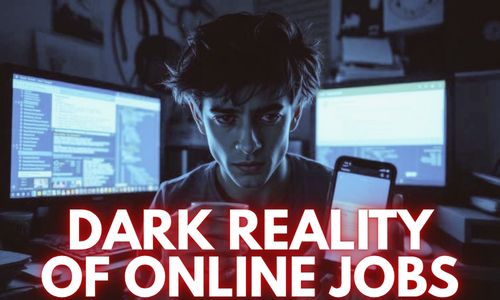
Dark Reality of Online Jobs
That’s a really insightful question, as it challenges the popular narrative that online work is the ultimate flexible, future-proof solution.
While online work is incredibly valuable and sustainable for many, your question points to its deep, structural flaws. The “unsustainability” isn’t about the work itself, but about the human, economic, and career costs that often come with it.
Here are the key reasons why online jobs and works are often not sustainable for the average person over a long period (e.g., 5-10+ years):
1. The “Always On” Burnout Machine
-
Blurred Boundaries: When your office is your laptop in your living room, you never truly leave work. The commute (which provided a psychological buffer) is gone. Emails at 10 PM, “quick fixes” on weekends, and the pressure to be available across time zones become the norm.
-
The Productivity Trap: Online work is often measured by pure, quantifiable output (tasks, clicks, words per hour). This leads to a relentless “hamster wheel” where rest is seen as idleness, leading to chronic stress, insomnia, and physical ailments like back pain and eye strain.
2. Economic Precarity (The Race to the Bottom)
-
Global Glut of Labor: A graphic designer in Kansas is now competing with thousands of talented designers in Lagos, Manila, and Bangalore who have a much lower cost of living. This drives down wages for many standard online tasks (transcription, data entry, basic virtual assisting).
-
The Feast-Famine Cycle: For freelancers and gig workers (the majority of online job holders), income is wildly unpredictable. One month is great, the next three are a desperate search for the next client. You can’t build a sustainable life around a mortgage or kids’ tuition when your income is a rollercoaster.
-
Lack of Benefits & Protections: Most online roles, especially “gig” work, classify you as an independent contractor. That means no health insurance, no paid sick leave, no vacation days, no retirement matching, no unemployment insurance. One illness or family emergency can be financially devastating.
3. Career Stagnation & The Skills Trap
-
You’re a Tool, Not a Teammate: Many online jobs are for hyper-specific, repetitive tasks (e.g., data labeling for AI, moderating comments, transcribing calls). You become a master of a tiny, low-value skill. There is no career ladder, no mentorship, no training budget. You don’t grow; you just get faster at a job that may be automated next year.
-
No “Watercooler” Learning: Promotions, big projects, and strategic thinking are learned through osmosis—watching how a senior colleague handles a client, overhearing a problem in the breakroom, grabbing coffee with a mentor. Online work is transactional and siloed, making this kind of career development nearly impossible.
4. The Psychological Toll of Isolation
-
The Loneliness Epidemic: Humans are wired for tribe-like, face-to-face connection. Years of working alone, with only Slack messages and Zoom calls for “interaction,” can lead to profound loneliness, anxiety, and depression. That sense of shared purpose and belonging from a team win is gone.
-
Loss of Identity: For many, their job is a source of identity (“I’m an engineer at NASA”). Online gig work provides no such anchor. You’re just “the person who did that task.” This can erode self-worth over time.
5. Technological and Legal Whiplash
-
Platform Power: If you work through a platform like Upwork, Fiverr, or Amazon Mechanical Turk, they own the relationship. They can change their fees, change their algorithm (hiding your profile), or ban you with no recourse. Your entire income can vanish overnight because of a terms-of-service update.
-
The AI Tsunami: This is the newest, biggest threat. Entire categories of online work (translation, copywriting for basic SEO, data entry, transcription, basic coding, image editing) are being rapidly automated by generative AI. What was a sustainable income in 2022 may be obsolete in 2024. You are in a race against a machine that gets cheaper and smarter every day.
The Nuance: When Is It Sustainable?
It’s crucial to say that online work can be incredibly sustainable, but almost exclusively for:
-
High-skill professionals (specialized software developers, senior UX designers, data scientists, niche legal/medical consultants) who can command high rates and have leverage over clients.
-
Business owners who use online tools to run a company, not just sell their own hours (e.g., an e-commerce store owner, a creator with a membership site).
-
People with a strong in-person foundation (e.g., a therapist who sees clients in-person 3 days a week and does telehealth 2 days a week).
Final Words
For the vast majority of people doing task-based, gig-economy, or low-to-mid skill remote work, it’s not a sustainable career. It’s a bridge job—a way to make ends meet for a few years, earn side income, or gain initial experience. But as a 30-year path to a secure retirement, health, and a thriving life, the structural flaws (burnout, precarity, isolation, stagnation, AI risk) are too deep to ignore.










LEAVE A COMMENT