

Z.A. Bhutto – Crooked Legacy
Supporters admire Zulfikar Ali Bhutto for his nationalism and secular internationalist agenda, as well as his role as a protector of democracy. He’s celebrated as a charismatic leader who championed the cause of the poor with the famous ‘Roti, Kapra aur Makaan’ slogan. However, critics condemn him for political repression, a struggling economy, and human rights abuses in Balochistan. Despite his socialist image, with his Mao Zedong-like attire of waistcoat and cap, Bhutto aligned himself with feudal and religious elites.
Zulfikar Ali Bhutto, the Pakistan People’s Party (PPP) founder and Prime Minister from 1973 to 1977, achieved notable milestones during his tenure. Yet, his policies and decisions also played a role in undermining Pakistan’s long-term economic and political stability.
Charge Sheet Against Bhutto
Here are some ways in which Zulfikar Ali Bhutto’s policies and decisions had an adverse impact on Pakistan:
- Nationalization of industries: One of the major policy decisions of Bhutto’s government was the nationalization of several key industries, including banking, steel, and chemical industries. This move led to the state taking control of these industries, leading to inefficiencies, corruption, and ultimately resulting in a decline in their performance.
- Centralization of power: Bhutto centralized power in the federal government, which resulted in weakening the power of provincial governments. This created resentment among the people of provinces, leading to a feeling of discrimination and marginalization, ultimately contributing to political instability.
- Polarization and political repression: Bhutto’s government also saw increased polarization between different political factions, which led to political repression and violence. This led to a decline in democratic values and the erosion of civil liberties.
- Economic mismanagement: Bhutto’s government mismanaged the economy, leading to a decline in economic growth, high inflation, and a balance of payment crisis. Bhutto’s socialist policies also discouraged foreign investment, leading to a lack of industrial growth and job opportunities.
- Political manipulation: Bhutto’s government was accused of manipulating the political process to maintain power, which ultimately led to his downfall. His government was accused of rigging the 1977 elections, leading to widespread protests and ultimately a military coup.
Dent to Kashmir Cause
Zulfiqar Ali Bhutto’s boycott of the United Nations General Assembly (UNGA) session in 1971 significantly impacted the Kashmir issue. The UNGA had passed resolutions on Kashmir, advocating for a plebiscite to determine its future.
However, Bhutto’s boycott meant Pakistan did not present the Kashmir issue in the international forum. India seized this opportunity to portray Pakistan as the aggressor, sidelining its own human rights abuses in Kashmir.
This shift of international attention weakened Pakistan’s diplomatic position, reducing its ability to garner global support for the Kashmir cause. Bhutto’s decision had long-term consequences, weakening Pakistan’s stance and allowing India to maintain control over Kashmir. Ultimately, it reflected a shortsighted diplomatic approach, harming Pakistan’s strategic interests.
Bhutto’s Double Game During Indo-Pak War 65
Zulfikar Ali Bhutto, renowned for his political acumen, balanced relations with the establishment while pursuing his personal political goals. An illustrative case is his involvement in the 1965 Indo-Pak War. Publicly, he supported the military and the government, but privately, he actively undermined their efforts.
However, Bhutto’s political maneuvering couldn’t shield him from a military coup in 1977. His intricate relationship with the establishment has been a subject of extensive debate and analysis.
One contentious aspect involves Bhutto’s alleged initiation of the 1965 conflict with India while simultaneously pursuing diplomatic avenues, resulting in accusations of playing a “double game.” While some defend his approach as a response to India’s aggression, experts have debated and scrutinized Bhutto’s actions during the 1965 Indo-Pak War for decades.
Politicization of Bureaucracy
Zulfikar Ali Bhutto appears to have aimed for a civilian bureaucracy personally loyal to him with greater power over society and the economy. The consequences reverberated throughout the state apparatus. During the 1960s, increases in development spending and civil servants’ manipulation of local governments to help the Ayub Khan military regime secure legitimacy led to a substantial increase in corruption. However, while the increase was alarming, the higher bureaucracy remained fairly clean and, with leadership, training, and resources, was in a position to contain the spread of corruption.
In the 1970s, the first Pakistan People’s Party government enacted several reforms to assert political control over the civilian bureaucracy while pursuing a socialistic development model that justified nationalizing industrial and commercial assets. These reforms significantly undermined the higher bureaucracy’s ability to resist corruption while dramatically increasing state penetration of society and the economy, thus creating more abundant opportunities for corruption.
Bhutto’s Response Over Assassination of Fatma Jannah
There is no credible evidence suggesting Zulfikar Ali Bhutto’s direct involvement in the assassination of Fatima Jinnah, the younger sister of Pakistan’s founder Muhammad Ali Jinnah. In fact, Bhutto condemned the assassination and initiated an investigation when he served as the Foreign Minister under President Ayub Khan’s regime.
Fatima Jinnah was a significant political figure in Pakistan and posed a challenge to Ayub Khan’s regime during the 1964 presidential election. Her campaign enjoyed substantial public support, and her defeat raised suspicions and accusations of electoral fraud.
While some conspiracy theories have implicated Bhutto in the assassination of Fatima Jinnah, there is no credible evidence supporting these claims. In reality, Bhutto himself was a target of political persecution under Ayub Khan’s regime and faced imprisonment for his opposition to the government.

The investigation into Fatima Jinnah’s assassination was inconclusive, and authorities never identified or brought the perpetrators of the crime to justice. However, it is widely accepted that Bhutto was not involved in the assassination, and any allegations to the contrary are unfounded.
Although Bhutto initially supported Fatima Jinnah’s bid for the presidency in 1965, he later withdrew his support and threw his weight behind the incumbent president, Ayub Khan. When Fatima Jinnah died in 1967, Bhutto expressed his condolences but also faced criticism for not attending her funeral. Some have suggested that Bhutto’s absence stemmed from his complicated relationship with Fatima Jinnah and his fear that attending her funeral would harm his political career.
However, Bhutto later paid tribute to Fatima Jinnah, referring to her as a “great woman” who had made significant contributions to Pakistan’s struggle for independence. He also criticized Ayub Khan for his role in the election, arguing that it was rigged in Ayub’s favor and that Fatima Jinnah had been denied a fair chance to win. Overall, Bhutto’s reaction to Fatima Jinnah’s assassination was mixed, reflecting his complicated relationship with her and his political ambitions.
Bhutto’s Role in Fall of Dhaka
Zulfiqar Ali Bhutto, who served as Pakistan’s President from 1971 to 1973, has faced accusations of playing a role in the fall of Dhaka and the separation of East Pakistan. Bhutto held a key government position during the crisis and participated in negotiations with Bengali nationalist leaders and the Pakistani military.
Bhutto strongly advocated for a united Pakistan, but his hardline stance on negotiations and his refusal to acknowledge the Awami League’s electoral victory in the 1970 elections escalated tensions between East and West Pakistan. The Awami League, led by Sheikh Mujibur Rahman, achieved a sweeping victory in the elections held in December 1970.
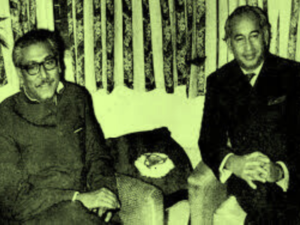
However, the military establishment in West Pakistan refused to hand over power to the Awami League, leading to a political crisis and a military crackdown in East Pakistan. Bhutto, who was then serving as the Minister of Foreign Affairs, actively participated in the negotiations that resulted in the Agartala Conspiracy Case, further inflaming tensions between East and West Pakistan.
As the crisis deepened, Bhutto advocated for a military crackdown in East Pakistan, arguing that it was necessary to maintain the unity of Pakistan. However, his hardline stance ultimately proved counterproductive, as it contributed to the growing sense of alienation and resentment among the Bengali population.
Despite his efforts to preserve the unity of Pakistan, critics widely condemn Bhutto’s role in the crisis. Many argue that his refusal to accept the Awami League’s electoral victory and his uncompromising stance on negotiations fueled escalating tensions and ultimately led to the fall of Dhaka and the separation of East Pakistan.
Effect of Bhutto’s Policy for East Pakistan
Here are some ways in which Zulfiqar Ali Bhutto contributed to the separation of East Pakistan:
- Centralization of power: Bhutto’s centralization of power in the federal government weakened the power of provincial governments, which created resentment among the people of East Pakistan, who felt marginalized and discriminated against. This contributed to the growing demand for autonomy and eventually independence.
- Failure to address economic disparities: Bhutto’s government failed to address the economic disparities between East and West Pakistan, leading to a sense of economic exploitation among the people of East Pakistan. This contributed to the demand for greater economic autonomy and eventually independence.
- Political repression: Bhutto’s government engaged in political repression and violence, which further fueled the demand for autonomy and independence. This included the military crackdown in East Pakistan in 1971, which resulted in widespread human rights abuses and atrocities against the Bengali population.
- Failure to address cultural differences: Bhutto’s government failed to address the cultural differences between East and West Pakistan, leading to a sense of cultural alienation among the people of East Pakistan. This further fueled the demand for greater autonomy and eventually independence.
Overall, while Zulfiqar Ali Bhutto played a limited role in the separation of East Pakistan, his policies and decisions added to the political turmoil and economic instability that eventually resulted in the breakup of the country. The failure to redress the grievances of East Pakistan’s people and the utilization of repression and violence to retain power were substantial factors that contributed to the eventual separation of the two regions.
Nationalization Policy
Zulfiqar Ali Bhutto’s nationalization policy, which aimed to bring major industries under state control, had a significant impact on Pakistan’s economy, leading to long-term damage. Here are some ways in which Bhutto’s nationalization policy dented Pakistan and its economy:
- Loss of efficiency and productivity: Nationalization led to a decline in the efficiency and productivity of industries, as the state was not equipped to manage them effectively. This resulted in a decline in the quality of goods and services, leading to a loss of competitiveness and revenue.
- Rise in corruption: Nationalization led to a rise in corruption, as state officials gained control over key industries and used their power to enrich themselves. This led to a decline in public trust in the government and contributed to economic instability.
- Reduction in foreign investment: Bhutto’s nationalization policy discouraged foreign investment, as foreign investors were reluctant to invest in a country where the state had control over key industries. This led to a decline in foreign investment, reducing the growth potential of the economy.
- Increase in government expenditure: Nationalization led to an increase in government expenditure, as the state had to provide subsidies and other financial support to industries that were not profitable. This increased the burden on the state budget, leading to a decline in public services and an increase in debt.
- Disruption in supply chains: Nationalization disrupted supply chains and distribution networks, leading to shortages of goods and services. This had a significant impact on the overall economy, as it affected businesses and consumers alike.
Overall, Bhutto’s nationalization policy significantly harmed Pakistan’s economy. It resulted in declining productivity, increased corruption, reduced foreign investment, higher government expenditure, and disrupted supply chains. These long-term effects led to economic instability and hindered industrial growth. While Bhutto’s government achieved some notable successes, his policies and decisions ultimately had a detrimental impact on Pakistan’s economic and political stability, impeding the country’s growth and development.
When examining Z.A. Bhutto’s legacy, we encounter a complex figure whose influence on Pakistan’s history sparks ongoing debate. Whether regarded as a charismatic leader or a controversial figure, his impact on the nation’s political landscape is undeniable. ‘Z.A. Bhutto – Crooked Legacy’ invites us to navigate the intricate layers of his story, providing a deeper understanding of a pivotal era in Pakistan’s history.










LEAVE A COMMENT