
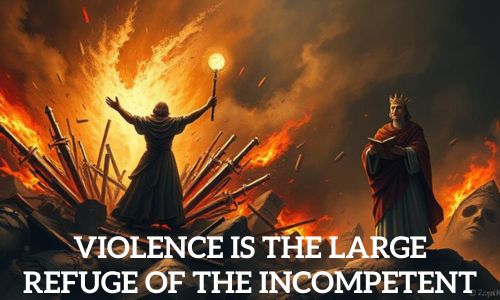
Violence is the Large Refuge of the Incompetent
ESSAY OUTLINE
1. Introduction
- Opening Thought: Begin with a statement on how violence has often been used as a means to assert power or resolve conflicts.
- Context: Explain that the proverb suggests violence arises when individuals or groups lack wisdom, patience, or the skill to resolve issues peacefully.
- Thesis Statement: Violence reflects weakness, not strength—those who resort to it reveal their inability to reason, persuade, or act with competence and moral maturity.
2. Understanding the Quote
- Literal Meaning:
- Explain that “violence” represents physical or verbal aggression, while “incompetent” refers to those unable to use intellect or reason.
- Philosophical Interpretation:
- Discuss how true intelligence seeks solutions through dialogue, empathy, and logic rather than force.
3. Why Violence Reflects Incompetence
- Failure of Reasoning:
- Explain how resorting to aggression shows an inability to solve problems through intellect and communication.
- Lack of Emotional Control:
- Show how anger and fear override judgment in those who lack self-discipline.
- Absence of Strategic Thinking:
- Point out that competent individuals plan and negotiate, while the incompetent act impulsively.
4. Consequences of Resorting to Violence
- Moral and Social Decay:
- Violence destroys trust, ethics, and human dignity.
- Perpetuation of Conflict:
- Force breeds retaliation and endless cycles of hatred.
- Loss of Respect and Credibility:
- Societies and leaders that use violence lose moral authority and public faith.
5. Alternatives to Violence
- Dialogue and Diplomacy:
- Encourage peaceful communication and compromise.
- Education and Empathy:
- Promote understanding as a means to prevent conflict.
- Justice and Fairness:
- Build systems where grievances are resolved through law and equity, not aggression.
6. Counterargument
- Recognize that some believe violence is necessary for defense or justice.
- Rebuttal: Even then, violence should be a last resort, justified only when all rational means fail.
7. Conclusion
- Restate Thesis: Violence exposes incompetence, as true strength lies in wisdom, patience, and understanding.
- Summarize Key Points: Reason, dialogue, and moral courage define competent individuals and societies.
- Final Thought: A truly capable person or nation conquers not through violence, but through intellect, justice, and compassion.
ESSAY
Throughout history, people have often used violence as a way to assert dominance, control others, or resolve disputes. From political revolutions to personal conflicts, violence has been seen as a shortcut to power when dialogue and reason fail. Individuals and nations alike have turned to aggression, believing it demonstrates strength. However, such actions often reveal the opposite — a lack of wisdom, restraint, and understanding.
The proverb “Violence is the last refuge of the incompetent” highlights a profound truth about human behavior and leadership. It suggests that when individuals or groups fail to think critically, communicate effectively, or find peaceful resolutions, they fall back on violence as their only remaining option. Incompetence here does not merely refer to lack of ability, but also to moral and emotional immaturity — the failure to control impulses, understand others’ perspectives, and choose wisdom over aggression. The saying urges society to see violence not as a mark of courage or power, but as a sign of failure in reasoning and leadership.
Violence reflects weakness, not strength. Those who rely on it display their inability to reason, persuade, or act with moral integrity. True competence lies in the ability to solve problems through intellect, empathy, and patience. A person who can resolve conflict without resorting to force demonstrates real power — the kind that builds trust, peace, and long-lasting respect. Thus, the use of violence exposes a lack of both skill and humanity, revealing the fragility of those who depend on it to achieve control or success.
When we read the line “Violence is the last refuge of the incompetent,” we should first take its words at face value. By violence the proverb means any deliberate use of physical force or aggressive verbal attacks intended to intimidate, coerce, or harm another person or group. By incompetent it refers to people who lack the practical skills, moral judgment, communicative ability, or intellectual resources to resolve conflicts by nonviolent means. In everyday situations this plays out clearly: instead of negotiating, persuading, or finding constructive solutions, an incompetent actor resorts to hitting, shouting, or threatening. Where reasoning, planning, or negotiation would solve the problem, the incompetent choose the blunt instrument of force. The literal reading therefore presents violence not as proof of strength but as evidence that a person cannot handle complexity—so they fall back on an immediate, destructive response.
On a deeper level the proverb argues that genuine intelligence and moral competence favor dialogue, empathy, and rational problem-solving over force. A thoughtful person examines motives, listens to opposing views, and seeks compromise that preserves dignity and long-term interests. Philosophically, violence signals a failure of imagination: the inability to conceive of alternatives, to anticipate consequences, or to build consensus. Competence requires self-control, perspective-taking, and strategic thinking—qualities that prevent escalation and transform conflict into opportunity. Empathy converts disagreement into understanding; logic transforms emotion into policy; dialogue converts confrontation into cooperation. Thus the proverb holds up nonviolence as a marker of competence: those who can influence by argument, earn trust by fairness, and solve disputes by institutions demonstrate true power. Violence, by contrast, reveals a shortfall in those faculties and reduces authority to fear rather than respect.
When individuals resort to aggression, they reveal their inability to think critically or solve problems through logic and communication. Instead of analyzing situations or seeking mutual understanding, they choose confrontation as a shortcut. Competent people use dialogue, patience, and evidence to persuade others or resolve disputes, while the incompetent abandon reason for rage. By using violence, they silence opposition rather than winning respect through ideas. This lack of intellectual problem-solving exposes their weakness, not their strength.
Violence often arises when anger, frustration, or fear overpowers judgment. Those who cannot control their emotions allow impulsive reactions to dictate their behavior. A competent person recognizes the importance of calmness and restraint, especially during conflict. In contrast, an incompetent person loses control, allowing emotions to destroy rational thought and escalate tensions. When people act out of fury rather than reflection, they prove that they lack self-discipline — one of the core qualities of true capability and leadership. Emotional instability turns them into aggressors rather than problem-solvers.
Competent individuals think ahead, weigh consequences, and choose solutions that ensure long-term peace and stability. They understand that violence produces only temporary dominance, not genuine success. Incompetent individuals, on the other hand, act impulsively without considering outcomes or alternatives. They rely on force because they lack the foresight to plan, negotiate, or persuade effectively. History repeatedly shows that leaders who choose violence over strategy often destroy their credibility and invite failure. Strategic thinkers build, while impulsive aggressors only destroy — and this distinction clearly separates competence from incompetence.
When individuals or societies choose violence over understanding, they actively destroy the moral fabric that holds communities together. Violence replaces compassion with cruelty and reason with fear. It erodes ethical standards, making people numb to injustice and suffering. As trust fades and hatred grows, society loses its sense of humanity. People begin to view aggression as normal, and moral values—like empathy, honesty, and respect—gradually weaken. In this way, violence not only harms its victims but also corrupts the conscience of those who commit it.
When people respond to disagreement or injustice with violence, they fuel an endless cycle of revenge and resentment. Every act of aggression provokes another, and peace becomes increasingly difficult to achieve. History repeatedly shows that wars and violent uprisings rarely produce lasting solutions—they simply shift power while leaving wounds unhealed. By choosing force, the incompetent fail to address the real causes of conflict. Instead, they multiply suffering and division. Only through patience, dialogue, and understanding can individuals and nations break this destructive cycle.
When leaders or societies depend on violence to maintain control or assert authority, they lose the trust and respect of the people they claim to serve. The use of force reveals insecurity and moral weakness rather than strength. People may fear violent rulers, but they do not admire them. Over time, such leaders isolate themselves and invite resistance, both domestically and internationally. In contrast, those who use wisdom, justice, and compassion earn genuine loyalty and influence. Violence might command obedience, but competence commands respect—and that is the foundation of lasting credibility.
Competent individuals and nations rely on dialogue and diplomacy to resolve differences peacefully. They initiate open communication, listen actively, and seek compromise instead of confrontation. When people exchange ideas respectfully, they build understanding and trust, reducing the likelihood of conflict. Diplomacy allows leaders to protect national or personal interests without resorting to bloodshed. By negotiating in good faith and valuing the power of words over weapons, they demonstrate maturity, patience, and emotional intelligence—traits that mark true competence.
Education and empathy empower people to replace ignorance with understanding and prejudice with compassion. Educated minds analyze problems critically and search for rational solutions, while empathetic hearts feel the pain of others and avoid causing harm. When societies invest in education, they nurture citizens who value peace, respect diversity, and resolve disagreements constructively. By teaching emotional intelligence and ethics, education transforms aggression into awareness. Empathy allows individuals to see opponents as humans, not enemies—encouraging cooperation instead of conflict.
Strong societies build systems of justice that resolve grievances through law and fairness rather than violence. When governments uphold equality and accountability, people trust institutions instead of taking matters into their own hands. Fair legal systems punish wrongdoing and protect the innocent, ensuring order without oppression. Leaders who promote justice lead with moral authority, not fear. By making fairness a foundation of governance, societies prevent the frustration and resentment that often lead to violence. True competence lies in creating justice that unites, not conflict that divides.
Many people argue that violence, though undesirable, becomes necessary in certain circumstances such as self-defense, protection of national sovereignty, or the pursuit of justice when peaceful efforts fail. They believe that when diplomacy, reasoning, or moral persuasion cannot stop aggression or injustice, the use of force becomes justified to preserve life, freedom, or dignity. For instance, nations often engage in war to defend their people from invasion, or individuals may use force to protect themselves or others from immediate harm. This view emphasizes that violence, in such cases, serves as a tool of necessity rather than incompetence.
While defensive or justifiable violence may sometimes be unavoidable, truly competent individuals and societies always exhaust peaceful options before resorting to it. Rational dialogue, negotiation, and compromise demonstrate strength, patience, and intelligence, while violence reveals the breakdown of these virtues. A wise leader or person uses force only as a final measure—when every moral, diplomatic, and intellectual approach has been tried and proven ineffective. This restraint reflects true competence, as it balances courage with conscience and justice with humanity. Violence, therefore, must remain the exception, not the rule, and its use must always be guided by moral responsibility and the pursuit of lasting peace.
Violence exposes the weakness and incompetence of those who rely on it. When individuals or nations choose aggression over understanding, they reveal their inability to think critically and solve problems intelligently. True strength lies in using wisdom to analyze situations, patience to endure challenges, and understanding to find fair and lasting solutions. Competent people control their emotions and seek progress through thoughtful actions, not through destruction or dominance.
Throughout history, competent individuals and societies have demonstrated that reason, dialogue, and moral courage lead to genuine success. When people use logic and empathy to settle differences, they create stronger relationships and lasting peace. Dialogue allows ideas to evolve, reason promotes fairness, and moral courage helps individuals stand firm in their principles without resorting to harm. By prioritizing discussion over aggression, societies preserve justice and maintain mutual respect among their members.
A truly capable person or nation conquers not with weapons or violence but with intellect, integrity, and compassion. The world remembers those who build, not those who destroy. When humans rise above anger and choose understanding, they prove their competence and humanity. In the end, peace achieved through wisdom is far more powerful than any victory gained through violence — for it reflects mastery not over others, but over oneself.











LEAVE A COMMENT