
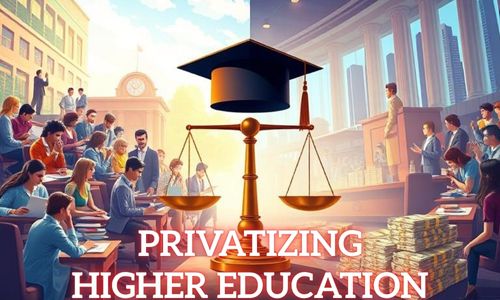
Privatizing Higher Education
ESSAY OUTLINE
1. Introduction
- Hook: Highlight the global trend of privatizing higher education and its rapid growth in both developed and developing countries.
- Context: Explain how private institutions emerged to fill the demand–supply gap in higher education.
- Thesis Statement: While privatization in higher education promises innovation and expanded access, it often prioritizes profit over academic excellence, deepening inequality and shifting education from a public good to a commercial enterprise.
2. Historical Background and Conceptual Framework
- Point: Trace the evolution of higher education — from state-funded institutions to the rise of private universities.
- Explanation: Discuss globalization, neoliberal reforms, and the state’s reduced role in funding education.
- Example: Reference the emergence of private universities in countries like Pakistan, India, and the USA during the late 20th century.
3. Arguments Supporting Privatization
- Expansion of Educational Opportunities
- Private institutions accommodate growing student populations.
- Reduce pressure on public universities with limited seats.
- Example: Mushroom growth of private universities in Asia meeting unmet demand.
- Quality and Innovation
- Competition motivates institutions to improve infrastructure and teaching standards.
- Private universities often offer modern curricula and international collaborations.
- Example: Partnerships with foreign universities, advanced technology, and updated programs.
- Financial Sustainability and Reduced State Burden
- Privatization lessens government spending on education.
- Allows state resources to be redirected to other social sectors.
4. Arguments Against Privatization
- Education as a Commodity
- Shift from knowledge creation to profit generation.
- Universities market degrees as consumer goods.
- Example: High tuition fees leading to commercialization.
- Inequality and Limited Accessibility
- High costs exclude students from middle and lower-income backgrounds.
- Widening gap between elite and average citizens.
- Example: Private universities catering only to the wealthy.
- Compromised Academic Integrity and Research Quality
- Focus on quantity (enrollment, profit) over quality (research, innovation).
- Faculty often underpaid or overburdened; emphasis on marketable disciplines.
- Brain Drain and Knowledge Gaps
- Privatized education produces job-seekers, not thinkers.
- Less focus on nation-building, social responsibility, and critical research.
5. Case Studies and Global Perspectives
- Developed Countries: The U.S. model — innovation vs. student debt crisis.
- Developing Countries: Pakistan and India — privatization bridging access but widening inequality.
- International Organizations: UNESCO and World Bank perspectives on education as a human right vs. a market product.
6. Balancing Profit and Purpose
- Regulatory Mechanisms: Role of governments in ensuring quality assurance and equitable access.
- Public-Private Partnerships (PPP): Combining public funding with private innovation.
- Scholarship and Quota Systems: To ensure inclusion of marginalized groups.
- Promotion of Research-Oriented Models: Incentivizing innovation over profit.
7. Conclusion
- Restate Thesis: Privatizing higher education can generate knowledge but risks serving only the affluent unless properly regulated.
- Summary: True educational progress lies in balance — where private institutions maintain financial viability without sacrificing inclusivity and academic purpose.
- Closing Thought: Education should remain a right, not a privilege; its ultimate goal must be the creation of knowledge, not the accumulation of wealth.
ESSAY
Privatization of higher education has become a defining trend of the 21st century, rapidly reshaping academic landscapes across both developed and developing nations. Governments around the world have increasingly encouraged private investment in education to meet growing demands and reduce fiscal burdens. As a result, private universities and colleges now play a major role in producing skilled graduates and influencing global educational standards.
Private institutions emerged as a direct response to the widening gap between the rising demand for higher education and the limited capacity of public universities. As populations expanded and economies became more knowledge-based, public funding could no longer sustain the growing number of students seeking advanced education. Private entrepreneurs, recognizing this opportunity, established institutions that promised modern infrastructure, updated curricula, and flexible admission policies. These institutions positioned themselves as competitive alternatives to state-run universities, aiming to provide quality education while maintaining financial independence.
While privatization in higher education brings several benefits — such as innovation, flexibility, and increased access — it also presents serious challenges. Many private institutions prioritize profit generation over academic integrity, transforming education from a social service into a lucrative business. This trend deepens social inequality, limits opportunities for underprivileged students, and undermines the true purpose of higher education: to generate knowledge, foster critical thinking, and serve the collective progress of society.
Higher education has evolved significantly over time, shifting from state-funded public institutions to a system increasingly dominated by private universities. In the early stages, governments across the world viewed education as a public good and invested heavily in universities to promote literacy, social mobility, and national development. Public universities served as the main centers of research, innovation, and intellectual discourse. However, as demand for higher education increased and public funding declined, private institutions began to fill the gap, transforming the educational landscape into a more market-driven system.
Globalization and neoliberal economic reforms accelerated this transformation. Governments began adopting policies that emphasized deregulation, privatization, and reduced state expenditure on social services, including education. As a result, education started to shift from being a social responsibility to an economic enterprise. The rise of global competitiveness encouraged countries to open their educational sectors to private investment and international collaboration. Private universities emerged as dynamic players offering modern curricula, advanced facilities, and job-oriented programs. While these reforms expanded access and introduced innovation, they also encouraged commercialization and deepened inequality. The state’s retreat from funding education allowed market forces to dictate priorities, often placing profit above academic integrity and public interest.
This trend became especially visible during the late 20th century. In the United States, the growth of private universities such as Stanford and Harvard set a precedent for combining academic excellence with financial independence. In India, liberalization policies in the 1990s encouraged private investment in education, leading to a surge in private engineering and management institutions. Similarly, in Pakistan, the establishment of private universities like LUMS and Bahria University reflected the government’s reduced ability to meet growing educational demands. These examples illustrate how the global shift toward privatization reshaped higher education systems — creating opportunities for expansion, but also raising concerns about equity, accessibility, and the true purpose of learning.
Private institutions play a vital role in expanding access to higher education by accommodating the growing number of students that public universities cannot handle. As populations rise and more young people seek higher education, government-funded universities often face capacity constraints, limited infrastructure, and outdated resources. In this context, private universities step in to fill the educational gap by providing additional campuses, flexible programs, and diverse fields of study.
By offering both traditional and online modes of learning, these institutions create more seats and learning pathways for students who would otherwise be left out of the system. This expansion not only reduces the burden on overcrowded public universities but also broadens educational access beyond urban centers through regional campuses and online programs.
Example: The rapid increase in private universities across Asian countries such as Pakistan, India, and Malaysia demonstrates how privatization has helped meet the rising demand for higher education. These institutions have absorbed thousands of students who might have been denied admission to public universities due to limited availability.
Privatization often drives competition among educational institutions, motivating them to improve academic quality, upgrade infrastructure, and modernize teaching methods. Unlike many public universities constrained by bureaucracy and limited funding, private institutions have the autonomy to adopt international standards, hire qualified faculty, and introduce advanced technologies in classrooms.
They continuously innovate by offering programs tailored to market needs, integrating technology-based learning, and collaborating with foreign universities. This dynamic approach helps students develop practical skills that enhance employability in a competitive global economy.
Example: Many private universities across Asia and the Middle East have entered partnerships with Western institutions to introduce international curricula, exchange faculty, and promote research collaboration. These initiatives bring diversity, global exposure, and modern perspectives to higher education, elevating the overall academic environment.
Privatization also promotes financial sustainability in the education sector by reducing the heavy fiscal burden on governments. In many developing countries, state-funded universities rely on limited public resources, which often leads to underfunding, poor facilities, and low research output. By encouraging private investment, governments diversify funding sources and enable higher education to grow without exhausting the national budget.
Private universities generate their own revenue through tuition fees, endowments, and partnerships, allowing the state to redirect funds toward other critical areas such as health care, infrastructure, or primary education. This shift creates a more balanced public expenditure structure and encourages efficient resource management.
Moreover, private institutions can attract international students and investments, contributing foreign exchange and boosting the national economy. When managed effectively, this model ensures that both the public and private sectors work together to sustain educational growth.
Privatization transforms education from a social responsibility into a commercial product. Private universities operate primarily to maximize profit rather than to promote knowledge and intellectual growth. They design programs that attract high-paying students instead of focusing on national or intellectual development. As a result, degrees become commodities that institutions market like consumer goods — their value often tied more to brand prestige than to academic quality. High tuition fees reinforce this commercialization, turning education into a privilege reserved for those who can afford it. When profit becomes the goal, the true spirit of learning — inquiry, critical thinking, and social awareness — weakens.
Privatization deepens social inequality by restricting access to quality education. High tuition fees and additional costs such as accommodation, technology, and materials push higher education beyond the reach of middle- and lower-income families. Private universities often design admission processes and campus cultures that cater to the elite, creating a divide between privileged students and those from less affluent backgrounds. This gap not only limits social mobility but also perpetuates economic disparity. Students from wealthy families enjoy superior learning resources and global exposure, while talented but underprivileged students struggle to access similar opportunities. Consequently, the education system ceases to be a tool for equality and becomes a mechanism for maintaining class hierarchies.
Private institutions often prioritize profit and enrollment numbers over academic rigor and innovation. They focus on offering popular, market-driven programs — such as business management or information technology — because these fields attract more students and generate more revenue. This approach sidelines disciplines like humanities, social sciences, and fundamental research that are crucial for critical thought and long-term intellectual growth. Moreover, many private universities hire faculty on short-term or contractual bases to reduce expenses, leading to job insecurity and low morale among educators. Underpaid and overburdened teachers have little incentive to conduct research or mentor students effectively. As a result, the pursuit of knowledge loses depth, and universities produce graduates with limited critical or creative skills.
Privatization indirectly fuels brain drain by producing graduates who seek financial success abroad rather than contributing to their home country’s progress. Many private institutions focus on job-oriented training rather than nurturing thinkers, researchers, or innovators. Students learn to chase employment rather than knowledge, often viewing education as a means to personal gain rather than collective advancement. Because private universities seldom invest in research and national problem-solving, they fail to generate new knowledge or local solutions. This results in intellectual dependency on foreign institutions and the migration of skilled individuals to developed nations. Consequently, developing countries face widening knowledge gaps, weakened innovation, and a reduced capacity to address their socio-economic challenges.
In developed countries, particularly the United States, privatization has transformed higher education into a competitive and innovative system. Private universities such as Harvard, Stanford, and MIT lead global research, technological advancement, and academic excellence. These institutions invest heavily in research facilities, attract international talent, and collaborate with industries to produce practical, market-driven knowledge.
However, this innovation comes at a high cost. The American higher education system relies heavily on tuition fees, which have increased dramatically over the past decades. As a result, millions of students accumulate massive student loan debt, creating one of the most pressing social and economic crises in the U.S. The student debt burden now exceeds $1.7 trillion, limiting graduates’ financial freedom and social mobility.
Private universities in the U.S. have successfully generated world-class knowledge, yet their profit-oriented structure often prioritizes wealthier students and commercial partnerships over accessibility and affordability. This imbalance shows that while privatization can promote excellence, it also risks turning education into a luxury commodity rather than a public good.
In developing nations such as Pakistan and India, privatization has emerged as a response to the state’s inability to meet the growing demand for higher education. Both countries have witnessed a boom in private universities over the past few decades. In Pakistan, institutions like LUMS, IBA, and FAST have provided students with modern infrastructure, global exposure, and specialized programs that public universities often cannot offer. Similarly, India has seen the rise of prominent private institutions like Amity University and Manipal University, which cater to students seeking quality education aligned with international standards.
However, this expansion has also deepened socio-economic inequality. High tuition fees exclude lower and middle-income students, leaving education accessible primarily to the urban elite. Many private universities operate with minimal regulatory oversight, focusing more on profitability than research or innovation. This commercial mindset often reduces academic freedom and sidelines disciplines that do not promise immediate financial return, such as the humanities and social sciences.
Thus, while privatization in Pakistan and India has increased educational opportunities, it has also reinforced class divisions and limited the social mobility that education is supposed to foster. Without effective state regulation, the private education model risks turning knowledge into a privilege rather than a right.
International organizations such as UNESCO and the World Bank have played a crucial role in shaping global discourse on higher education. UNESCO consistently emphasizes education as a fundamental human right and a public responsibility. It advocates for inclusive, equitable, and quality education systems that empower individuals and promote sustainable development. UNESCO warns that excessive privatization undermines these goals by excluding marginalized groups and prioritizing profit over learning.
In contrast, the World Bank approaches education through an economic development lens. It views higher education as an investment that contributes to human capital formation and economic growth. The World Bank often encourages developing countries to involve the private sector to improve efficiency, reduce public expenditure, and stimulate innovation. While this perspective supports financial sustainability, critics argue that it commodifies education and neglects its social and moral dimensions.
The tension between UNESCO’s human rights approach and the World Bank’s market-oriented philosophy reflects the global debate over whether education should serve collective social development or individual economic advancement. Striking a balance between these two perspectives remains one of the most significant challenges in the global education landscape.
Governments play a crucial role in maintaining the balance between profit and purpose in higher education. By implementing strict accreditation systems and monitoring standards, they ensure that private universities uphold academic integrity and quality. Regulatory bodies can enforce transparent admission policies, faculty qualifications, and curriculum standards to prevent commercialization from undermining educational objectives. When governments actively regulate tuition fees and performance metrics, they discourage exploitation and make education more accessible to all social groups. For instance, many countries have established higher education commissions that evaluate and rank universities to maintain accountability and protect students’ interests.
Public-Private Partnerships offer an effective way to merge the efficiency of the private sector with the inclusivity of public initiatives. Through such collaborations, governments can provide funding, land, or tax incentives, while private institutions contribute expertise, technology, and management efficiency. This partnership ensures that education remains affordable without compromising on innovation and infrastructure. For example, PPP models in education have enabled the establishment of research centers, joint-degree programs, and skill development initiatives that benefit both students and the national economy. By sharing responsibilities, both sectors can promote sustainable growth and equitable access in higher education.
To counter inequality in privatized education, scholarship programs and quota systems are essential. Private universities can allocate a percentage of their revenue to fund scholarships for underprivileged students. Governments can also mandate reserved seats for marginalized communities to promote diversity and inclusion. By offering financial aid, merit-based rewards, and need-based grants, institutions ensure that talented students are not denied opportunities due to economic hardship. For example, several private universities globally dedicate specific funds to support low-income students, thereby reinforcing the principle that education should be a right, not a privilege. These initiatives create a socially responsible image for institutions while building a more inclusive academic community.
Private universities can shift their focus from mere degree production to genuine knowledge creation by promoting research-oriented models. Encouraging faculty and students to engage in research not only enhances institutional reputation but also contributes to national development. Governments can support this by providing grants, tax exemptions, or research collaborations with industry partners. By rewarding innovation and research output instead of enrollment numbers, universities can maintain academic excellence and intellectual integrity. For instance, universities that invest in research centers and innovation hubs often attract global recognition and partnerships, transforming education into a driver of societal progress rather than a commercial enterprise.
Privatizing higher education has the potential to foster innovation, expand academic opportunities, and generate valuable knowledge. Private universities often introduce modern facilities, flexible curricula, and international collaborations that enhance learning outcomes. However, without strong regulation and oversight, the system tends to prioritize profit over purpose. This imbalance transforms education from a public good into a privilege for the wealthy. Therefore, while privatization can contribute to academic growth, it must operate under ethical and equitable frameworks that ensure access for all socioeconomic groups.
True educational progress depends on finding the right balance between quality and accessibility. Private institutions can maintain financial sustainability while still upholding inclusivity and intellectual integrity. Governments and educational authorities must establish policies that encourage transparency, fair tuition practices, and scholarship opportunities for underprivileged students. When private education aligns with social responsibility and public goals, it strengthens the overall academic ecosystem. Sustainable progress occurs when institutions invest not only in infrastructure and technology but also in students’ intellectual and moral development.
Education must remain a universal right rather than a privilege reserved for the elite. Its essence lies in the creation, preservation, and dissemination of knowledge that benefits humanity. When societies treat education as a tool for profit, they weaken their intellectual and moral foundations. A truly progressive nation invests in minds, not markets. The ultimate purpose of higher education should be to cultivate wisdom, critical thinking, and innovation — qualities that empower individuals and uplift entire communities, ensuring that knowledge serves people, not profit.












LEAVE A COMMENT