
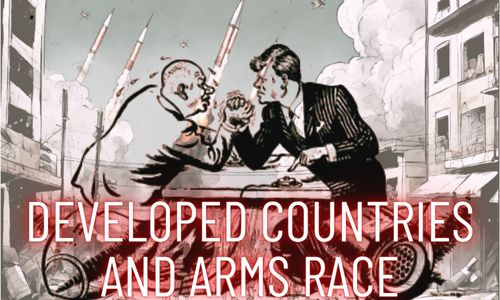
Developed Countries and Arms Race
ESSAY OUTLINE
1: Introduction
A. Hook: A brief look at historical examples of developed nations and their military capabilities.
B. Thesis Statement: As countries develop economically and technologically, they tend to build more lethal arsenals, driven by a mix of geopolitical ambitions, security concerns, and technological advancements.
2: Historical Context
A. Early Examples: Development of lethal weapons by historically powerful empires (e.g., Roman Empire, British Empire).
B. 20th Century Warfare: Industrialization and the arms race during the World Wars, leading to the development of nuclear weapons.
3: Economic and Technological Factors
A. Economic Growth and Military Spending: Correlation between GDP and defense budgets.
B. Technological Innovation: How advancements in technology, such as AI, cyber warfare, and drones, are leveraged by developed nations to create more lethal weapons.
4: Geopolitical Motivations
A. Power Projection: How developed nations use advanced military capabilities to exert influence globally.
B. Security Dilemma: The role of mutual distrust and arms races among developed nations (e.g., Cold War, modern-day tensions between NATO and Russia/China).
5: Ethical and Moral Considerations
A. The Human Cost: Impact of advanced weaponry on civilian populations during conflicts.
B. Global Inequality: The disparity between developed and developing nations in terms of military capabilities and the ethical implications.
6: Counterarguments
A. Defense vs. Aggression: The argument that lethal arsenals in developed countries are primarily for defense and deterrence.
B. International Cooperation: The role of international treaties and organizations in limiting the proliferation of lethal weapons.
7: Case Studies
A. The United States: As a global superpower with a vast and advanced military arsenal.
B. China: Rapid economic development leading to significant advancements in military capabilities.
C. Russia: The legacy of the Soviet Union’s military prowess and its continuation in modern Russia.
8: Conclusion
A. Recap of Main Points: Summarizing how development correlates with lethal armament.
B. Reflection on Future Implications: The potential future of arms races and the necessity for global cooperation to prevent catastrophic conflicts.
C. Final Thought: The paradox of development leading to both progress and peril, as the world’s most developed nations become increasingly armed and dangerous.
ESSAY
Throughout history, the most powerful and developed nations have often been those with formidable military capabilities. Consider the Roman Empire, which leveraged advanced military strategies and weapons to dominate much of the known world. Similarly, during the British Empire’s height, its naval supremacy was a key factor in maintaining control over vast territories across the globe. In the 20th century, the United States emerged as a superpower, not only through its economic strength but also by developing and deploying nuclear weapons, forever altering the nature of global warfare. These examples illustrate the strong connection between a nation’s level of development and the sophistication of its military forces.
As countries develop economically and technologically, they tend to build more lethal arsenals. This trend is driven by a combination of geopolitical ambitions—where powerful nations seek to exert influence or protect their interests globally—security concerns that prompt nations to arm themselves in response to perceived threats, and the rapid advancements in technology that enable the creation of increasingly deadly weapons. Consequently, the most developed nations often become the most heavily armed, leading to a paradox where progress in development coincides with the capacity for greater destruction.
Historically powerful empires have often been characterized by their ability to develop and deploy lethal weapons. The Roman Empire, for instance, utilized advanced engineering to create effective siege weapons and armories, allowing them to conquer and maintain control over vast territories. The Roman legions were equipped with sophisticated weapons like the gladius (a short sword) and the pilum (a heavy javelin), which were pivotal in their military successes. Similarly, the British Empire, at its height, relied heavily on its powerful navy, which was equipped with advanced ships and cannons. The British Royal Navy’s dominance enabled the empire to protect its trade routes and exert influence over its colonies, contributing to its global supremacy.
The 20th century marked a significant shift in warfare, driven by industrialization and technological advancements. During World War I and World War II, nations heavily invested in the mass production of weapons, including tanks, airplanes, and machine guns, which changed the scale and lethality of conflicts. The arms race during these wars culminated in the development of nuclear weapons, most notably the atomic bombs dropped by the United States on Hiroshima and Nagasaki in 1945. The creation of these weapons introduced a new era of warfare, where the potential for mass destruction became a central concern for global security. The Cold War that followed saw the United States and the Soviet Union amassing large stockpiles of nuclear weapons, further emphasizing the link between a nation’s level of development and its military capabilities.
There is a strong correlation between a country’s economic growth and its military spending. As nations develop economically, their GDP increases, providing them with greater financial resources to allocate toward defense budgets. This increased spending often translates into the expansion and modernization of military forces. For example, the United States, with the world’s largest economy, also has the highest defense budget, funding everything from personnel and equipment to research and development of new technologies. Similarly, countries like China and Russia have increased their defense spending as their economies have grown, allowing them to build more advanced and lethal arsenals. This pattern reflects how economic prosperity enables nations to invest heavily in their military capabilities.
Technological advancements play a crucial role in the development of more lethal weapons, and developed nations are often at the forefront of these innovations. For instance, artificial intelligence (AI) is increasingly being integrated into military systems, allowing for the development of autonomous weapons and advanced decision-making tools that can enhance the effectiveness of military operations. Cyber warfare has also emerged as a significant threat, with developed nations using sophisticated cyber tools to disrupt the infrastructure and communications of adversaries. Additionally, the use of drones has revolutionized modern warfare, enabling precise strikes with minimal risk to human operators. These technologies, driven by the research and innovation capacities of developed countries, contribute to the creation of more effective and deadly military capabilities, reinforcing the link between technological progress and the lethality of a nation’s arsenal.
Developed nations often use their advanced military capabilities as a means of projecting power and exerting influence on the global stage. This power projection allows them to protect their interests, secure trade routes, and maintain strategic alliances. For example, the United States maintains a global network of military bases and deploys its naval fleets worldwide, enabling it to respond quickly to international crises and exert influence in key regions such as the Middle East and Asia-Pacific. Similarly, countries like Russia and China use their military strength to assert dominance in their respective spheres of influence, such as Russia’s involvement in Ukraine or China’s military presence in the South China Sea. This ability to project power globally not only strengthens a nation’s geopolitical position but also serves as a deterrent to potential adversaries.
The security dilemma refers to a situation where one nation’s efforts to enhance its security—such as by building up its military—prompt other nations to do the same, leading to an arms race. This dynamic is often driven by mutual distrust and fear of potential threats. A prime example of this is the Cold War, where the United States and the Soviet Union engaged in a prolonged arms race, each side developing increasingly powerful weapons to counter the other’s perceived threat. This same pattern can be observed in modern-day tensions between NATO and Russia, as well as between the United States and China. As each side enhances its military capabilities, the other responds in kind, creating a cycle of escalation that can increase the risk of conflict. The security dilemma highlights how geopolitical rivalries among developed nations can lead to the accumulation of more lethal arsenals, even when neither side desires outright war.
The use of advanced weaponry in conflicts often has devastating effects on civilian populations. Modern weapons, such as precision-guided missiles, drones, and even nuclear weapons, can cause immense destruction, leading to high civilian casualties and widespread suffering. For example, drone strikes, while effective in targeting specific threats, have also resulted in unintended civilian deaths, raising serious ethical concerns. The bombings of Hiroshima and Nagasaki during World War II illustrate the catastrophic human cost of using advanced weaponry, where tens of thousands of civilians were killed instantly, and many more suffered long-term effects from radiation. The increasing lethality of modern weapons amplifies the potential for humanitarian crises, making the ethical implications of their use a critical concern in warfare.
There is a significant disparity between developed and developing nations in terms of military capabilities, which raises ethical questions about global security and equity. Developed nations possess advanced weapons systems, vast defense budgets, and the technological expertise to maintain and enhance their military power. In contrast, many developing nations struggle to meet basic needs for their populations and lack the resources to build or acquire sophisticated military equipment. This imbalance creates a power dynamic where developed nations can dominate or influence less developed countries, potentially leading to exploitation or coercion. Moreover, the arms trade often exacerbates global inequality, as wealthier nations export weapons to developing countries, sometimes fueling conflicts and instability. The ethical implications of this disparity challenge the fairness and justice of the global order, as it perpetuates inequalities in both security and development.
Proponents of advanced military arsenals in developed countries often argue that these weapons are primarily intended for defense and deterrence rather than aggression. The logic behind this argument is that a strong military capability can prevent conflicts by discouraging potential aggressors from attacking. For instance, nuclear weapons are often justified under the doctrine of mutually assured destruction (MAD), where the sheer destructive power of these weapons serves as a deterrent against their use. Additionally, many countries claim that their military build-up is necessary to protect their sovereignty and respond to potential threats, rather than to pursue aggressive foreign policies. This perspective suggests that a well-armed nation is less likely to be attacked, thereby contributing to global stability rather than increasing the likelihood of conflict.
International treaties and organizations play a crucial role in limiting the proliferation of lethal weapons and promoting global security. Agreements like the Non-Proliferation Treaty (NPT), which aims to prevent the spread of nuclear weapons, and the Chemical Weapons Convention (CWC), which prohibits the use of chemical weapons, are examples of how the international community seeks to regulate the development and deployment of highly destructive arms. Additionally, organizations such as the United Nations work to mediate conflicts and promote disarmament, encouraging countries to resolve disputes through diplomacy rather than military force. These efforts demonstrate that, despite the existence of powerful arsenals, there is a global commitment to reducing the risks associated with lethal weapons and to promoting peace and stability. This counterargument highlights the importance of international cooperation in mitigating the dangers posed by advanced military capabilities, suggesting that the proliferation of such weapons can be controlled through collective action.
- The United States:
- As a global superpower, the United States possesses one of the most advanced and extensive military arsenals in the world. With the largest defense budget globally, the U.S. maintains cutting-edge technology across all branches of its military, including the most advanced fighter jets, naval fleets, and a significant stockpile of nuclear weapons. The U.S. military’s global presence, with bases in numerous countries, allows it to project power worldwide and respond rapidly to international crises. This vast military capability not only ensures national security but also reinforces the United States’ position as a dominant force in global geopolitics, capable of influencing international affairs and deterring potential adversaries.
- China:
- China’s rapid economic growth over the past few decades has been accompanied by significant advancements in its military capabilities. As the world’s second-largest economy, China has dramatically increased its defense spending, modernizing its military with new technologies such as stealth aircraft, hypersonic missiles, and an expanding naval force. The development of the People’s Liberation Army (PLA) into a modern and highly capable force is a key component of China’s broader strategy to assert itself as a major global power. China’s military advancements, particularly in areas like the South China Sea, reflect its growing ambitions and its desire to challenge the existing balance of power, particularly in the Asia-Pacific region.
- Russia:
- Russia’s military strength today is deeply rooted in the legacy of the Soviet Union, which was one of the two superpowers during the Cold War. The Soviet Union developed a vast and powerful military, including a large nuclear arsenal, which Russia inherited after the USSR’s dissolution. Today, Russia continues to maintain and modernize this military legacy, with a focus on strategic nuclear forces, advanced missile systems, and a strong defense industry. Russia’s military actions, such as its involvement in Syria and its annexation of Crimea, demonstrate its ongoing commitment to maintaining a powerful military presence on the global stage. Russia’s military capabilities and its willingness to use them underscore its desire to preserve its influence, particularly in regions that were once part of the Soviet sphere.
Throughout history, there has been a clear correlation between a nation’s development and its military capabilities. As countries become more economically prosperous and technologically advanced, they tend to build more lethal arsenals. Economic growth enables higher defense spending, technological innovation produces more sophisticated weapons, and geopolitical motivations, such as power projection and the security dilemma, drive this trend. While these developments have strengthened the security and global influence of developed nations, they have also raised significant ethical concerns and contributed to global inequality.
Looking forward, the continuation of this trend raises important questions about the future of global security. The potential for new arms races, particularly in areas such as artificial intelligence, cyber warfare, and hypersonic weapons, could lead to an even more dangerous and unstable world. As nations compete to develop ever more advanced and lethal weapons, the risk of catastrophic conflicts increases. To prevent such outcomes, there is a pressing need for stronger international cooperation, including arms control agreements, disarmament initiatives, and diplomatic efforts to reduce tensions between rival powers. The future of global peace may well depend on the ability of nations to manage and mitigate the risks associated with their military advancements.
The paradox of development lies in the fact that progress in economic and technological domains can also lead to greater peril. As the world’s most developed nations become increasingly armed and dangerous, they not only enhance their security but also contribute to a more volatile global environment. This duality highlights the complex relationship between development and security, where advancements meant to protect and empower also carry significant risks. The international community faces the challenge of navigating this paradox, balancing the benefits of development while maintaining peace and preventing the destructive potential of modern military capabilities.










LEAVE A COMMENT