
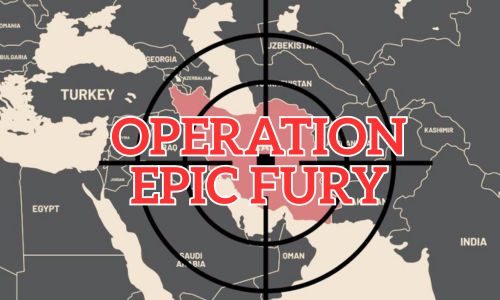
Operation Epic Fury
The long-simmering tensions between the United States and Iran have erupted into a large-scale military confrontation. On February 28, 2026, the U.S. military launched Operation Epic Fury, a massive bombing campaign against the Islamic Republic of Iran. This operation, coordinated with Israel’s own “Operation Roaring Lion,” marks a significant escalation in the Middle East, with goals that are decidedly more destructive than previous engagements in the region by targeting IRGC command nodes, air defenses, missile and drone launch sites, and airfields; the operation has already cost an estimated $3.7 billion in its first 100 hours and U.S. officials say it could run for several weeks while assessing Tehran’s leadership and capabilities.
This blog post breaks down the details of the operation, its scale, the damages inflicted, and what this means for the future.
What is Operation Epic Fury?
In Operation Epic Fury, the United States leads a military offensive to systematically dismantle Iran’s military infrastructure. Secretary of War Pete Hegseth states that the mission focuses on clear objectives: destroying Iran’s offensive missile capabilities, eliminating its missile production facilities, sinking its navy, and preventing it from ever obtaining nuclear weapons. Hegseth emphasized that this is not a nation-building exercise like the wars in Iraq or Afghanistan, but a campaign with a clear, devastating, and decisive military purpose.
Overview and Timeline
- Launch date: 28 February 2026 — CENTCOM announced coordinated strikes at 01:15 ET to “dismantle the Iranian regime’s security apparatus.”
- Primary targets: Reports indicate that a daylight “decapitation strike” early in the operation resulted in the death of Iran’s Supreme Leader, Ayatollah Ali Khamenei, along with other senior political and military figures.
-
100-Hour Milestone: By the sixth day (March 5), CENTCOM reported striking over 2,000 targets, sinking more than 20 vessels (including a submarine), and reducing Iranian drone and missile launch capacity by over 70%.
-
U.S. Assets Deployed: The operation involves over 50,000 troops, 200 fighter jets, and two carrier strike groups: the USS Gerald R. Ford and the USS Abraham Lincoln.
- U.S. stated objectives: Degrade Iran’s ability to threaten U.S. forces and partners; assess longer-term leadership scenarios in Tehran. Officials projected the campaign could conclude in about four to six weeks.
The Immense Scale of the Operation
The scope of Operation Epic Fury is staggering. It involved months, and in some cases years, of planning . In the days leading up to the assault, the U.S. repositioned thousands of service members, hundreds of advanced fighter aircraft, and two aircraft carrier strike groups—the USS Abraham Lincoln and the USS Gerald R. Ford—into the region .
-
Aerial and Naval Power: Over 100 aircraft launched in the first wave from land and sea, including fighters, bombers, and unmanned platforms . More than 50,000 troops, 200 fighter jets, and two carriers are now involved in the theater .
-
Target Saturation: In the first 24 hours alone, U.S. forces struck more than 1,000 targets . Within the first four days, that number doubled to over 2,000 targets using more than 2,000 precision-guided munitions.
-
Multi-Domain Attack: The operation is not just kinetic. U.S. Cyber Command and Space Command initiated actions to disable Iran’s communications, while strikes have been conducted “from seabed to space and cyberspace”
- Financial scale: ~$3.7 billion in the first 100 hours of operations, reflecting intensive air, naval, and precision-strike activity.
- Military scale: U.S. statements compare the campaign’s airpower to “twice the air power of Shock and Awe (2003),” signaling a very large sortie and munitions tempo.
- Human cost: Reports indicate U.S. combat fatalities occurred during the campaign, including a dignified transfer of six American soldiers killed in an Iranian drone attack at Shuaiba Port.
Strategic Objectives
According to the Pentagon and the White House, the operation is “laser-focused” on four primary goals:
-
Neutralizing Missile Threats: Destroying Iran’s offensive ballistic missile arsenal and production facilities.
-
Eliminating Naval Capability: Dismantling the Iranian Navy to ensure the security of global waterways like the Strait of Hormuz.
-
Nuclear Prevention: Striking infrastructure to permanently prevent Iran from acquiring nuclear weapons.
-
Regime Degradation: Targeting the Islamic Revolutionary Guard Corps (IRGC) and the regime’s security apparatus.
Damages, Effects, and Regional Impact
The early phases of the operation have reportedly devastated Iranian military capacity, but not without cost.
Damages Inflicted on Iran
According to U.S. Central Command (CENTCOM), the offensive has severely degraded Iran’s ability to project power:
-
Leadership Killed: The initial strikes resulted in the death of Iranian Supreme Leader Ayatollah Ali Khamenei and other top defense officials .
-
Naval Destruction: The U.S. claims to have sunk the entire Iranian navy, destroying over 20 ships and holing its most operational submarine .
-
Degraded Firepower: Iran’s ballistic missile launches have dropped by 86% , and their drone attacks have fallen by 73% since the operation began.
- Iranian military degradation: U.S. officials claim severe weakening of Iran’s naval and missile capabilities and disruption of command networks.
- Infrastructure and economic damage: Strikes on military airfields, ports, and missile sites have immediate repair costs and longer-term impacts on Iran’s force projection; early financial figures for Iran’s losses remain unconfirmed in open sources.
- Civilian and regional collateral effects: Air and maritime disruptions have raised shipping insurance rates and strained regional logistics; humanitarian impacts in affected Iranian provinces are being monitored.
Costs and U.S. Losses
The operation is expensive and not without losses. One estimate placed the cost to U.S. forces at $5.82 billion in the first 100 hours . Furthermore:
-
Asset Losses: Iran’s retaliatory strikes have damaged high-value U.S. assets, including a $1.1 billion early warning radar in Qatar and multiple THAAD radar systems.
-
Friendly Fire: Three U.S. F-15E Strike Eagles were lost in a friendly fire incident involving Kuwaiti air defenses, though the crews survived.
-
Casualties: At least four U.S. service members have been killed in action . In Iran, over 1,000 people have been reported killed, with dozens more in Lebanon and Israel.
Link Between Operation Epic Fury and Operation Roaring Lion
The United States and Israel launched Operation Epic Fury and Operation Roaring Lion on 28 February 2026 as a coordinated kinetic campaign. They aligned the timing and selected complementary targets, which triggered a synchronized Iranian multi-vector cyber and kinetic response and intensified regional instability.
Comparison (side‑by‑side)
| Attribute | Operation Epic Fury | Operation Roaring Lion |
|---|---|---|
| Lead actor | United States | Israel |
| Launch date | 28 February 2026 | 28 February 2026 |
| Primary targets | IRGC command nodes, air defenses, missile/drone sites | Iranian military infrastructure and leadership targets |
| Role in campaign | Strategic air/naval strikes; degrade Iranian strike capability | Complementary strikes; tactical/strategic targeting to amplify effects |
| Immediate consequence | Triggered Iranian multi‑vector retaliation including cyber operations | Triggered Iranian multi‑vector retaliation including cyber operations |
How they are linked — Operational and Strategic pathways
- Synchronized timing and objectives. Both codenames refer to the same coordinated offensive launched on 28 February 2026, designed to degrade Iran’s military command, air defenses, and strike capabilities; U.S. and Israeli actions were complementary rather than independent.
- Complementary target sets. Public reporting indicates the U.S. focused on broad degradation of IRGC networks and air/missile infrastructure while Israeli strikes targeted leadership nodes and high‑value military assets—together producing cumulative operational effects.
- Shared strategic intent. The pairing aimed to maximize pressure on Tehran while complicating Iranian command responses and limiting single‑actor attribution windows. Open‑source analysis frames the two operations as parts of a single campaign rather than isolated strikes.
Cyber and information‑space linkage
- Immediate cyber retaliation. Iran launched a multi‑vector cyber campaign in response, involving state‑aligned actors, hacktivists, and opportunistic cybercriminals; the cyber offensive targeted infrastructure and produced near‑nationwide connectivity drops inside Iran.
- Intelligence and attribution interplay. Cyber operations complicated battlefield situational awareness and created a parallel front where both Epic Fury and Roaring Lion had to account for information‑space effects on command, control, and public messaging.
Regional implications and what to watch
- Escalation risk: Coordinated strikes increase the chance of wider spillover via proxies, maritime attacks, and cyber spillover across the Gulf and Levant.
- Diplomatic pressure points: The linkage makes unilateral de‑escalation harder; multilateral channels (UN, regional partners) are essential to prevent further escalation.
Practical takeaways
- For policymakers: Treat Epic Fury and Roaring Lion as a single campaign when negotiating ceasefires or sanctions relief.
- For cyber defenders: Expect sustained Iranian cyber activity and prioritize resilience for critical infrastructure and maritime communications.
Regional Impact
The conflict has engulfed the region. Iran has launched hundreds of ballistic missiles and thousands of drones at U.S. and Israeli targets . Missiles have struck U.S. embassies in Riyadh and Dubai, and hit central Israel, causing civilian casualties . Oil and gas exports through the Strait of Hormuz have come to a standstill, prompting President Trump to order the Navy to begin escorting tankers.
- Wider Middle East destabilization: Analysts warn the conflict is already “moving east,” with risks of spillover into the Arabian Sea, Levant, and beyond; proxy escalations and attacks on commercial shipping are key concerns.
- Allied posture: U.S. partners are recalibrating force posture and contingency plans; diplomatic channels are active but fragile.
Way Forward: “The Throttle is Going Up”
The U.S. shows no signs of de-escalation. Chairman of the Joint Chiefs of Staff Dan Caine warned that the campaign will cause “additional losses,” signaling that it will be sustained rather than a short-term raid. Defense Secretary Hegseth reinforced this, stating, “The throttle is going up—and it’s going to stay on high” .
The stated path forward involves:
-
Deepening Strikes: Expanding operations further inland to hunt remaining mobile missile launchers and destroy lingering military capacity .
-
Preventing Reconstitution: A key goal is to ensure Iran cannot quickly rebuild its combat power .
-
Political Navigation: While President Trump asserts his authority as Commander-in-Chief, the operation is sparking political debate in Washington. Democrats are pushing for War Powers resolutions to force Congressional approval, though Republican majorities make this unlikely in the short term.
Operation Epic Fury and its Israeli counterpart, Operation Roaring Lion, represent a fundamental shift in the U.S.-Iran conflict. Moving beyond sanctions and proxy wars, the U.S. has launched an overt, massive, and ongoing military campaign with the stated goal of crippling Iran’s military for good. With thousands of targets hit, billions of dollars spent, and the region on edge, the world is watching to see if this “epic fury” will bring a new order to the Middle East—or plunge it into an even deeper abyss.











LEAVE A COMMENT