
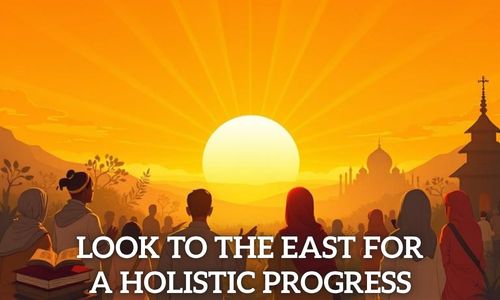
Look to the East for a Holistic Progress
ESSAY OUTLINE
1. Introduction
- Opening Thought: Begin with a statement about how global progress has often been measured by Western standards—focused on material and technological growth.
- Context: Explain how Eastern philosophies emphasize balance, spirituality, community, and sustainability alongside economic and scientific advancement.
- Thesis Statement: True holistic progress lies in learning from the East, where harmony between material, moral, and spiritual dimensions forms the foundation of a balanced society.
2. Understanding “Holistic Progress”
- Definition: Explain holistic progress as growth that integrates physical, intellectual, emotional, moral, and spiritual well-being.
- Contrast with Material Progress: Show how the West often prioritizes wealth and technology, while the East values inner peace, ethics, and social harmony.
- Importance: Emphasize that progress must improve both individual character and collective welfare.
3. Eastern Philosophies of Balance and Harmony
- Spiritual Foundation: Highlight teachings from Buddhism, Confucianism, Hinduism, and Islam that promote inner peace and moral integrity.
- Community and Family Values: Explain how Eastern societies stress cooperation, respect for elders, and collective well-being.
- Environmental Respect: Discuss Eastern traditions that advocate living in harmony with nature.
4. Eastern Contributions to Modern Progress
- Education and Wisdom: Mention how Eastern education systems now integrate mindfulness, ethics, and innovation.
- Healthcare and Wellness: Discuss yoga, meditation, herbal medicine, and holistic healing practices gaining global recognition.
- Economic Models with Morality: Highlight countries like Japan, China, and South Korea combining technological progress with cultural identity.
5. Lessons the World Can Learn from the East
- Encourage balance between technology and humanity.
- Promote moral leadership, empathy, and sustainability.
- Reintegrate spiritual values into education, governance, and daily life.
6. Counterarguments and Synthesis
- Acknowledge Western achievements in science and governance.
- Argue that true progress combines the West’s innovation with the East’s wisdom.
- Suggest global cooperation built on shared human values.
7. Conclusion
- Restate Thesis: The East offers a model of progress that nurtures both material and spiritual dimensions of life.
- Summarize Key Ideas: Balance, community, and moral strength are essential to lasting progress.
- Final Thought: The future belongs to civilizations that look to the East—not just for technology, but for wisdom that sustains humanity as a whole.
ESSAY
For centuries, the world has measured progress primarily through Western lenses that prioritize material success, industrialization, and technological innovation. People often equate advancement with economic power, urbanization, and scientific breakthroughs. However, such a view focuses narrowly on external achievements while neglecting the inner growth of individuals and societies. By defining success only in terms of material wealth and technological superiority, humanity risks losing its connection to values, ethics, and collective well-being.
In contrast, Eastern philosophies have long emphasized a more balanced and holistic approach to life. Thinkers and traditions from the East—such as Buddhism, Confucianism, Taoism, Hinduism, and Islam—teach that true progress arises from harmony between the body, mind, and spirit. Eastern cultures promote spirituality, moral integrity, compassion, and respect for nature as essential parts of human development. They encourage societies to grow economically while preserving emotional health, social unity, and environmental balance. This vision of progress integrates personal enlightenment with social responsibility, creating a foundation for sustainable and meaningful growth.
True holistic progress lies in learning from the East, where material advancement does not overshadow moral and spiritual values. Eastern thought teaches that the real measure of civilization is not how much wealth a nation accumulates, but how well it nurtures humanity, justice, and inner peace. By blending modern innovation with timeless wisdom, societies can achieve harmony between external success and internal fulfillment. Thus, to attain genuine and sustainable progress, the world must look to the East, where balance and harmony form the essence of development.
Holistic progress represents a comprehensive form of development that goes beyond material or economic success. It integrates physical health, intellectual growth, emotional stability, moral integrity, and spiritual enrichment into a unified vision of human advancement. When societies pursue holistic progress, they aim to nurture not just wealth or infrastructure but also the well-being of the mind and soul. In this approach, education inspires wisdom, not just skill; governance serves people, not power; and individuals grow with a sense of purpose, not mere ambition. By aligning moral values with innovation and compassion with achievement, holistic progress creates balance between external advancement and inner fulfillment.
The modern world, particularly the West, has long measured progress through material gains such as industrialization, wealth, and technological innovation. While these achievements have transformed human life, they have also led to stress, isolation, and environmental degradation. In contrast, the East defines progress through balance and harmony. Eastern philosophies teach that true success lies in inner peace, ethical behavior, and collective happiness rather than in competition or consumerism. For instance, societies rooted in Eastern values promote meditation, respect for nature, and cooperation over excessive individualism. By prioritizing mental and spiritual health alongside material prosperity, the East demonstrates that genuine progress must nourish both the body and the soul.
Holistic progress holds immense importance because it ensures that advancement benefits both individuals and society as a whole. When education cultivates empathy, when economies operate ethically, and when communities uphold compassion and justice, development becomes meaningful and sustainable. A society that values only material success may achieve wealth but lose humanity, whereas one that pursues holistic growth strengthens its moral foundation and social unity. Individuals also find deeper satisfaction when they balance ambition with contentment and competition with kindness. By integrating physical, emotional, intellectual, and spiritual dimensions of life, holistic progress creates a more peaceful, equitable, and purposeful world.
Eastern philosophies place great emphasis on spiritual growth as the foundation of a meaningful life. Teachings from Buddhism encourage individuals to free themselves from suffering through mindfulness, compassion, and detachment from material desires. Confucianism teaches people to uphold moral virtues such as honesty, loyalty, and respect in their personal and social lives. Hinduism inspires followers to seek balance through dharma (duty), karma (actions), and moksha (liberation), creating harmony between self and the universe. Islam, too, emphasizes discipline, justice, and compassion as guiding principles that nurture both inner peace and social harmony. By grounding life in spiritual and ethical values, Eastern traditions inspire individuals to act responsibly and to find fulfillment beyond material success.
Eastern societies uphold family and community as the heart of social stability. People in these cultures value cooperation over competition and collective well-being over individual gain. Families function as the primary source of education, emotional support, and moral guidance. Children learn to respect their elders, care for the young, and contribute to family unity. Community interactions encourage empathy, kindness, and mutual assistance, creating strong social bonds. In contrast to the growing individualism seen in the West, Eastern traditions teach that one’s identity and happiness are deeply connected to others. By prioritizing relationships and shared responsibility, Eastern societies preserve social harmony and cultural continuity.
Eastern philosophies view nature as sacred and emphasize humanity’s duty to live in balance with the environment. Ancient teachings from Hinduism describe the Earth as “Mother,” deserving reverence and protection. Buddhism encourages nonviolence toward all living beings and promotes simplicity as a path to reducing harm. In Confucian and Taoist thought, humans are seen as part of the natural order, not separate from it, and must therefore act in harmony with the rhythms of nature. Many Eastern societies practice sustainable living through traditions like organic farming, herbal medicine, and seasonal rituals that honor the environment. By respecting natural resources and avoiding exploitation, the East teaches the world that ecological harmony is essential for true progress.
Eastern nations have redefined education by integrating mindfulness, ethics, and innovation into their learning systems. Educators in countries like Japan, China, and India actively promote not just academic excellence but also moral and emotional development. They encourage students to practice self-discipline, empathy, and respect—values deeply rooted in Eastern traditions. Schools in these regions often combine modern technology with cultural teachings, ensuring that young minds grow both intellectually and ethically. By doing so, the East demonstrates that true education must cultivate wisdom alongside knowledge, preparing individuals to contribute positively to society.
Eastern societies have made remarkable contributions to global health and wellness by promoting holistic healing practices that focus on the mind-body connection. Practices such as yoga, meditation, acupuncture, Ayurveda, and herbal medicine have gained international recognition for their effectiveness in maintaining physical and mental balance. Countries like India, China, and Thailand actively export these traditions through wellness tourism and research-based healthcare models. Unlike the Western focus on treating symptoms, Eastern medicine emphasizes prevention, harmony, and natural balance. This approach empowers individuals to take responsibility for their own health and promotes long-term well-being across communities.
Eastern nations such as Japan, China, and South Korea have successfully demonstrated that economic success does not require abandoning moral and cultural values. These countries have built thriving economies by blending technological advancement with collective discipline, humility, and respect for tradition. Japan’s model, for example, emphasizes teamwork, precision, and lifelong dedication to excellence, while China’s development strategy combines innovation with cultural identity and national pride. South Korea promotes entrepreneurship grounded in community and shared progress. Through these examples, the East proves that economic development can coexist with ethics, showing the world that morality and modernity are not opposites but partners in sustainable progress.
Eastern philosophies teach the world to pursue advancement without losing compassion. Nations in the East often integrate innovation with mindfulness, ensuring that technology serves humanity rather than controls it. For instance, Japan and South Korea use technology to enhance quality of life while preserving cultural and environmental harmony. The world can adopt this approach by developing technology that uplifts human values, promotes social well-being, and protects natural ecosystems. When societies balance progress with empathy, they create sustainable growth that benefits all.
The East places great emphasis on leadership rooted in morality and service. Historical and modern Eastern leaders have demonstrated that true progress comes when those in power act with empathy, humility, and a sense of duty toward the people. Eastern traditions remind us that progress built on greed or exploitation cannot last. By following these values, the world can nurture leaders who prioritize justice, environmental care, and long-term social stability. Such leadership not only strengthens nations but also fosters global harmony and trust.
Eastern cultures emphasize spirituality as a guiding force in every aspect of life. They encourage people to cultivate inner peace, discipline, and ethical awareness before seeking external success. Modern societies can learn from this approach by incorporating moral and spiritual education alongside technical knowledge. Governments can design policies inspired by compassion and fairness, while individuals can practice mindfulness and gratitude in daily living. When spirituality informs action, education, and leadership, societies evolve into more compassionate, resilient, and peaceful communities.
Western nations have played a vital role in advancing global civilization through their remarkable contributions to science, technology, and governance. They have developed democratic institutions, promoted human rights, and led innovations that have transformed industries and communication systems. By establishing research-based education, fostering creativity, and encouraging scientific inquiry, the West has shaped the modern world. Recognizing these achievements allows us to appreciate that Western progress has provided humanity with tools for comfort, efficiency, and discovery.
True progress emerges when societies integrate Western technological innovation with Eastern spiritual and ethical wisdom. While the West excels in developing systems of productivity, organization, and governance, the East contributes values of balance, compassion, and mindfulness. A society that only values machines but neglects morality risks imbalance and unrest. Therefore, the world must unite the East’s emphasis on inner growth and moral discipline with the West’s strength in material advancement. This synthesis can create a civilization that is both intelligent and humane, efficient yet empathetic.
Nations must cooperate globally by embracing shared human values such as justice, compassion, sustainability, and respect for diversity. The East can guide the world in understanding the interconnectedness of life, while the West can offer models for innovation and governance. Together, they can create a global culture that values both progress and peace. By learning from each other rather than competing, humanity can build systems that nurture physical development, mental clarity, and spiritual fulfillment. Such cooperation ensures that progress serves not only economic interests but the moral and emotional well-being of all people.
The East offers a powerful and comprehensive model of progress that actively nurtures both material advancement and spiritual enrichment. Eastern societies demonstrate that true development does not rely solely on technology or wealth but also on cultivating inner peace, ethical behavior, and social harmony. By integrating moral values with innovation, the East provides a blueprint for balanced and sustainable growth that strengthens both individuals and nations.
When we examine the essence of Eastern progress, we find that balance, community, and moral strength play crucial roles. The East teaches the world to live in harmony with nature, to value relationships over competition, and to pursue success without compromising integrity. These principles remind humanity that progress must benefit not just economies but also hearts and minds. By combining discipline with compassion and progress with purpose, the East continues to set an example of how societies can thrive without losing their moral compass.
The future will belong to civilizations that embrace the wisdom of the East—those that understand progress as a journey of both the mind and the soul. Nations that seek not only innovation but also insight, not just growth but also gratitude, will lead humanity toward a more peaceful and meaningful existence. By looking to the East, we do not reject modernity; we enrich it with timeless wisdom that sustains humanity, preserves harmony, and ensures that progress remains truly holistic.









LEAVE A COMMENT