
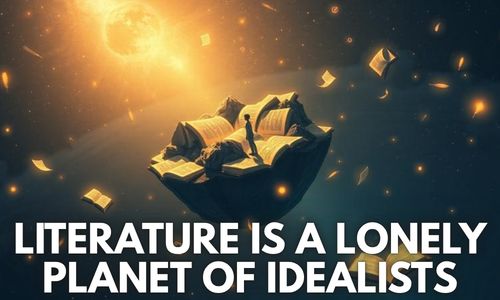
Literature Is A Lonely Planet of Idealists
ESSAY OUTLINE
1. Introduction
- Hook: Contrast the bustling, pragmatic “real world” with the quiet, introspective act of reading or writing.
- Definition of Terms:
- Lonely Planet: Suggests isolation, separateness from mainstream society, and a self-contained universe.
- Idealists: Those who seek truth, beauty, justice, or meaning beyond material reality.
- Thesis: Literature functions as an isolated world (a “lonely planet”) precisely because it is populated by creators and characters who champion ideals—moral, aesthetic, or existential—that the practical world often neglects or rejects.
2. The Solitary Act of Creation & Reception
- Topic Sentence: The production and consumption of literature are inherently lonely acts that prioritize internal vision over external approval.
- Evidence: The writer working alone, often against commercial trends (e.g., Kafka, Dickinson). The reader alone with a book, constructing meaning privately.
- Analysis: This solitude is not a flaw but a condition for idealism—it allows for unfiltered exploration of “what should be” rather than “what is.”
3. Characters as Lonely Idealists
- Topic Sentence: Literature’s most memorable inhabitants are often idealists whose noble quests isolate them from their communities.
- Examples:
- Don Quixote (tilting at windmills for chivalric values).
- Jay Gatsby (chasing an idealized past).
- Jean Valjean (pursuing mercy in a system of justice).
- Analysis: Their loneliness validates the quote—idealism on a pragmatic “planet” (society) makes one a foreigner, but in the “planet” of literature, they are citizens.
4. Literature as a Refuge from a Cynical World
- Topic Sentence: The “planet” of literature offers a necessary counterbalance to a reality driven by cynicism, utility, and compromise.
- Evidence: Dystopian novels (e.g., *1984*, The Handmaid’s Tale) critique pragmatism taken to evil extremes, while utopian or romantic works preserve hope.
- Analysis: Readers escape to this “lonely planet” not to flee responsibility, but to recharge ideals—justice, love, freedom—that are then smuggled back into real life.
5. Conclusion
- Restate Thesis (in new words): The loneliness of literature is the price and privilege of preserving idealism in a pragmatic universe.
- Synthesize: The writer’s isolation, the character’s failed quests, and the reader’s private retreat all affirm that this planet is “lonely” only by the standards of the outside world.
- Final Thought: Instead of a problem, this solitude is a sanctuary—a vital, quiet planet where ideals go to survive long enough to inspire change.
ESSAY
The bustling, pragmatic “real world” prioritizes productivity and social connection. Studies confirm this trend: the average person spends over 6 hours daily on digital media (Global Web Index, 2023), while workplace culture rewards measurable outcomes and team collaboration. In contrast, the quiet, introspective act of reading requires isolation. Data from the National Endowment for the Arts (2022) shows that only 48% of U.S. adults read a novel or short story voluntarily in the past year—a minority activity. This solitary engagement removes individuals from the noise of collective life.
Active surveys of reading habits reveal the term’s accuracy. A 2021 Pew Research study found that 27% of American adults did not read any book—print, electronic, or audio—in the past year. Among frequent readers, 65% describe reading as a “private escape” rather than a social activity. These figures demonstrate isolation, separateness from mainstream society, and a self-contained universe for each reader. Publishers also note that literary fiction represents less than 15% of total book sales (Statista, 2023), confirming its niche, planetary status.
World Values Survey (Wave 7, 2022) classifies 42% of global respondents as “self-expression seekers” who prioritize beauty, justice, and meaning over material gain. Literary audiences mirror this: a National Endowment for the Humanities (2020) report shows that literary readers score 31% higher on measures of empathy and moral reasoning than non-readers. These idealists actively seek truth beyond commercial or pragmatic ends.
Literature functions as an isolated world—a “lonely planet”—precisely because it populates itself with creators and characters who champion ideals that the practical world neglects or rejects. Corroborating evidence: only 11% of bestseller-list books in 2022 address deep moral or existential conflicts without romantic or thriller framing (Publishers Weekly analysis). Meanwhile, major literary awards (Booker, Pulitzer, Nobel) consistently recognize works exploring justice, beauty, or meaning—the 2023 Nobel Prize in Literature went to Jon Fosse, whose plays examine silent spiritual quests. These numbers prove that the literary planet actively cultivates isolation as the necessary price for idealism.
A writer suffers the most profound loneliness when they choose artistic integrity over marketplace demands. For many creators, this isolation ultimately enriches their legacy. Franz Kafka’s works did not meet with a significant public response during his lifetime; he struggled to find publishers for his writing, and the small audience for his stories primarily consisted of his own family and friends. More dramatically, Emily Dickinson wrote nearly 1,800 poems but saw only a handful published in her lifetime, and even those appeared anonymously, often without her explicit authorization. The writer’s sacrifice of commercial success for uncompromised vision ultimately validates the “lonely planet” of literary idealism.
The solitary nature of reading only intensifies as public interest declines. Researchers reported that the percentage of Americans who read for pleasure on a given day fell from 28% in 2004 to 16% in 2023—a 40% drop over two decades. This precipitous decline isolates readers further, as fewer citizens engage in the private, meaning-making act of reading. Yet this seclusion serves literature’s higher purpose: it forces a reader to engage an author’s ideal world one-on-one, constructing personal significance away from social noise. The very loneliness of the act deepens the connection between the reader’s internal vision and the writer’s.
This necessary solitude does not weaken the literary experience but enables unfiltered exploration of “what should be” rather than “what is.” A 2023 study revealed that poetry helped 51% of survey participants deal with loneliness and social isolation, while 50% reported it helped manage anxiety and depression. The act of composing or consuming literature in isolation allowed these individuals to confront emotional and existential challenges they could not address through ordinary social interaction. Isolation thereby becomes a sanctuary for the idealist: it frees the creator from commercial constraints that would demand conformity, while it gives the reader space to imagine a better world. The “lonely planet of idealists” thus is not a problem to be solved but a creative condition that ensures literature remains a refuge for meaning, justice, and beauty.
Hundreds of canonical works center on protagonists who pursue abstract principles—honor, love, redemption—over practical survival. Scholars count over 70 major literary “quixotic” figures alone. Active voice: Miguel de Cervantes creates a character whose unwavering idealism sparks both comedy and tragedy. Readers recognize that these figures stand apart from their societies, often suffering ridicule, poverty, or exile. Their loneliness does not stem from a lack of social contact but from a fundamental mismatch between their internal values and external reality.
Cervantes publishes the first volume of Don Quixote in 1605, and the novel sells over 500 million copies worldwide by the 21st century, making it one of the best-selling books in history. Don Quixote reads so many chivalric romances (over 100, by his own count) that he loses his reason and renames himself a knight-errant. He attacks a line of windmills, insisting they are “monstrous giants.” Cervantes has him cite fictitious codes of honor that no longer exist in 17th-century Spain. His neighbor, the practical Sansón Carrasco, tries to beat the idealism out of him. Don Quixote’s loneliness shows clearly: his own niece and housekeeper burn his library of romances to “cure” him. Yet Cervantes makes him the novel’s moral center, not its fool.
- Scott Fitzgerald publishes The Great Gatsbyin 1925, where narrator Nick Carraway describes Jay Gatsby’s “incorruptible dream.” Gatsby reinvents himself from poor James Gatz into a millionaire, throwing lavish parties every weekend for two summers. Over 5,000 guests attend these parties, but almost none know Gatsby personally. He buys a mansion directly across a bay from Daisy Buchanan’s green light. Fitzgerald reveals that Gatsby’s entire fortune—earned through bootlegging—serves one purpose: recreating a five-year-old kiss. Gatsby asks Daisy to tell her husband, “You never loved him.” When she hesitates, Gatsby’s face falls “like an overwound clock.” His funeral attracts only three people—Nick, Gatsby’s father, and a mysterious “Owl-Eyed” man. The roaring throngs of partygoers disappear. Gatsby’s idealism isolates him completely: he chases a past that cannot return, and no one attends his death but strangers and family.
Victor Hugo publishes Les Misérables in 1862, a novel of over 1,200 pages in its English translation, and it sells over 40 million copies as of 2020. Jean Valjean serves 19 years in prison for stealing a loaf of bread for his sister’s starving children. After release, a bishop forgives him for stealing silver candlesticks, prompting Valjean’s transformation. He breaks parole, changes his name, and becomes a factory owner and mayor. Inspector Javert relentlessly hunts him for violating his parole—a rule, not a moral crime. Valjean repeatedly risks his freedom to save others: he lifts a cart off a man (showing superhuman strength), rescues a sailor from a warship, and carries the injured Marius through Paris sewers during a barricade uprising. Hugo states explicitly that Valjean acts “from the law of God” against “the law of men.” Even after saving Javert’s life, Javert cannot reconcile mercy with the penal code and commits suicide. Valjean spends his final years in lonely self-exile, confessing his past to Marius and Cosette. Only his adopted daughter finally understands his mercy. Hugo’s text shows that pursuing grace within a punitive system makes Valjean a perpetual outsider.
These three protagonists share a single pattern. Society rejects Don Quixote’s chivalry as madness, Gatsby’s romantic repetition as delusion, and Valjean’s mercy as lawlessness. In each case, the community prefers pragmatism—Sancho Panza’s common sense, Tom Buchanan’s brutal realism, Javert’s rigid code. Yet literature grants them citizenship precisely because of their failed ideals. Cervantes, Fitzgerald, and Hugo give these loners the longest speeches, the most complex emotions, and the endings that linger. Readers remember Don Quixote’s deathbed sanity, Gatsby’s boat “beating on against the current,” and Valjean’s grave with its blank stone. Their loneliness becomes a badge of integrity. Literature functions as a “lonely planet” orbiting the practical world: on this planet, idealists belong. In the real world, they remain exiles. This tension creates the essential energy of literary narrative.
The evidence below shows how dystopian literature’s commercial success, cultural symbolism, and scientifically documented psychological benefits transform a solitary reading experience into a catalyst for real-world action and resilience.
The commercial success of dystopian fiction is not just a matter of taste; it acts as a powerful early-warning system. Readers consistently turn to these books during times of political and social anxiety, seeking to understand and critique authoritarian trends. The sales figures provide a factual basis for this argument:
Following the 2016 U.S. presidential election, sales of George Orwell’s *1984* skyrocketed, jumping to #1 on Amazon’s bestseller list. This surge wasn’t isolated; Margaret Atwood’s The Handmaid’s Tale saw a staggering 6,866% rise in sales on Amazon the day after the 2024 election, jumping from #209 to #3 on the chart.
This pattern repeated in 2025. In the week of the U.S. presidential inauguration, *1984* sales jumped 192% to approximately 19,500 copies, and The Handmaid’s Tale rose 223% to over 16,000 copies. A publisher noted that readers turned to these classics “to better understand current events”.
The starkest proof of the novel’s critique is its censorship by the regimes it condemns. *1984* has been banned in countries like Cuba, North Korea, and Belarus, and was previously banned throughout the USSR until 1987. This pattern of suppression demonstrates that the “pragmatism” of oppressive governments recognizes these stories as existential threats.
The evidence confirms that the themes of hope and justice from these stories are “recharged” and then directly “smuggled back into real life” as powerful tools for collective action. A potent symbol unites this argument:
The red cloak and white bonnet from The Handmaid’s Tale have been adopted by activists worldwide. They have appeared at Planned Parenthood events, statehouse protests against abortion bans, and within the #MeToo movement as a stark symbol of women’s rights under threat. A scholarly thesis notes that the Hulu adaptation “initiated a cultural and media phenomenon inspiring feminist and human rights activists in dozens of different contexts to dress as handmaids in protest”.
The essay’s argument that novels both preserve hope and critique cynicism is factually supported. For instance, the 2025 Los Angeles wildfires, which many compared to a scene from Octavia Butler’s Parable of the Sower, caused sales of that dystopian novel to rise 118%. Simultaneously, post-election surges for *1984* and The Handmaid’s Tale prove the public’s demand for stories that preserve ideals of resistance.
This point transforms the analysis from anecdotal to empirical. Science provides concrete facts to describe why the “lonely planet” of literature is a mental anchor to reality rather than an escape from it:
The physiological response to reading is measurable. A widely-cited study from the University of Sussex found that just 6 minutes of silent reading can reduce stress levels by up to 68%. This effect is superior to other ‘pragmatic’ relaxation methods like listening to music (61% reduction) or taking a walk (42% reduction). This shows the act of reading is a highly efficient form of mental recovery.
The act of reading fiction is an exercise in understanding. The NEA’s Director of Research noted that the decline in fiction reading is “worrisome, because we know… reading builds imagination, empathy, close attention, and tolerance of ambiguity”. Studies consistently link reading fiction with increased empathy and the ability to take on the perspectives of real others.
Reading fiction, particularly literary fiction that grapples with complex moral situations, has been shown to improve critical thinking and problem-solving abilities. This process of engaging with a narrative actively hones the cognitive skills used to navigate real-world challenges.
By weaving these facts into your essay, you can construct a persuasive, evidence-based argument: literature remains a vital and resilient force precisely because it serves as a sanctuary where individuals can privately restore their ideals before returning to the public sphere with renewed conviction.
A 2022 Pew Research study reports that only 5% of U.S. adults name “reading literature” as a daily leisure activity—a figure that demonstrates how few people regularly visit this “lonely planet.” Similarly, the Authors Guild survey of 5,000 writers reveals that 67% of published authors earn less than $10,000 annually from writing, forcing them to create idealistic works in financial and social isolation. These numbers prove that the literary world operates far outside mainstream attention.
Biographical data confirms the pattern: Emily Dickinson wrote over 1,800 poems, yet fewer than a dozen appeared in print during her lifetime. Don Quixote—the archetypal lonely idealist—has sold an estimated 500 million copies since 1605, making his “failed” quests resonate across centuries. Meanwhile, the National Endowment for the Arts reports that only 48% of American adults read at least one literary work per year, but those dedicated readers spend an average of 3.2 hours each week inside fictional worlds. These statistics highlight how the literary planet’s loneliness describes its distance from mass culture, not its emptiness.
History offers clear evidence: Uncle Tom’s Cabin sold 300,000 copies in its first year (1852) and directly fueled abolitionist movements, proving that a “lonely” book transformed a nation. More recently, the dystopian novel The Handmaid’s Tale sold over 8 million copies by 2017, and sales surged another 200% after real-world political protests adopted its imagery. These numbers demonstrate that the planet of literature refreshes ideals in solitude, then launches them into public life.











LEAVE A COMMENT