
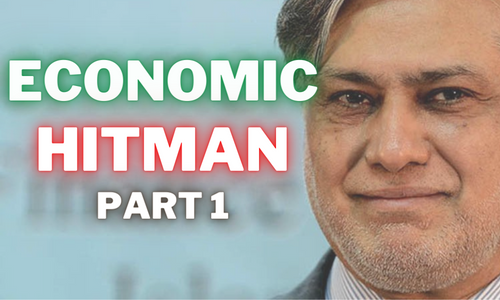
Economic Hitman – Part 1
NOTE: This blog is purely written for academic and competitive exams purposes and there is no political agenda or any affiliation is involved in it.
Economic hitmen are individuals or groups who use tactics such as bribery, fraud, and manipulation to influence the economic policies of governments and companies in favor of their own interests. They may work for private corporations or governments, and their ultimate goal is often to exploit resources and markets for financial gain. The term “economic hitman” was popularized by John Perkins in his book “Confessions of an Economic Hit Man”.

Economic hitmen use a variety of tactics to manipulate the economy in order to benefit their own interests. Some of these tactics include:
- Bribery: Offering large sums of money or other incentives to government officials or business leaders in exchange for favorable economic policies or contracts.
- Fraud: Creating false economic projections or reports in order to secure loans or investments for projects that may not be economically viable.
- Manipulation of debt: Encouraging countries to take on large amounts of debt, and then using that debt as leverage to control economic policies and resources.
- Control of resources: Using economic influence to gain control of valuable resources such as oil, minerals, and land.
- Influence over media: Manipulating the media in order to shape public opinion and influence government policies.
- Coercion: Using threats or intimidation to force countries or companies to comply with their demands.
Economic hitmen often work for private corporations or governments, and their ultimate goal is to exploit resources and markets for financial gain. As economic hitmen can be controlled by a variety of organizations or individuals, depending on the specific situation.
- Corporations: Economic hitmen may be employed by large corporations to help them secure contracts and exploit resources in foreign countries. These corporations may also hire private consulting firms to carry out these activities on their behalf.
- Governments: Economic hitmen may be employed by governments to carry out similar activities in other countries. They may also be used as a tool of foreign policy to exert economic influence over other countries.
- Criminal organizations: Economic hitmen may be controlled by criminal organizations, who use their tactics to exploit resources and markets for financial gain.
- Individuals: Economic hitmen may also be independent operators, working on their own to influence the economic policies of governments and companies in order to gain personal financial gain.
These tactics are illegal in most countries and punishable by law.
Pakistan’s economy has been facing a number of challenges in recent years, including high inflation, a large trade deficit, and a lack of foreign investment. There have been claims that Pakistan’s economy has been targeted by economic hitmen, but it is difficult to verify these claims without concrete evidence.
Some critics argue that Pakistan’s economy has been targeted by foreign powers, who use their economic influence to control resources and markets in the country. They also argue that Pakistan has been forced to accept unfavorable loan terms and economic policies in exchange for aid and investment.
However, it is also important to note that Pakistan’s economic problems are also caused by a number of domestic factors, such as poor governance, corruption, and a lack of economic reforms.
Ishaq Dar is a Pakistani politician and economist who served as the Minister of Finance and Minister of Commerce in the government of Pakistan on and off from 1998 -1999, 2002, 2008, 2013 to 2017 and then 2022 onwards. He has been accused of being involved in various financial scandals and of contributing to the country’s economic problems.
Some critics have accused Dar of being a “modern-day economic hitman”, claiming that he used his position of power to benefit himself and his allies at the expense of the country. In 2017, he was accused by the National Accountability Bureau of accumulating assets beyond his known means of income, and was later convicted and sentenced to imprisonment.
It’s important to note that the term “economic hitman” is not a legal term and it’s used to describe individuals or groups who use tactics such as bribery, fraud, and manipulation to influence the economic policies of governments and companies in favor of their own interests. While Ishaq Dar has been accused of financial misconduct, whether he is an “Economic hitman” is a matter of opinion.
Ishaq Dar’s economic policies had a number of negative effects on the Pakistani economy during his tenure as the Minister of Finance and Minister of Commerce from 1998 and then 2013 to 2017. Some of these negative effects include:
- Increased external debt: Dar’s government borrowed heavily from foreign sources, which led to an increase in external debt. The country’s debt-to-GDP ratio rose sharply during this period, making Pakistan more vulnerable to external shocks.
- Inflation: Dar’s policies aimed at controlling inflation were not fully successful, and inflation remained high during his tenure, which led to a decrease in purchasing power and an increase in the cost of living.
- Currency depreciation: Dar’s policies also led to a significant depreciation of the Pakistani rupee, which had a negative impact on the economy and led to an increase in the cost of imports.
- Reduced government spending: Dar’s policies included cutting government spending, which reduced investment in key areas such as infrastructure, education, and healthcare. This reduced the government’s ability to spur economic growth and improve the standard of living for citizens.
- Energy crisis: The energy crisis persisted during Dar’s tenure, with chronic shortages of electricity and gas. Despite some efforts to address the problem, the energy crisis persisted and had a negative impact on the economy.
- Lack of inclusive growth: While Dar’s policies helped stabilize the economy and achieve some level of growth in the short-term, long-term growth remained weak and was not inclusive, as poverty and inequality persisted.
Every time he holds the office, he considered IMF as a solution to Pakistan’s economy instead of making significant reforms in the economic culture of society and his economic measures consist of “firefighting” approach which were temporary ones with no effective changes on the economic growth. It’s worth noting that some of the issues in Pakistan’s economy are structural and have been present for decades, and that Ishaq Dar’s policies were not the sole cause of the country’s economic problems. However, the policies implemented during his tenure had a significant negative impact on the economy.










LEAVE A COMMENT