
Beyond GDP
ESSAY OUTLINE
1. Introduction
- Define development as both economic growth and improvements in people’s quality of life.
- Explain that governments often measure progress using indicators like GDP, income, and investment.
- Introduce the argument that economic statistics alone do not reflect whether people are healthier, safer, or happier.
- Thesis statement: Real development should prioritize transforming people’s lives through better education, healthcare, equality, and opportunities, while using economic growth as a means rather than an end.
2. Economic Growth Is Important but Insufficient
Topic Sentence: Economic growth provides resources for development, but it does not automatically improve people’s well-being.
- GDP can increase while poverty and inequality remain.
- Wealth may be concentrated among a small portion of the population.
- Example: A country with rapid economic growth but poor public healthcare or education.
Key Point: Economic success should be judged by how its benefits are shared.
3. Human Development Reflects Real Progress
Topic Sentence: Development should be measured by improvements in people’s daily lives.
- Access to quality education.
- Affordable healthcare and longer life expectancy.
- Clean water, sanitation, and safe housing.
- Employment opportunities with fair wages.
Example: Countries that invest in education and healthcare often achieve higher standards of living even if their GDP is moderate.
4. Inclusive Development Creates Sustainable Societies
Topic Sentence: Development is meaningful only when it benefits all members of society.
- Reduce poverty and income inequality.
- Promote gender equality and equal opportunities.
- Protect human rights and social justice.
- Encourage environmental sustainability for future generations.
Example: Renewable energy projects that create jobs while protecting the environment.
5. Counterargument
Topic Sentence: Some argue that economic growth should come first because it generates the resources needed for social programs.
- A strong economy can increase government revenue.
- However, without fair policies, economic gains may not reach ordinary citizens.
- Therefore, growth and human development should progress together.
6. Conclusion
- Restate that development is about improving people’s lives, not merely increasing economic figures.
- Summarize that education, healthcare, equality, and sustainability are better indicators of genuine progress.
- End with a concluding thought: A nation can truly be called developed only when its people enjoy dignity, opportunity, and a high quality of life—not simply when its economic statistics rise.
ESSAY
People often associate development with economic growth, but true development extends far beyond increasing national income or expanding industries. A country achieves real development when it improves the quality of life for its citizens by providing better education, healthcare, housing, employment opportunities, and security. Therefore, development combines economic progress with meaningful improvements in people’s overall well-being.
Governments usually measure national progress by examining economic indicators such as Gross Domestic Product (GDP), per capita income, foreign investment, and employment rates. These statistics help policymakers evaluate economic performance, attract investors, and compare their country’s growth with others. Although these indicators provide useful information about economic activity, they do not present a complete picture of national development.
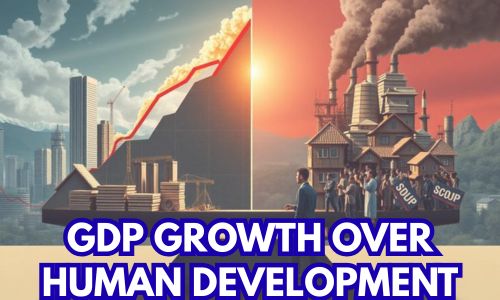
Economic statistics cannot fully capture the everyday experiences of ordinary people. A country may achieve impressive economic growth while many citizens continue to struggle with poverty, poor healthcare, unemployment, unequal access to education, or unsafe living conditions. High GDP figures cannot guarantee happiness, good health, social justice, or equal opportunities. For this reason, policymakers should evaluate development by considering both economic achievements and improvements in people’s lives.
Real development should transform people’s lives by expanding access to quality education, reliable healthcare, equal opportunities, and a higher standard of living. Governments should treat economic growth as a tool that supports human development rather than as the ultimate goal. A nation achieves genuine progress only when its economic success creates lasting benefits for all members of society.
Economic growth provides the financial resources that governments and businesses need to invest in national development, but it does not automatically improve people’s quality of life. Policymakers must ensure that economic gains reach all citizens rather than benefiting only a privileged few.
A country can achieve impressive GDP growth while many people continue to live in poverty. Although businesses may generate higher profits and industries may expand, low-income families often struggle to afford basic necessities such as food, housing, healthcare, and education. As a result, economic growth alone cannot guarantee a better standard of living for everyone.
Economic growth sometimes benefits only wealthy individuals, large corporations, or urban areas. When governments fail to distribute opportunities fairly, a small group accumulates most of the nation’s wealth while the majority receives limited economic benefits. This unequal distribution widens the gap between the rich and the poor and weakens social cohesion.
For example, a country may experience rapid industrial growth and attract significant foreign investment, yet many citizens may still lack access to quality healthcare and education. Although the economy appears strong on paper, families continue to face preventable diseases, overcrowded schools, and limited opportunities for social mobility. These conditions show that economic growth does not necessarily translate into meaningful improvements in people’s daily lives.
A nation should evaluate its economic success by examining how it distributes the benefits of growth among its people. Governments should invest economic gains in education, healthcare, public infrastructure, and social welfare so that all citizens can enjoy a higher quality of life. When a country shares prosperity fairly, it achieves genuine and sustainable development.
Quality education equips people with knowledge, skills, and confidence to improve their lives. It increases employment opportunities, reduces poverty, and encourages innovation. For example, Finland has consistently invested in free, high-quality education, resulting in a highly skilled workforce and one of the world’s best education systems. This investment has strengthened both individual well-being and national development.
Accessible healthcare enables people to live healthier and more productive lives. Governments that provide affordable medical services reduce preventable diseases and improve life expectancy. For instance, Japan’s universal healthcare system has contributed to one of the highest life expectancies in the world, allowing citizens to enjoy healthier and longer lives despite the country’s aging population.
Clean water, proper sanitation, and secure housing protect people from disease and improve their quality of life. Communities with these basic services experience lower child mortality, better health, and greater economic productivity. For example, Singapore transformed itself by investing heavily in modern sanitation systems, clean water infrastructure, and public housing. These improvements significantly raised living standards and created a healthier urban environment.
Meaningful employment and fair wages allow individuals to support their families, reduce poverty, and contribute to the economy. Governments that encourage decent work create more stable and prosperous societies. For example, Germany’s vocational training system prepares young people with practical skills that match industry needs, helping maintain low youth unemployment and providing workers with stable, well-paid careers.
Countries that prioritize education, healthcare, and social welfare often achieve a higher standard of living even when their GDP is not among the highest. Costa Rica, for example, abolished its military in 1948 and redirected public spending toward education and healthcare. As a result, the country enjoys high literacy rates, long life expectancy, and strong human development despite having a relatively moderate GDP.
Governments should create jobs, improve access to education, and provide social protection to help low-income families escape poverty. When people earn fair wages and have equal opportunities, the gap between rich and poor narrows, leading to a more stable society. For example, Brazil’s Bolsa Família program provided financial support to poor families in exchange for keeping children in school and attending health check-ups, significantly reducing extreme poverty and improving living standards.
Societies develop faster when they allow everyone, regardless of gender, to contribute their talents. Governments and employers should ensure equal access to education, employment, and leadership positions for women and marginalized groups. For instance, Bangladesh’s garment industry has employed millions of women, increasing their financial independence and contributing significantly to the country’s economic growth while improving family welfare.
Governments should safeguard freedom, equal treatment under the law, and access to justice so that every citizen can live with dignity. Fair legal systems and anti-discrimination policies build trust and social stability. A notable example is South Africa’s post-apartheid Constitution, which established equal rights for all citizens and laid the foundation for a more inclusive and democratic society after decades of racial discrimination.
Countries should invest in clean energy, conserve natural resources, and reduce pollution to support long-term development. Sustainable practices protect public health while creating new economic opportunities. For example, Denmark has invested heavily in wind energy, generating clean electricity, creating thousands of green jobs, and reducing carbon emissions. This demonstrates that environmental protection and economic development can advance together.
By reducing inequality, ensuring equal opportunities, protecting human rights, and promoting environmental sustainability, governments can create inclusive development that benefits both present and future generations.
When businesses expand and workers earn higher incomes, governments collect more taxes. They can use this additional revenue to build schools, hospitals, roads, and public transport. For example, South Korea used the wealth created during its rapid industrialization to invest heavily in education and healthcare, which significantly improved its citizens’ quality of life.
Economic growth does not automatically benefit everyone. If governments fail to enforce fair taxation, labor protections, and social welfare programs, wealth often remains concentrated among large corporations and high-income groups. For instance, despite strong GDP growth in some developing countries, many rural communities still lack clean water, quality education, and reliable healthcare because public investment remains uneven.
Governments should combine economic expansion with policies that improve people’s well-being. They should invest in education, healthcare, affordable housing, and social protection while encouraging business growth. For example, the Nordic countries have maintained competitive economies while providing universal healthcare, high-quality education, and strong social welfare systems, demonstrating that economic success and human development can reinforce each other.
Real development goes beyond rising GDP or higher national income. It focuses on improving the lives of ordinary people by ensuring they have access to essential services, decent jobs, and equal opportunities. For example, a country may report impressive economic growth, but if millions of people still struggle with poverty, unemployment, or poor healthcare, that growth cannot be considered genuine development.
A truly developed nation invests in quality education, accessible healthcare, equal opportunities, and environmental protection. Countries such as Finland have built strong education systems that equip citizens with valuable skills, while nations like Costa Rica have improved public health and environmental conservation despite having smaller economies than many developed countries. These achievements demonstrate that human well-being provides a more meaningful measure of progress than economic statistics alone.
A nation can truly be called developed only when its people enjoy dignity, opportunity, and a high quality of life—not simply when its economic statistics rise. Ultimately, governments should treat economic growth as a tool rather than the final goal. They should use national wealth to reduce poverty, create jobs, improve public services, and protect the environment. When every citizen can live with dignity, pursue opportunities, and enjoy a safe and healthy life, a nation achieves real development. Therefore, the true success of a country lies not in the size of its economy but in the well-being and prosperity of its people.











LEAVE A COMMENT