
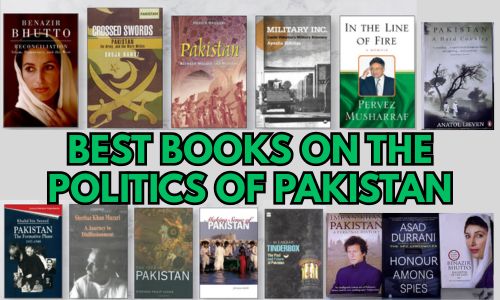
Best Books on The Politics of Pakistan
Understanding Pakistan’s political history requires much more than memorizing dates, prime ministers, military coups, elections, and constitutional amendments. Pakistan’s political development has been shaped by the interaction of democratic institutions, military rule, political parties, constitutional changes, civil-military relations, regional identities, economic pressures, foreign policy, and social movements.
For students, researchers, journalists, competitive-examination candidates, and anyone interested in South Asian politics, the right books provide an opportunity to understand not only what happened in Pakistan, but also why political events unfolded in particular ways.
We can approach Pakistan’s political history through books that cover the country from its creation in 1947 to the major political developments of the contemporary period. The following selection includes important works on Pakistan’s political institutions, leadership, constitutional history, military governments, democracy, political parties, and society.
Best Books on Pakistan’s Political History
1. Pakistan: The Formative Phase 1857–1948 — Khalid B. Sayeed
Khalid B. Sayeed’s work is an important starting point for understanding the political circumstances that eventually led to the creation of Pakistan. Rather than beginning the story abruptly in 1947, the book helps place Pakistan’s emergence within the wider political developments of British India.
We gain insight into the growth of Muslim political consciousness, the constitutional evolution of British India, the demand for Muslim political representation, and the political developments surrounding partition.
For readers beginning their study of Pakistani political history, this book provides valuable historical context for understanding the origins of Pakistan’s political system.
2. Politics in Pakistan: The Nature and Direction of Change — Khalid B. Sayeed
Khalid B. Sayeed is one of the important scholars for anyone studying Pakistan’s political development. His analysis examines the institutions and forces that shaped Pakistani politics after independence.
The book explores issues involving political leadership, bureaucracy, the military, political parties, constitutional development, and the difficulties faced by democratic institutions.
It is particularly useful because it encourages us to examine Pakistan’s political history as an institutional process rather than simply as a succession of individual rulers.
3. The Idea of Pakistan — Stephen P. Cohen
Stephen P. Cohen’s The Idea of Pakistan is widely regarded as an important modern study of Pakistan’s political identity and state development.
The book examines the historical origins of Pakistan, its political institutions, military establishment, economy, society, and foreign relations. Cohen also considers the competing ideas about what Pakistan should become.
For readers looking for a broad overview, this is one of the books we can use to connect Pakistan’s history, politics, military, society, and international relations.
4. Pakistan: Beyond the Crisis State — Maleeha Lodhi
Maleeha Lodhi’s edited volume brings together perspectives on Pakistan’s political and economic challenges. It is particularly useful for understanding the structural problems confronting the Pakistani state.
The book examines governance, economic development, security, institutions, and political stability. Instead of presenting Pakistan exclusively through the lens of crisis, it considers the institutional and policy challenges that have shaped the country.
This makes it valuable for readers who want to connect historical political developments with contemporary governance issues.
5. Pakistan: A Hard Country — Anatol Lieven
Anatol Lieven’s Pakistan: A Hard Country provides an extensive examination of Pakistani society and its relationship with the state.
The book looks beyond Islamabad and the formal political system. It considers families, tribes, local political structures, the military, religion, provincial identities, and other social forces that influence political life.
For understanding why Pakistani politics cannot be explained solely through elections and political parties, this book is particularly valuable. It helps us recognize the importance of informal political networks and social structures.
6. The Struggle for Pakistan: A Muslim Homeland and Global Politics — Ayesha Jalal
Ayesha Jalal is one of the most influential historians of modern South Asian political history. The Struggle for Pakistan examines Pakistan’s history from its creation through later political developments.
The book explores the challenges faced by the new state, political institutions, civil-military relations, regional tensions, and Pakistan’s position in international politics.
It is especially useful for readers who want to understand Pakistan within the larger history of South Asia, partition, nationalism, and global politics.
7. The State of Martial Rule: The Origins of Pakistan’s Political Economy of Defence — Ayesha Jalal
For a deeper examination of Pakistan’s civil-military relationship, Ayesha Jalal’s work on martial rule is particularly important.
Pakistan experienced several periods in which the military directly governed the country, including the governments of Ayub Khan, Yahya Khan, Zia-ul-Haq, and Pervez Musharraf.
This book helps readers examine the historical conditions behind the growing political influence of the military and the development of Pakistan’s political economy of defence.
8. Military Inc.: Inside Pakistan’s Military Economy — Ayesha Siddiqa
Ayesha Siddiqa’s Military Inc. focuses on the economic dimensions of Pakistan’s military establishment.
The book is important for readers studying civil-military relations in Pakistan because it goes beyond military coups and constitutional interventions. It investigates the economic interests and institutional structures associated with the military establishment.
For advanced students of Pakistani politics, this provides another perspective on why the military has remained such a significant institution in the country’s political system.
9. Pakistan: The Army and the State — Aqil Shah
Aqil Shah’s Pakistan: The Army and the State is highly relevant for anyone studying the relationship between Pakistan’s armed forces and civilian political institutions.
The book examines the historical development of military influence, political instability, constitutional arrangements, and the relationship between civilian governments and the armed forces.
It provides a useful framework for understanding one of the central themes of Pakistan’s political history: the continuing struggle to establish a stable balance between civilian authority and military power.
10. Constitutional and Political History of Pakistan — Hamid Khan
For students of law, political science, history, and competitive examinations, Hamid Khan’s Constitutional and Political History of Pakistan is one of the most useful books available.
The book provides detailed coverage of Pakistan’s constitutional development, including the Objectives Resolution, constitutional debates, the 1956 Constitution, the 1962 Constitution, the 1973 Constitution, martial-law periods, constitutional amendments, and major political developments.
It is particularly useful when we need to understand how Pakistan’s constitutional structure evolved and why constitutional crises repeatedly became central to political life.
Books on Pakistan’s Political Leaders
Pakistan’s political history is also closely associated with several influential leaders. Biographical and political studies allow us to examine how individual leadership affected national institutions.
Muhammad Ali Jinnah
Books on Muhammad Ali Jinnah are essential for understanding the political movement that culminated in Pakistan’s creation. Stanley Wolpert’s works on Jinnah are frequently consulted by students and researchers.
Studying Jinnah allows us to examine the constitutional and political arguments behind the demand for Pakistan and the challenges faced by the new state after independence.
Zulfikar Ali Bhutto
The political career of Zulfikar Ali Bhutto is essential to understanding Pakistan’s political history during the 1960s and 1970s.
Stanley Wolpert’s Zulfi Bhutto of Pakistan: His Life and Times provides a biographical perspective on Bhutto’s rise, his political ideology, his relationship with the military, his government, and the events that eventually led to his execution in 1979.
Benazir Bhutto
Benazir Bhutto’s memoir Daughter of the East offers a first-person perspective on her political life, her family, exile, political struggle, and return to Pakistan.
While memoirs should be read alongside independent historical scholarship, they are valuable because they provide insight into how major political figures understood the events surrounding them.
Books on Pakistan’s Military and Civil-Military Relations
One of the most important subjects in Pakistani political history is civil-military relations.
From the first military coup in 1958 to subsequent periods of military government and military influence over political affairs, the armed forces have played an unusually prominent role in the country’s political development.
Recommended books in this area include works by Ayesha Jalal, Aqil Shah, Ayesha Siddiqa, and Stephen P. Cohen.
Reading several authors is particularly important because interpretations of military involvement differ considerably. Comparing perspectives helps us distinguish between historical evidence, political interpretation, and the author’s analytical framework.
Books on Pakistan’s Constitutional History
Pakistan’s constitutional history is essential for understanding its political development.
The country adopted its first constitution in 1956, introduced a new constitutional structure under the 1962 Constitution, and later adopted the 1973 Constitution, which remains the foundation of the country’s constitutional system.
For this subject, Hamid Khan’s Constitutional and Political History of Pakistan is especially useful.
We can also study the original constitutional documents and amendments alongside historical scholarship. This approach enables us to understand the difference between constitutional text and how political institutions actually operated.
Books on Democracy and Political Parties in Pakistan
Pakistan’s political history cannot be understood without examining its political parties.
The Pakistan Muslim League, Pakistan Peoples Party, Pakistan Tehreek-e-Insaf, Muttahida Qaumi Movement, Awami National Party, Jamiat Ulema-e-Islam, Jamaat-e-Islami, and numerous regional parties have played different roles at different periods.
Books dealing with Pakistan’s political parties and democratic development help us understand elections, coalition governments, opposition movements, political mobilization, and changing voter behavior.
For a complete study, we should combine political biographies with academic studies of institutions and electoral politics.
Books on Pakistan’s Regional Politics
Pakistan is a federation comprising diverse provinces and regions with different historical, linguistic, ethnic, and political experiences.
The political histories of Punjab, Sindh, Khyber Pakhtunkhwa, and Balochistan are therefore essential components of the national political narrative.
The events surrounding the creation of Bangladesh in 1971 are particularly important. Understanding the political relationship between West and East Pakistan, economic grievances, linguistic identity, electoral representation, and the crisis of 1971 provides essential context for understanding Pakistan’s subsequent political development.
A serious reader should therefore avoid studying Pakistan solely from the perspective of federal politics in Islamabad.
Books on Pakistan’s Foreign Policy and Geopolitics
Pakistan’s domestic political history has frequently intersected with international affairs.
Relations with India, Afghanistan, China, the United States, Iran, and the wider Muslim world have influenced Pakistan’s security priorities and foreign-policy choices.
The Cold War was particularly significant because Pakistan became closely involved with Western security arrangements and later played an important role in the geopolitical struggle surrounding Afghanistan.
Stephen P. Cohen’s writings, along with specialist works on Pakistan’s foreign relations, can help us understand how external pressures influenced domestic political institutions.
How to Read Books on Pakistan’s Political History
We should not rely on a single author when studying a politically contested history.
Different historians and political scientists may interpret the same event differently. For example, the 1958 military takeover, the 1971 crisis, the 1977 coup, the 1988 democratic transition, the 1999 military takeover, and later political crises have generated competing interpretations.
A strong reading strategy is to compare:
- Academic histories for chronology and historical context.
- Political biographies for leadership perspectives.
- Constitutional studies for institutional development.
- Military and civil-military studies for the role of the armed forces.
- Memoirs for first-person accounts.
- Election studies for democratic development.
- Regional histories for provincial perspectives.
This approach gives us a more balanced understanding of Pakistan’s political evolution.
Recommended Reading Order for Beginners
Readers who are new to Pakistani political history can follow a structured sequence.
We can begin with The Idea of Pakistan by Stephen P. Cohen for a broad introduction. We can then move to The Struggle for Pakistan by Ayesha Jalal for a deeper historical interpretation.
After establishing the historical foundation, Constitutional and Political History of Pakistan by Hamid Khan can provide detailed knowledge of constitutional development.
For civil-military relations, Pakistan: The Army and the State by Aqil Shah and Military Inc. by Ayesha Siddiqa offer important perspectives.
Finally, books such as Pakistan: A Hard Country by Anatol Lieven can broaden our understanding by connecting formal political institutions with Pakistani society.
Best Books for CSS and Competitive Exam Preparation
Students preparing for CSS, PMS, political science, international relations, history, and other competitive examinations can particularly benefit from books that combine chronology with analysis.
For examination preparation, we should focus on:
- Pakistan Movement and creation of Pakistan
- Constitutional development
- Parliamentary and presidential systems
- Civil-military relations
- Political parties
- Major military regimes
- Democratic governments
- The 1971 crisis
- Federalism and provincial politics
- Pakistan’s foreign policy
- Political institutions
- Governance and political instability
- Major constitutional amendments
- Contemporary political developments
Hamid Khan’s Constitutional and Political History of Pakistan is particularly useful as a reference because it brings constitutional and political developments together in one comprehensive study.
Final Recommended Reading List
For a well-rounded understanding of Pakistan’s political history, we recommend building a reading list around the following titles and authors:
- The Idea of Pakistan — Stephen P. Cohen
- The Struggle for Pakistan — Ayesha Jalal
- Pakistan: The Army and the State — Aqil Shah
- Military Inc.: Inside Pakistan’s Military Economy — Ayesha Siddiqa
- Constitutional and Political History of Pakistan — Hamid Khan
- Pakistan: A Hard Country — Anatol Lieven
- Politics in Pakistan — Khalid B. Sayeed
- Pakistan: The Formative Phase — Khalid B. Sayeed
- Pakistan: Beyond the Crisis State — Maleeha Lodhi
- Zulfi Bhutto of Pakistan — Stanley Wolpert
- Daughter of the East — Benazir Bhutto
Building a Deeper Understanding of Pakistan’s Political History
The best way to understand Pakistan’s political history is to treat it as a complex interaction between institutions, personalities, society, geography, constitutional structures, and international politics.
No single book can explain every dimension of Pakistan’s political journey. Jinnah, the Pakistan Movement, partition, constitutional experiments, military governments, political parties, the 1971 crisis, democratic transitions, regional politics, and contemporary political developments all require different perspectives.
By reading Ayesha Jalal, Stephen P. Cohen, Hamid Khan, Aqil Shah, Ayesha Siddiqa, Khalid B. Sayeed, Anatol Lieven, and other established scholars alongside primary sources and political memoirs, we can develop a much more nuanced understanding of how Pakistan’s political system evolved.
For students and general readers alike, these books provide an excellent foundation for exploring the political history of Pakistan from the Pakistan Movement to the modern era and for understanding the institutions, conflicts, decisions, and ideas that have shaped the country’s political trajectory.










LEAVE A COMMENT