
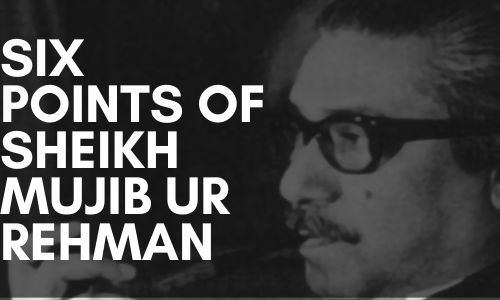
Six Points of Sheikh Mujib Ur Rehman
Mujib’s Six Points were a set of political and economic demands put forward by Sheikh Mujibur Rahman, the leader of the Awami League in East Pakistan (now Bangladesh), in 1966. These points played a significant role in the eventual separation of East Pakistan from West Pakistan (present-day Pakistan). Here’s a brief overview of Mujib’s Six Points and their role in the separation:
- Federalism: Mujib advocated for a federal structure for Pakistan, where the provinces would have maximum autonomy. He called for a true federation with a weak central government and strong provincial governments. This demand aimed to address the perceived economic and political disparities between East and West Pakistan.
- Autonomy of Provinces: The second point emphasized the autonomy of the provinces, giving them control over their own resources, administration, and economy. This was particularly crucial for East Pakistan, which felt marginalized in the distribution of resources and economic benefits.
- Defense: Mujib proposed that each wing of Pakistan should have its own separate military to ensure its defense. This was a response to the concerns in East Pakistan about the disproportionate allocation of military resources and the military’s dominance by West Pakistan.
- Currency: Mujib called for a separate currency for East Pakistan to prevent the exploitation of its resources by the central government. This point highlighted the economic grievances of East Pakistan and sought to ensure a fair distribution of economic benefits.
- Control over Foreign Exchange Earnings: Mujib demanded that each wing should have control over its foreign exchange earnings. This point aimed to address the economic disparity and ensure that East Pakistan could independently manage its economic affairs.
- Communication and Commerce: The sixth point focused on the regulation of communication and commerce. Mujib sought to guarantee that East Pakistan had control over its communication networks and could regulate its commerce independently, preventing economic exploitation by the central government.
The Six Points, while representing the demands of East Pakistan, were met with resistance from the ruling authorities in West Pakistan. The refusal to accommodate these demands and the subsequent political deadlock fueled discontent in East Pakistan. The situation eventually escalated into the Bangladesh Liberation War in 1971, leading to the independence of Bangladesh from Pakistan. Mujib’s Six Points played a crucial role in shaping the political discourse and aspirations that ultimately led to the creation of the independent state of Bangladesh.
Reaction and Deadlock Over Six Points of Mujib
The military establishment, led by President Yahya Khan, and Zulfikar Ali Bhutto, who was a key political figure in West Pakistan, responded to Mujib’s Six Points with resistance and reluctance to negotiate for a variety of reasons:
- Centralized Power: Both the military establishment and Bhutto were proponents of a centralized form of government where power resided primarily in the central authority. Mujib’s Six Points, particularly the emphasis on autonomy for provinces, challenged this centralization of power, which both groups were unwilling to compromise.
- Fear of Disintegration: The military leadership, in particular, feared that conceding to Mujib’s demands might lead to the disintegration of Pakistan. Bhutto shared this concern, and both parties were wary of setting a precedent that could encourage other provinces to demand similar autonomy, potentially resulting in the breakup of the country.
- Economic Concerns: Mujib’s demand for a separate currency and control over foreign exchange earnings raised economic concerns. The economic interests of the industrialized West Pakistan, where Bhutto had strong political support, were at odds with the economic autonomy sought by East Pakistan. Both the military and Bhutto were hesitant to relinquish control over economic resources.
- Political Opposition and Power Dynamics: Bhutto, who was a key political figure in West Pakistan, saw Mujib’s demands as a challenge to his own political ambitions. He was not in favor of decentralization, and the idea of separate military forces for each wing was unacceptable as it would diminish the central government’s control over the armed forces.
- Nationalism and Identity Issues: Both the military establishment and Bhutto were influenced by nationalist sentiments that saw the demands of East Pakistan as a threat to the unity of the nation. Cultural and linguistic differences, coupled with a strong sense of a unified Pakistani identity in West Pakistan, contributed to their reluctance to negotiate on issues related to autonomy.
- Political Calculations: Bhutto, as a political leader, saw an opportunity to enhance his own political standing by opposing Mujib’s demands. He believed that taking a hardline stance against the Six Points would bolster his popularity in West Pakistan.
Due to these factors, the military establishment, supported by Bhutto, did not engage in substantive negotiations on Mujib’s Six Points. This lack of willingness to address the concerns of East Pakistan ultimately contributed to the deterioration of the political situation, leading to the Bangladesh Liberation War in 1971 and the subsequent creation of Bangladesh as an independent state.










LEAVE A COMMENT