
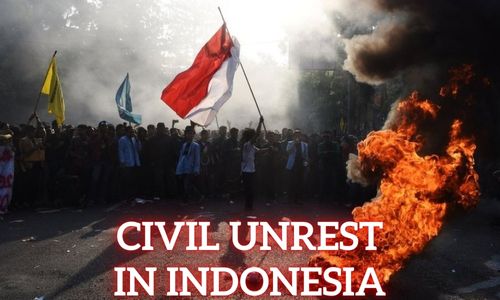
Civil Unrest in Indonesia
Indonesia has entered one of the most turbulent periods in its modern history. What began as frustration over rising economic inequality and political dissatisfaction quickly escalated into nationwide unrest, culminating in the downfall of President Prabowo Subianto’s government. This article examines the root causes of the riots, the consequences of the regime’s collapse, and the uncertain road ahead for Southeast Asia’s largest democracy.
Civil unrest has always been a force capable of reshaping nations, and Indonesia is no exception. The wave of riots that swept across the country was not the result of sudden chaos, but rather the outcome of years of public disillusionment. Deep-seated corruption, weak governance, widening economic divides, and restrictions on democratic freedoms built up a reservoir of anger among ordinary citizens. When that anger finally erupted, it reflected more than just frustration—it was the collective demand of civil society for meaningful change and a new direction for the nation’s future.
Causes of Civil Riots against the Indonesian Government
Every civil riot has its roots in prolonged frustrations and systemic failures. In Indonesia, the civil riots stemmed from a combination of political, economic, and social issues that snowballed into full-scale unrest.
The unrest began in late August 2025, triggered by a series of grievances that had been simmering for months:
- Lavish Lawmaker Perks: Reports revealed that members of parliament were receiving housing allowances up to 50 million rupiah/month—nearly 10x Jakarta’s minimum wage.
- Police Brutality: The death of 21-year-old food delivery driver Affan Kurniawan, run over by a police vehicle during protests, became a national symbol of injustice.
- Economic Strain: Rising costs of living, mass layoffs, and stagnant wages fueled public anger.
- Elite Entitlement: Public outrage grew over insensitive remarks by officials and proposed tax schemes targeting social media users.
These factors converged into a perfect storm of protests, looting, and violent clashes across Jakarta, Bali, Sumatra, and beyond
Other Causes
- Rampant Corruption
Corruption in Indonesia had reached alarming levels, with government officials and business elites deeply entangled in embezzlement scandals, vote-buying, and misuse of public funds. Citizens felt that instead of serving the public, leaders enriched themselves, leaving ordinary Indonesians struggling to survive. This corruption eroded trust in institutions and ignited the anger of civil society.
- Economic Inequality
Despite Indonesia’s rapid economic growth in recent years, wealth was concentrated in the hands of a few elites. Large segments of the population faced job insecurity, low wages, and rising living costs. The widening gap between the rich and poor fueled resentment, leading many Indonesians to feel abandoned by their leaders.
- Suppression of Free Speech and Democracy
Civil rights groups and journalists frequently reported harassment, censorship, and arbitrary arrests when criticizing the government. Students and activists faced police crackdowns during protests. Such actions silenced dissent, but also amplified resistance, as people grew more determined to reclaim their voices.
- Failure in Public Services
From healthcare to education and infrastructure, the government failed to deliver basic services to millions. In rural and marginalized areas, people suffered from limited access to healthcare, poor roads, and lack of clean water. This neglect further fueled discontent.
- Triggering Events
While underlying grievances had simmered for years, certain events—such as the passage of controversial laws, allegations of election fraud, or police brutality against protesters—sparked widespread mobilization. These events acted as catalysts that pushed citizens into the streets, demanding change.
Demands of Civil Society
Civil society groups in Indonesia have rallied around a powerful reform agenda known as the “17+8 People’s Demands”, which emerged from the mass protests in August 2025. These demands reflect deep frustration with corruption, inequality, and authoritarian overreach. Here’s a breakdown of what they’re fighting for:
17 Short-Term Demands (Deadline: September 5, 2025)
These are urgent reforms aimed at restoring public trust and accountability:
- Police & Military Accountability
- Form an independent investigation into protest-related deaths (e.g., Affan Kurniawan)
- End military (TNI) involvement in civilian security
- Release all detained demonstrators and stop criminalizing protests
- Prosecute officers responsible for violence and human rights abuses2
- Parliamentary Transparency
- Freeze salary hikes and revoke new perks for lawmakers
- Publish detailed budget reports on salaries, allowances, and facilities
- Investigate questionable assets of DPR members via the Corruption Eradication Commission (KPK)
- Empower the DPR Ethics Council to act against unethical members
- Political Reform
- Sanction political party leaders who incite public anger
- Publicly commit parties to side with the people
- Engage in open dialogue with civil society and student groups
- Security Sector Reform
- Ensure the TNI returns to barracks and does not replace police functions
- Enforce discipline to prevent military overreach
- End police brutality and enforce proper crowd-control protocols
8 Long-Term Demands (Deadline: August 31, 2026)
These are structural reforms aimed at reshaping Indonesia’s governance:
- Legal & Institutional Reform
- Revise the Police Law and TNI Law
- Strengthen the National Commission on Human Rights (Komnas HAM)
- Ratify the Asset Confiscation Bill to combat corruption
- Political System Overhaul
- Reform the House of Representatives (DPR) and political party structures
- Ensure fair representation and reduce elite dominance
- Economic Justice
- Review labor and outsourcing policies
- Guarantee living wages and prevent mass layoffs
- Open formal dialogue with labor unions
This reform package is not just a wishlist—it’s a roadmap for rebuilding Indonesia’s democracy from the ground up. If implemented, it could mark a historic shift in how power is held and exercised in the country.
Effects of the Government’s Collapse
The toppling of the Prabowo administration has unleashed a wave of uncertainty:
- Military Overreach: Thousands of soldiers were deployed to restore order, raising fears of martial law and democratic backsliding6.
- Economic Shockwaves: Financial markets dipped, foreign investment stalled, and infrastructure damage exceeded $3.4 million.
- International Fallout: Countries like Australia issued travel warnings, while Indonesian diaspora staged solidarity protests in London and Paris4.
- Leadership Vacuum: With no clear successor, political factions are scrambling to form a transitional government amid calls for reform.
- Rise of Civil Participation: On a positive note, the riots awakened a new era of civic engagement. Ordinary citizens, especially youth and grassroots organizations, became more active in shaping policies and holding leaders accountable. The sense of empowerment spread across society.
- Opportunities for Reform: While instability was inevitable, the fall of the government opened doors for new reforms, transparency, and accountability. Civil groups saw it as a chance to rebuild the nation on stronger democratic foundations.
What Comes After the Chaos?
Indonesia now stands at a crossroads:
- Democratic Renewal or Regression? Civil society groups demand police reform, reduced elite privileges, and constitutional limits on military power8.
- Youth-Led Movements: Students and labor unions have emerged as key voices for change, pushing for systemic reforms and social justice.
- Establishing Rule of Law: For Indonesia to avoid slipping back into authoritarianism, laws must protect human rights and ensure accountability for past abuses. Truth and reconciliation commissions may play a role in healing societal wounds.
- Long-Term Democratic Reforms: Indonesia’s path forward depends on deep reforms that address corruption, inequality, and institutional weaknesses. The riots showed the people’s power, but lasting peace will only come if reforms are implemented.
- Global Watch: The international community is closely monitoring Indonesia’s next steps, hoping for a peaceful transition and restoration of democratic norms.
The civil riots in Indonesia that led to the toppling of the government were not merely acts of rebellion—they were a people’s cry for justice, equality, and democracy. While the fall of leadership brought instability, it also created an opportunity for Indonesia to reset its political system. Civil society’s demands for anti-corruption measures, human rights protection, and economic justice are key to ensuring that the sacrifices of the people lead to meaningful change.
Indonesia now stands at a crossroads: it can either slip back into chaos or build a stronger, more democratic nation. The future depends on how leaders respond to the people’s call for reform.








LEAVE A COMMENT