

World Books Day
World Book Day is an annual event celebrated on April 23rd to promote reading, publishing, and copyright. It is also known as World Book and Copyright Day or International Day of the Book. The day was established by the United Nations Educational, Scientific and Cultural Organization (UNESCO) in 1995 to honor the importance of books and to encourage people to read more.
On this day, various events are organized worldwide, such as book fairs, readings, literary competitions, and other activities that promote reading and the love of books. It is a day to celebrate the power of books to educate, inspire, and entertain, as well as to promote cultural understanding and tolerance. In some countries, it is traditional to give books as gifts on World Book Day, particularly to children. The day is also an opportunity for authors and publishers to promote their works and to raise awareness of the importance of protecting intellectual property rights.
Initiative
World Book Day was established by UNESCO (the United Nations Educational, Scientific and Cultural Organization) in 1995. The first World Book Day was celebrated on April 23, 1996. Since then, it has been celebrated annually on the same date. The choice of April 23rd as the date for World Book Day is significant as it marks the death anniversary of renowned writers, including William Shakespeare, Miguel de Cervantes, and Inca Garcilaso de la Vega.
Purpose
The purpose of World Book Day is to promote reading, publishing, and copyright around the world. UNESCO established this day to celebrate the role that books play in our lives, and to encourage people to read more books. The day is an opportunity to raise awareness of the importance of books and reading, and to highlight the cultural, social, and economic benefits of reading.
World Book Day is also intended to promote the protection of intellectual property rights and to encourage respect for the rights of authors and publishers. The day provides an opportunity to recognize the efforts of authors and publishers in creating and disseminating books, as well as the importance of access to books for education, research, and cultural development. Overall, the purpose of World Book Day is to celebrate the joy of reading, to promote literacy, and to raise awareness of the cultural and social significance of books and reading in our lives.
Need of Books in Digital World?
Yes, books are still important even in the era of digital media. While it is true that digital media has revolutionized the way we access information and entertainment, books remain a valuable and irreplaceable source of knowledge, inspiration, and entertainment.
Firstly, reading books offers a unique and immersive experience that is different from other forms of media. Reading a book requires focus and concentration, allowing the reader to fully engage with the story or subject matter. Books also allow for a deeper exploration of a topic, with greater detail and nuance than is often found in digital media. Additionally, books are often seen as works of art and literature, with their own unique aesthetic qualities that make them valuable cultural artifacts. Many people still value the tactile experience of reading a physical book, with its smell, texture, and weight. Books also have a longer lifespan than digital media, as they can be preserved for centuries and passed down from generation to generation.
Finally, while digital media has certainly made information more accessible, it has also led to issues of misinformation, fake news, and a lack of critical thinking. Reading books can help develop critical thinking skills and promote a more nuanced understanding of complex issues. In conclusion, while digital media has certainly impacted the way we access information and entertainment, books remain a valuable and important part of our cultural heritage and intellectual life.
Refer to Digitalization Around the World
Books Industry in Pakistan
The book industry in Pakistan is an important part of the country’s cultural and intellectual landscape. Pakistan has a rich literary tradition, with a vibrant community of writers, poets, and intellectuals who produce works in a variety of languages, including Urdu, English, Punjabi, Sindhi, and others.
There are a number of major book publishers in Pakistan, including Oxford University Press Pakistan, Ferozsons, and Paramount Publishing Enterprise, among others. These publishers produce books in a range of genres, including fiction, non-fiction, poetry, and academic texts. In addition to traditional book publishing, there has been a growing interest in self-publishing and digital publishing in Pakistan. This has been facilitated by the growth of online marketplaces and the increasing availability of e-books and digital reading platforms.
Despite the challenges facing the book industry in Pakistan, including issues such as piracy, a lack of investment in publishing infrastructure, and a lack of government support, there is a strong appetite for reading and a growing interest in books among the country’s younger generations. Overall, the book industry in Pakistan is an important part of the country’s cultural and intellectual life, and is poised for growth in the years to come.
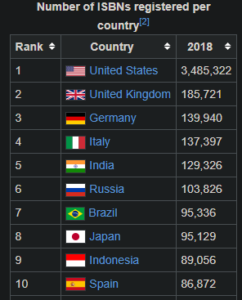
There is some data which shows the top 10 countries where most books published globally. In this list Pakistan ranked on 57th where around 3700 or so books published annually on different topics and among them around 2900+ are in Urdu and other languages. While 800 or so published in English language.

Here is list of top 10 countries where books published under number of ISBNs
Book Readers in Pakistan
It is difficult to make a direct comparison between book readers in Pakistan and the rest of the world, as there are a number of factors that can influence reading habits, such as literacy rates, access to books, and cultural attitudes towards reading. That being said, Pakistan has a relatively low literacy rate compared to many other countries, which could impact book readership.
According to UNESCO, the literacy rate in Pakistan is around 63%, compared to a global average of 86%. However, it is worth noting that there has been a significant increase in literacy rates in Pakistan over the past few decades, particularly among young people. Despite these challenges, there is still a strong tradition of reading in Pakistan, particularly in the areas of literature, poetry, and religious texts. Many Pakistanis also read in English and are interested in works of fiction and non-fiction from around the world. Overall, while book readership in Pakistan may not be as high as in some other countries, there is still a significant number of readers and a strong culture of reading and intellectual curiosity in the country.
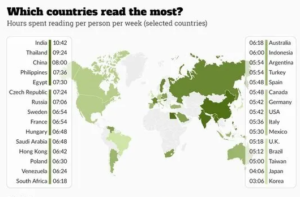
Here is data of number of book reading per hour recorded around the globe.
Do let us know in comments your favorite book and number of books you read in a year?










LEAVE A COMMENT