
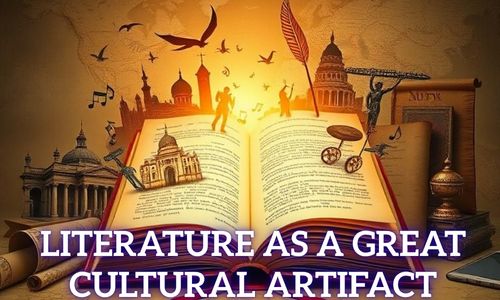
Literature as a Great Cultural Artifact
ESSAY OUTLINE
1. Introduction
- Opening Thought: Begin with how literature mirrors human experience, emotions, and values across ages.
- Context: Explain that literature is not just art—it’s a reflection of the beliefs, traditions, and evolution of societies.
- Thesis Statement: Literature stands as a great cultural artifact because it preserves history, expresses identity, and shapes the moral and intellectual development of civilizations.
2. Understanding Literature as Culture
- Definition of Literature: Define literature as written or spoken works that express human thought, imagination, and emotion.
- Cultural Reflection: Explain how literature records traditions, customs, and societal changes.
- Transmission of Values: Show how literature passes moral, religious, and philosophical beliefs across generations.
3. Literature as a Historical Record
- Preserving the Past: Discuss how epics, folklore, and historical novels document civilizations.
- Example: Mention works like The Iliad, Beowulf, or Shahnameh as reflections of their times.
- Understanding Change: Explain how literature helps readers trace the evolution of thought, politics, and identity.
4. Literature as a Mirror of Society
- Social Critique: Show how authors use literature to challenge injustice, inequality, or corruption.
- Cultural Identity: Explain how literature defines national character and unity.
- Example: Reference works like Things Fall Apart or Pride and Prejudice as cultural commentaries.
5. Literature and Human Experience
- Emotional Connection: Explore how literature expresses universal emotions like love, fear, and hope.
- Moral Guidance: Explain how stories teach empathy, ethics, and self-awareness.
- Cultural Exchange: Show how translated works promote global understanding and tolerance.
6. Modern Relevance of Literature
- Preservation through Technology: Discuss how digital archives and e-books extend cultural preservation.
- Globalization and Diversity: Highlight how modern literature amplifies multicultural voices.
- Enduring Power: Emphasize that literature continues to shape identity and inspire change.
7. Conclusion
- Restate Thesis: Literature remains a timeless cultural artifact that bridges past, present, and future.
- Summarize Key Points: Mention its role in preserving history, shaping culture, and uniting humanity.
- Final Thought: Literature endures as the soul of civilization—its most profound and lasting cultural legacy.
ESSAY
Literature mirrors human experience, emotions, and values across generations. Writers capture the essence of life through stories, poems, and plays that reflect the struggles, dreams, and triumphs of humanity. By reading literature from different eras, readers actively engage with the emotions and ideas that define human existence. Each work of literature acts as a bridge between the author’s world and the reader’s understanding, allowing timeless human truths to resonate across ages.
Literature goes beyond artistic expression; it serves as a living record of a society’s beliefs, traditions, and evolution. Authors write about their cultures, capturing the customs, languages, and moral codes that shape their communities. Through literature, societies express their collective identity, celebrate their heritage, and confront their challenges. Every novel, poem, or drama reveals the mindset and values of the time in which it was created, helping readers understand how civilizations evolve.
Literature stands as a great cultural artifact because it preserves history, expresses identity, and shapes the moral and intellectual growth of civilizations. By documenting human experiences and reflecting social changes, literature becomes a vessel that carries the soul of a culture across time. It not only records who we are but also inspires who we strive to become, making it an indispensable element of humanity’s cultural legacy.
Literature represents the creative and intellectual expression of humanity. Writers use words to communicate emotions, ideas, and experiences that define human existence. Through poetry, drama, fiction, and oral traditions, literature captures imagination and transforms abstract thoughts into meaningful narratives. It actively engages readers, encouraging them to reflect on life, question reality, and explore human nature. By expressing emotion and thought, literature becomes a living record of the human spirit.
Literature reflects the culture from which it emerges. Authors write about their surroundings, customs, traditions, and social values, turning their works into mirrors of society. Through literature, we understand how people lived, what they believed in, and how they interacted with one another. For example, classical epics reveal ancient values of heroism, while modern novels portray social struggles and identity crises. By capturing these changes, literature allows readers to witness the evolution of culture and human behavior over time.
Literature transmits moral, religious, and philosophical beliefs from one generation to another. Writers embed lessons, virtues, and cultural norms within stories, poems, and plays, guiding readers toward ethical reflection. For centuries, societies have relied on literature to teach respect, justice, and compassion. For instance, fables and folklore pass down wisdom through simple yet powerful narratives. By preserving these values, literature connects generations and ensures that cultural identity continues to thrive despite the passage of time.
Writers use literature to preserve the essence of past civilizations. Through epics, folklore, and historical novels, they capture the values, struggles, and triumphs of their societies. Epics like The Odyssey or The Mahabharata portray ancient heroes and moral ideals that defined their eras. Folk tales and legends record the daily lives, customs, and wisdom of ordinary people. By reading these works, modern audiences can vividly experience how ancient cultures lived, thought, and interacted. Literature thus acts as a living archive, allowing each generation to revisit and learn from the past.
Classical works such as The Iliad, Beowulf, and Shahnameh serve as powerful mirrors of their times. In The Iliad, Homer depicts the heroism, honor, and warfare central to Greek civilization. Beowulf reflects the values of courage, loyalty, and kinship in early Anglo-Saxon society. Similarly, Ferdowsi’s Shahnameh immortalizes Persian kings, legends, and the struggle between good and evil, celebrating Iran’s cultural identity. Each of these masterpieces preserves the political structures, religious beliefs, and social ideals of its age, enabling readers to understand how civilizations shaped their destinies through stories.
Readers use literature to trace the evolution of human thought, politics, and identity over time. Literary works reveal how societies transitioned from monarchy to democracy, from superstition to rationality, and from isolation to interconnectedness. For example, Enlightenment writings illustrate the rise of reason and individualism, while postcolonial literature reflects struggles for freedom and identity. By studying different eras through literature, readers recognize patterns of progress and regression, understanding how ideas, power, and values transform across history. Literature not only records change—it helps humanity make sense of it.
Authors use literature as a powerful tool to expose and challenge the flaws within society. Through novels, plays, and poems, they highlight issues such as injustice, inequality, corruption, and moral decay. Writers portray the struggles of ordinary people and reveal the hypocrisy of those in power to inspire social awareness and reform. For example, Charles Dickens uses Oliver Twist to criticize child labor and poverty in industrial England, while George Orwell, in Animal Farm and 1984, condemns political oppression and the dangers of totalitarian regimes. By addressing uncomfortable truths, authors push readers to reflect on societal wrongs and motivate them to demand change. In this way, literature actively questions authority and becomes a voice for the voiceless.
Literature plays a vital role in shaping and expressing a society’s cultural identity. Authors capture the language, traditions, values, and collective experiences that define a nation’s character. Through stories and poetry, they preserve cultural heritage and promote pride in one’s roots. For instance, Chinua Achebe’s Things Fall Apart celebrates African traditions while confronting the impact of colonialism, giving voice to indigenous perspectives that history once silenced. Similarly, Rabindranath Tagore’s works reflect the spiritual and philosophical depth of Indian culture. By depicting the nuances of community life, festivals, beliefs, and customs, authors strengthen national unity and help people connect with their cultural origins. Literature thus becomes a living document of identity, reminding societies of who they are and where they come from.
Throughout history, many literary works have served as cultural commentaries that reflect the morals, aspirations, and challenges of their times. Jane Austen’s Pride and Prejudice, for example, portrays the social class divisions and gender expectations of 19th-century England, subtly criticizing how wealth and marriage determined a woman’s worth. On the other hand, Achebe’s Things Fall Apart offers insight into pre-colonial African life and the clash between tradition and Western influence. Both works mirror their societies, allowing readers to understand the cultural and historical contexts that shaped human behavior. By blending art and observation, such literature records the evolution of values and norms, enabling future generations to learn from the past.
Literature conveys universal emotions—love, fear, joy, grief, and hope—so readers recognize themselves in fictional lives. Poets compress longing into a few lines that resonate across cultures; novelists build characters whose heartbreaks and triumphs mirror readers’ own experiences. When a story portrays a parent’s sacrifice, a lover’s yearning, or a child’s wonder, it triggers empathy and emotional recall. Readers cry with protagonists, celebrate their victories, and process their own feelings through the safety of a narrative. Because literature translates private emotions into shared language, it creates an emotional bridge between writer and reader and makes solitary feelings communal.
Stories teach ethical lessons by dramatizing choices and consequences, so readers learn values through example rather than abstract rules. Fables condense moral dilemmas into short, memorable tales that illustrate honesty, courage, and justice. Novels present complex characters facing ambiguous decisions, which forces readers to weigh motives, foresee outcomes, and reflect on their own principles. Through protagonists’ failures and redemptions, literature encourages self-awareness and moral growth: readers witness the harm caused by greed, the healing power of forgiveness, and the dignity of integrity. Teachers and parents use stories to spark discussions about right and wrong, and readers carry literary lessons into daily behavior, making ethical reflection habitual.
Translated literature opens windows onto other worlds, so readers gain insight into foreign customs, histories, and mentalities. When translators render a novel or poem into a new language, they transmit not only plot but also cultural nuance—food, ritual, idiom, and worldview—allowing readers to understand how people elsewhere think and feel. Exposure to diverse voices reduces prejudice by humanizing “the other”: readers discover that people separated by language or geography share similar hopes, sorrows, and dreams. International literary festivals, translated classics, and world fiction in school curricula promote tolerance and global empathy. By circulating stories across borders, literature fosters cross-cultural dialogue and builds a foundation for mutual respect.
Modern technology plays a crucial role in keeping literature alive for future generations. Digital archives, e-books, and online libraries allow people from all corners of the world to access literary works that were once confined to specific regions or institutions. By digitizing ancient manuscripts, classic novels, and historical texts, societies actively safeguard their cultural heritage from physical decay or loss. This digital revolution ensures that the wisdom, art, and emotions captured in literary works remain available for scholars, students, and general readers alike. In this way, technology transforms literature into a living, ever-accessible cultural treasure rather than a relic of the past.
Globalization has broadened the reach and influence of literature by breaking down cultural and linguistic barriers. Modern writers now share stories that represent diverse experiences, identities, and traditions. Through translated works and online platforms, readers across the world can connect with voices that were once marginalized or unheard. Literature now celebrates a wider spectrum of human life—from indigenous narratives to immigrant experiences and feminist perspectives. Authors use their voices to promote inclusivity, question stereotypes, and bridge cultural divides. By amplifying these multicultural perspectives, literature fosters mutual respect, empathy, and global understanding.
Even in a world dominated by technology and instant communication, literature continues to shape individual identity and social consciousness. Great books still inspire readers to think critically, feel deeply, and act with purpose. Literature provides a space for reflection and understanding, encouraging people to explore complex moral and emotional landscapes. Writers use their craft to influence public opinion, spark social movements, and advocate for justice and equality. Whether it’s a novel that challenges societal norms or a poem that ignites hope, literature maintains its power to transform minds and hearts. Its enduring relevance proves that words—when written with truth and passion—possess a timeless ability to inspire change and define the human spirit.
Literature remains a timeless cultural artifact because it actively connects the past, present, and future of human civilization. It allows generations to share ideas, beliefs, and emotions through words that transcend time. By preserving the wisdom of ancestors and inspiring future thinkers, literature continues to function as a living bridge that unites humanity across centuries.
Throughout history, literature has preserved the essence of human experience. It records historical events, captures cultural practices, and reflects the moral and intellectual progress of societies. Authors use their creative voices to shape culture by challenging injustice, celebrating identity, and inspiring reform. Through shared stories, poetry, and philosophies, literature unites people beyond borders and languages, fostering empathy and understanding among diverse communities.
Literature endures as the soul of civilization because it embodies the thoughts, struggles, and dreams of humankind. It gives life to culture and ensures that human values never fade with time. When societies lose their written word, they risk losing their collective memory; but as long as literature thrives, humanity continues to learn, evolve, and connect. In essence, literature stands not only as a record of who we are—but also as a guiding light toward who we aspire to become.










LEAVE A COMMENT